

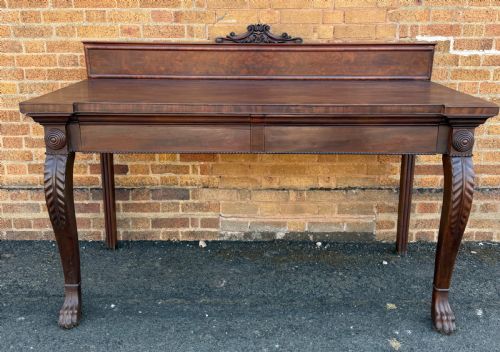


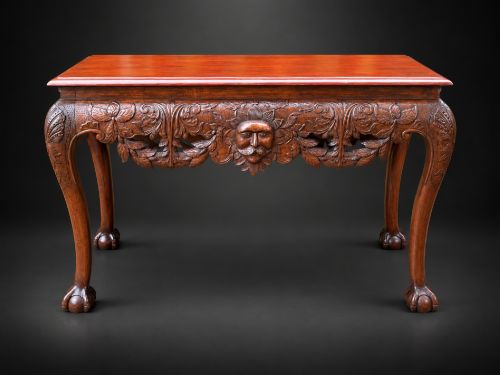


Irish Carved Serving Table
An irish carved serving table brings substantial presence and deep mahogany tones to a dining room, offering both surface utility and architectural weight.
Irish Carved Serving Table
An irish carved serving table is a grand dining room fixture designed to hold heavy platters and service ware during large meals. These pieces command attention through robust proportions and deeply worked wooden decoration.
The versions met on this page span the eighteenth and nineteenth centuries, taking forms such as console tables, side tables, and dumbwaiters alongside standard serving tables. Stylistic expressions range from Georgian and George II style to Regency and William IV iterations.
Makers often shaped these tables from dark timbers, employing bold design choices that reflect the distinct character of Irish cabinet making during the period. Buyers find both antique originals and later interpretations that maintain the heavy carved aesthetic.
How They Were Made
Cabinet makers constructed these tables primarily using solid mahogany, selecting dense stock capable of supporting heavy decorative carving without compromising structural integrity. Timber selection prioritized rich grain patterns that deepened in tone over centuries of polishing.
Workshops applied deep relief carving directly to the mahogany frames, rendering scrolling foliage, lion masks, or geometric motifs by hand. Brass components sometimes supplemented the wooden structure, appearing as subtle mounts or fittings on specific forms like dumbwaiters.
Irish Carved Serving Table Retail Price Guide 2026
Typical asking prices for irish carved serving table among the pieces listed under this phrase on Sellingantiques today, from the lower quarter to the upper quarter. They describe what is for sale here now, not the wider market.
The listings on this page span the eighteenth and nineteenth centuries, utilising solid mahogany and brass across multiple distinct periods.
What Varies in Quality
Quality rests principally on the crispness and depth of the carved woodwork, where master carvers achieved sharp undercut details that lesser hands left rounded and flat. The ambition of the overall design dictates the visual impact, separating standard utility pieces from imposing architectural works of grand scale.
The integrity of the mahogany timber and the fidelity of historical styling further divide the range, with period originals showing the natural patina of age while later interpretations rely on the quality of their initial construction and proportion.
ROBERT STRAHAN & CO·MACK WILLIAMS AND GIBTON
The Irish Carved Serving Table Glossary
- Mahogany
- A dense, reddish-brown tropical hardwood prized by cabinet makers for its stability and rich grain. It served as the primary material for high-status dining furniture.
- Console table
- A wall-mounted or freestanding table designed to sit flat against a surface, often supported by ornate legs. These pieces provided display space in formal reception rooms.
- Dumbwaiter
- A tiered serving stand fitted with revolving or fixed circular shelves to hold dishes and glasses. It allowed diners to help themselves without servant intervention.
- George II style
- A design vocabulary from the mid-eighteenth century characterised by heavy proportions, cabriole legs, and robust carving. Later cabinet makers frequently revived these motifs.
- Regency
- A British design period spanning the early nineteenth century defined by classical restraint, architectural lines, and archaeological influences.
Irish Carved Serving Table: Frequently Asked Questions
Where did these tables sit in a house?
These tables stood firmly against the dining room walls to hold heavy dishes, wine coolers, and silver service during large meals. Their placement allowed servants to dish up food efficiently without cluttering the main dining table.
In grander homes, matching side tables or console versions also occupied large entrance halls and drawing rooms to display decorative ornaments and candelabra.
How do I spot a George II style piece?
George II style pieces display robust proportions, heavy timber construction, and deeply carved ornamentation such as scrollwork or animal motifs. The overall aesthetic feels architectural and grounded, reflecting mid-eighteenth-century design preferences.
Cabinet makers working in later decades, including around nineteen-ten, revived these specific motifs to satisfy collectors who admired the earlier heavy aesthetic.
Can I use an antique serving table daily?
Solid mahogany construction makes these tables exceptionally sturdy and well-suited for everyday domestic use as sideboards or serving surfaces. Their generous tops easily accommodate modern dining items, lamps, or books without risk to the structure.
Care simply involves avoiding excessive moisture and using appropriate wax polishes to maintain the historical finish of the timber.
What separates Regency pieces from earlier ones?
Regency pieces lean towards cleaner classical lines and archaeological motifs, moving away from the heavier carved flourishes of earlier Georgian periods. They incorporate bold mahogany grains while maintaining a refined architectural symmetry.
Earlier examples from the mid-eighteenth century typically feature more exuberant carving and heavier structural profiles compared to their nineteenth-century counterparts.