



Interwar Oak Desk
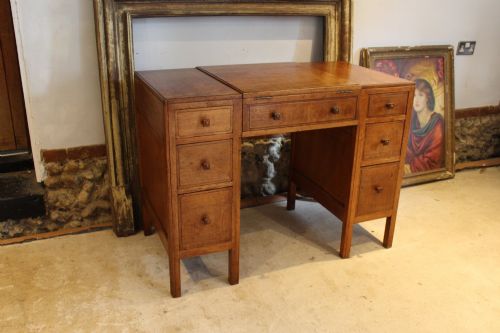
An interwar oak desk brings practical workspace and honest grain into a room, connecting early twentieth-century utility with enduring craft traditions.
Interwar Oak Desk
When you search for an interwar oak desk, you encounter pieces spanning the 1920s and 1930s, alongside related forms like writing bureaus and tables originating from this transformative period of British design.
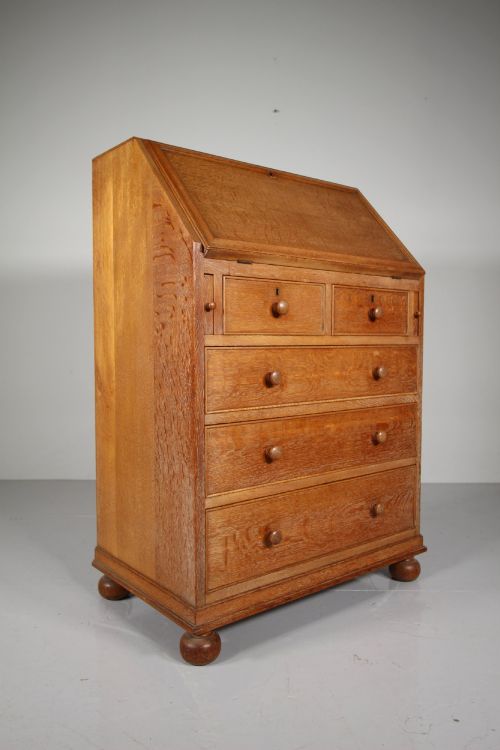
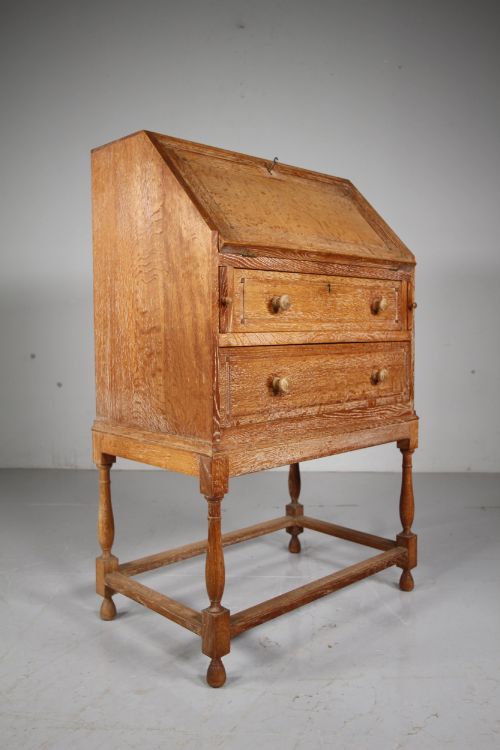
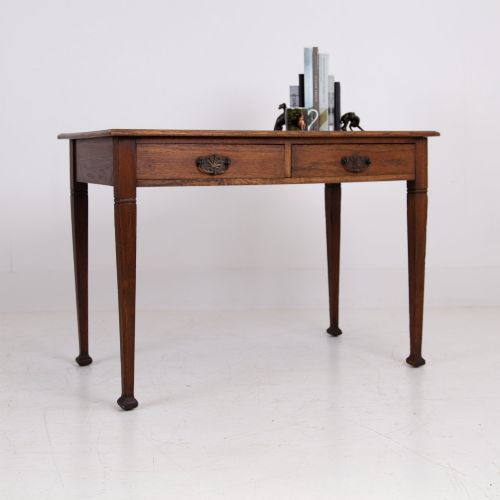
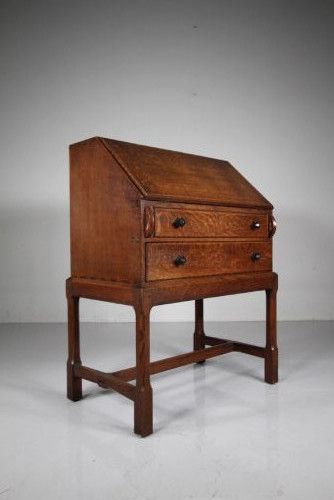
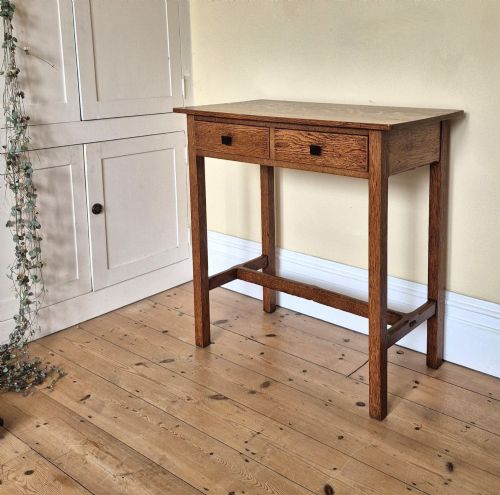
The pieces you meet most often on this page take the form of writing bureaus with drop-down fronts and fitted drawers, alongside occasional simpler two-drawer writing tables constructed in solid or quarter-sawn timber.
Makers and workshops of the era, from London firms to regional craft communities, adapted traditional vernacular styles like Jacobean Revival as well as emerging Art Deco and Arts and Crafts principles to domestic furniture.
Distinctions in quality
Quality reveals itself in the selection of timber, where quarter-sawn boards display superior figure and stability compared to plain-sawn equivalents utilised in more utilitarian pieces.
The refinement of hardware, the tightness of joinery, and the presence of authentic maker stamps or labels separate standard commercial production from workshop-attributable output.
Proportion and the handling of stylistic details, whether referencing earlier Jacobean revivals or clean Arts and Crafts lines, dictate the overall success of each design.
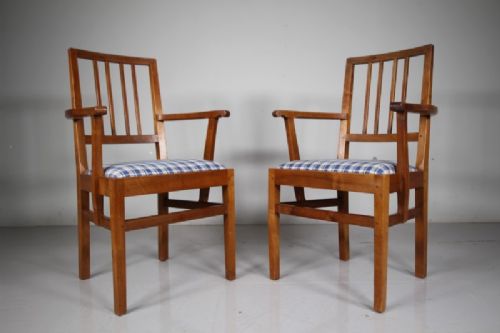
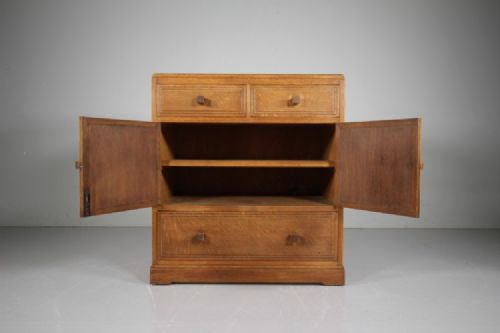
The documented object types span writing bureaus, dining tables, side tables, armchairs, and magazine racks alongside standard desks.
Heals of London·Edward Barnsley·Stanley Webb Davies·Bryn Mawr Welsh·Hubert Simpson of Kendal·Heal and Sons
The Interwar Oak Desk Glossary
- Quarter-sawn oak
- Timber cut radially through the growth rings, producing a distinct tiger-stripe figure known as medullary rays. This cut offers enhanced dimensional stability for furniture construction.
- Bureau
- A desk featuring a sloping or drop-down front that conceals a fitted interior of small drawers and pigeonholes. It serves primarily for correspondence and storage.
- Jacobean Revival
- A style popular in British furniture making that imitates the heavy, dark-finished turned legs and carved panels of seventeenth-century joinery. It persists in modified forms through the interwar decades.
- Arts and Crafts
- A design movement valuing honest construction, visible hand craftsmanship, and simple forms derived from vernacular traditions. Its influence remains strong in pieces by specific period makers.
- Trestle table
- A table supported by two or more trestles comprising a horizontal beam fixed to vertical legs. This form appears in dining and working formats during the 1920s and 1930s.
Interwar Oak Desk: Frequently Asked Questions
How do I identify an interwar desk?
Look for characteristic construction methods, timber selections such as quarter-sawn oak, and stylistic markers that bridge traditional British forms with early twentieth-century modernism.
Examine the interior fittings of drawers and writing flaps, as maker labels or stamps often confirm production dates from the 1920s and 1930s.
Where were these desks used?
These pieces served domestic studies, drawing rooms, and bedrooms in British homes during a period of shifting architectural scales and interior design trends.
Their compact writing surfaces and built-in storage accommodated letter writing, household administration, and personal correspondence before the dominance of digital communication.
How do I care for oak furniture?
Protect the timber surfaces from direct sunlight and excessive humidity fluctuations to prevent splitting or warping in the solid oak construction.
Apply traditional wax sparingly and buff with a soft cloth to maintain the natural sheen of the grain without building up synthetic residues.
What is the difference between a bureau and a desk?
A bureau specifically incorporates a hinged writing flap that pulls down to reveal a compartmented interior, allowing paperwork to be concealed when not in use.
Standard desks and writing tables provide an open top surface with immediate access to drawers beneath, prioritising continuous workspace over enclosed storage.