
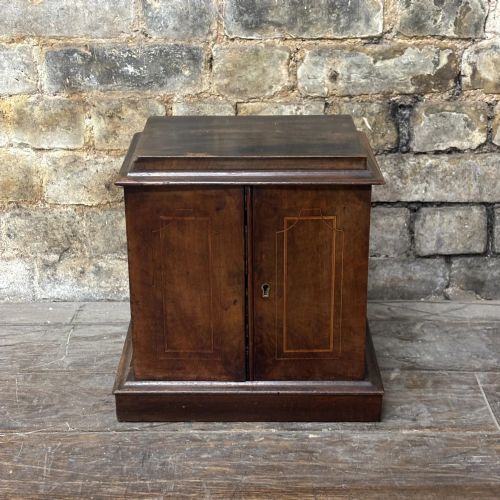
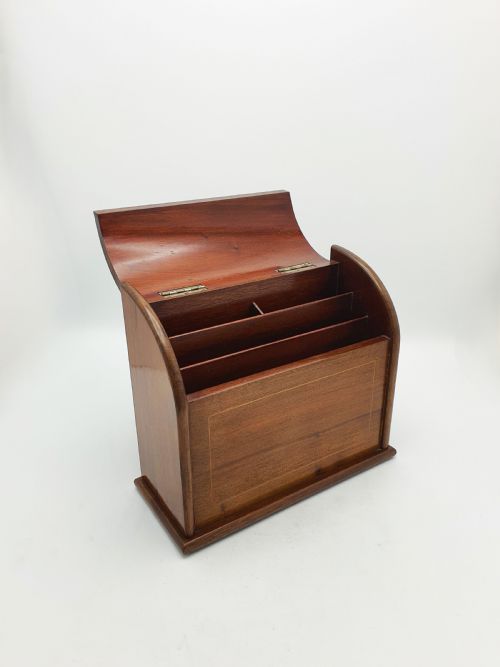


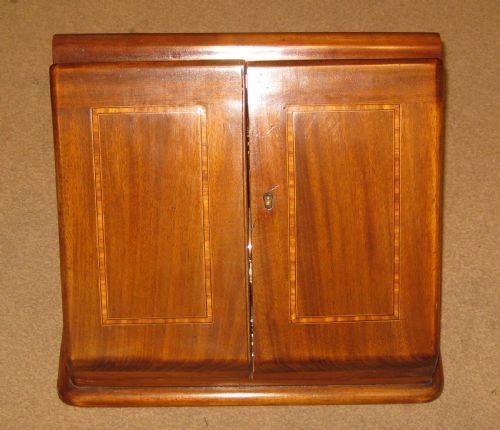


Inlaid Wooden Letter Box
An inlaid wooden letter box organises personal correspondence with a craftsmanship spanning Victorian and Edwardian periods.
Inlaid Wooden Letter Box
An inlaid wooden letter box takes the form of stationery cabinets, correspondence chests, and desk tidies designed to hold letters and writing paper. These pieces appear predominantly from the Victorian and Edwardian eras, reflecting the domestic correspondence habits of the nineteenth and early twentieth centuries.
The versions met most frequently on this page include mahogany stationery cabinets and rosewood correspondence boxes featuring inlaid details. Alongside standard British cabinet work, examples span Anglo-Indian carved wood and specialised Tunbridge ware forms.
How they were made
Cabinet makers constructed these boxes using dense timbers such as mahogany, walnut, rosewood, and coromandel, often incorporating hinged lids and fitted interiors. Structural strength relied on traditional joinery suited to daily desktop use.
Decoration involved contrasting veneers, boxwood stringing, marquetry, and specialised surface treatments like Tunbridge ware mosaic work or pietra dura panels. Functional hardware typically included brass mounts, hinges, and escutcheons.
Some Victorian letter boxes featured pivoting mechanisms to sort mail into answered and unanswered piles.
What varies in quality
Quality rests in the precision of the timber selection and the complexity of the inlaid decoration, distinguishing standard production from exceptional cabinet work. Tunbridge ware mosaics or detailed pietra dura panels indicate specialised artisan input rather than routine workshop output.
The sophistication of the internal fittings, such as sloping compartments for answered and unanswered mail or integrated writing surfaces, shapes the overall merit of a piece. Original brass hardware and well-preserved surface finishes elevate the standing of an individual box.
Edmund Nye·C.G. Hope Hastings
The Inlaid Wooden Letter Box Glossary
- Tunbridge ware
- A form of British woodwork characterised by mosaic designs built from tiny wood blocks to create pictorial or geometric scenes. This meticulous technique flourished in Kent during the nineteenth century.
- Pietra dura
- An inlay technique utilising cut and fitted polished coloured stones to form decorative motifs on a stone or wooden ground. It appears on select high-end Victorian pieces.
- Marquetry
- The art of applying pieces of veneer to a structure to form decorative patterns or pictures. Makers utilised various contrasting timbers to achieve pictorial depth.
- Escutcheon
- A flat plate of brass surrounding a keyhole to protect the surrounding wood from wear. These fittings often match other brass hardware on the box.
Inlaid Wooden Letter Box: Frequently Asked Questions
What is an inlaid wooden letter box?
An inlaid wooden letter box is a desk accessory or cabinet built to hold writing paper, envelopes, and incoming or outgoing mail. These containers kept private correspondence organised on Victorian and Edwardian writing desks.
Cabinet makers utilised timbers like mahogany, walnut, and rosewood, embellishing the exteriors with contrasting wood inlay, marquetry, or specialised mosaic work.
How were letter boxes used?
Users placed stationery, envelopes, and stamps inside the fitted compartments of these boxes to keep writing desks tidy. Some models included labeled slots to separate answered and unanswered letters.
Hinged lids and lockable doors protected private correspondence from prying eyes in busy nineteenth-century households.
How do I date a letter box?
Dating relies on stylistic clues, timber choices, and construction methods associated with Victorian and Edwardian periods. Pieces from around 1900 often feature lighter mahogany framing and Edwardian marquetry motifs.
Mid-nineteenth-century examples frequently display heavier rosewood or walnut bodies with substantial brass hardware and complex internal stationery partitions.
What materials are common?
Mahogany, rosewood, walnut, and coromandel form the primary wooden structures of these boxes. Boxwood stringing and mother-of-pearl accents frequently supply contrasting detail.
Decorative surfaces occasionally incorporate stone pietra dura panels or intricate Tunbridge ware wood mosaics alongside standard brass hinges and locks.