


Inlaid Wooden Cutlery Urn
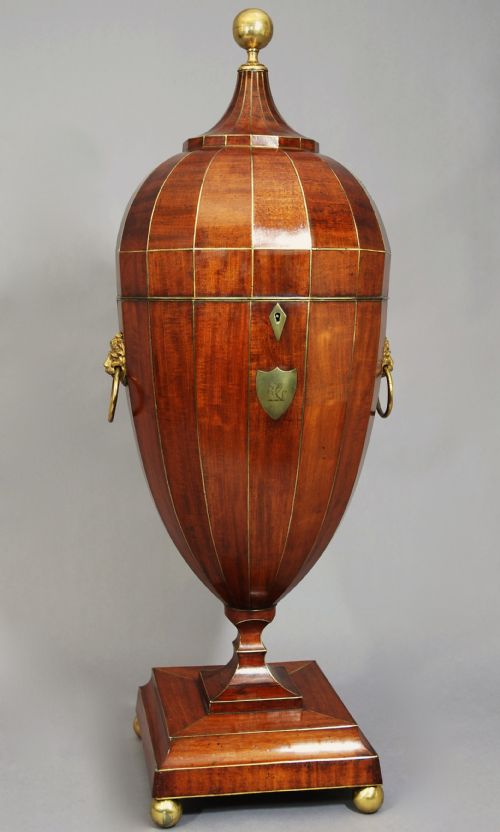
An inlaid wooden cutlery urn sits on the dining table as a classical architectural vessel, holding silver knives and forks with absolute elegance.
Inlaid Wooden Cutlery Urn
An inlaid wooden cutlery urn represents a sophisticated form of dining room storage originating in the Georgian and Victorian eras. These urn-shaped vessels were designed to stand upon sideboards, keeping fine cutlery clean and close at hand during formal meals.
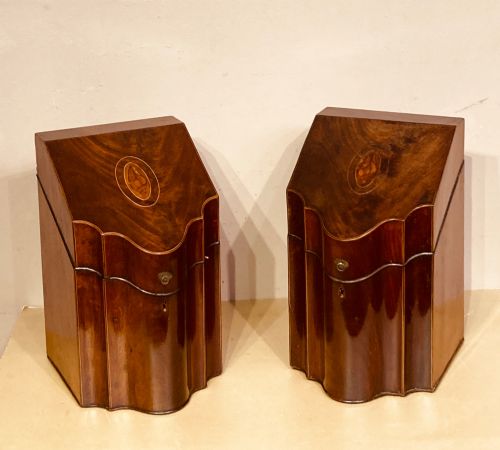
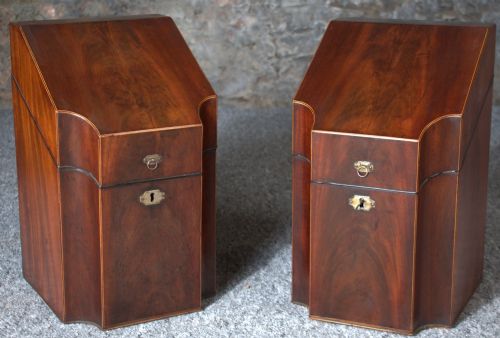
Buyers searching for an inlaid wooden cutlery urn will encounter pieces primarily fashioned from rich mahogany, often enhanced by delicate boxwood and satinwood inlay. The selection on this page ranges from George III neoclassical examples to later Victorian interpretations.
How they were made
Cabinet makers constructed these urns using solid mahogany timber, shaping the curved staves or bodies to create the characteristic classical vase silhouette. Brass hardware, including hinges, handles, and lock escutcheons, was fitted to secure the compartments within.
Intricate wood inlay, particularly boxwood and satinwood, was hand-cut and set into the mahogany surface to create geometric borders or shell motifs. The contrasting light and dark woods highlighted the neoclassical taste prevalent during the Georgian period.
Some nineteenth-century examples hide internal compartments so tightly that guests spent the entire dinner wondering how the silver vanished.
What varies in quality
The refinement of the wood inlay dictates the visual success of the piece, with crisp, tightly fitted boxwood and satinwood lines separating ordinary boxes from superior examples. Master cabinet makers achieved seamless transitions between the contrasting timbers.
Proportion and architectural balance define the highest tier of these urns, where the curve of the body and the taper of the lid follow classical proportions precisely. The choice of mahogany grain and the quality of the brass fittings further distinguish the best work.
The Inlaid Wooden Cutlery Urn Glossary
- Mahogany
- A durable, deep brown tropical hardwood favoured by Georgian cabinet makers for its rich grain and stability. It forms the primary body of almost all pieces listed here.
- Boxwood
- A pale, dense wood utilised for contrasting stringing and inlay details. Its fine grain permits precise cutting.
- Satinwood
- A luminous, yellowish wood used alongside boxwood to create bright geometric patterns and decorative motifs on darker surfaces.
- Neoclassical
- A style drawing inspiration from classical antiquity, prominent during the George III period. It governs the urn shape and symmetrical inlaid decoration.
- Serpentine front
- A gently undulating curved front edge seen on certain box designs. This shape adds movement and complexity to the cabinet work.
Inlaid Wooden Cutlery Urn: Frequently Asked Questions
What is a cutlery urn used for?
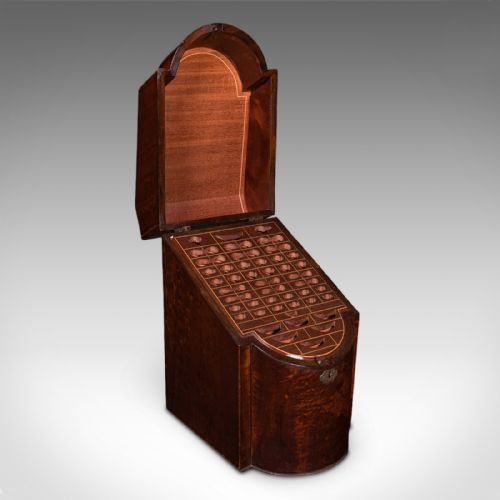
These vessels held knives, forks, and spoons safely within fitted interior compartments on the dining room sideboard.
Servants retrieved the silver just before meals and returned them to the urn afterwards to prevent tarnish and loss.
How do I tell Georgian from Victorian pieces?
Georgian pieces display the crisp neoclassical restraint and rich mahogany timbers typical of the eighteenth century.
Victorian examples, such as those from eighteen ninety, often revisit these earlier styles with slightly heavier proportions and different inlay combinations.
Where did these urns sit?
They stood upon the dining room sideboard, frequently flanking a central serving table or cellarette.
Their commanding height and architectural presence balanced the heavy mahogany furniture of the period.
Are the interiors original?
Many surviving pieces retain fitted wooden block interiors designed to slot specific knife blades securely.
Some examples have been adapted over time to suit modern storage needs while preserving the exterior decorative shell.