
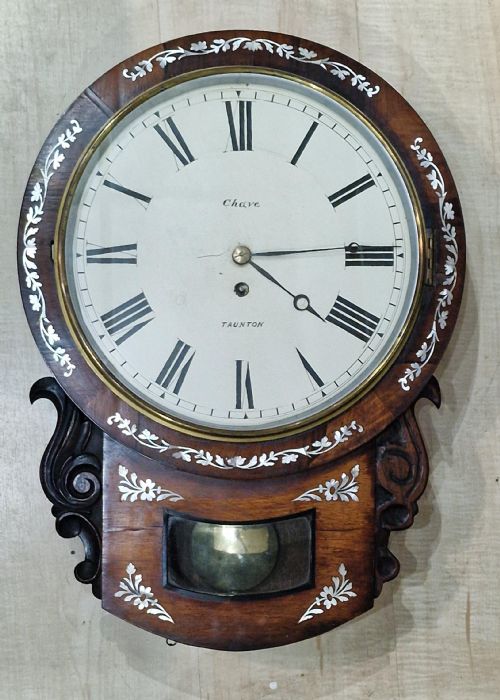


Inlaid Rosewood Wall Clock
An inlaid rosewood wall clock brings warmth and precise mechanical timekeeping to a room, combining rich timber with polished brass, mother-of-pearl or boxwood details.
Inlaid Rosewood Wall Clock
An inlaid rosewood wall clock is a timepiece designed to hang securely on a wall while displaying a prominent circular dial. These pieces span the Georgian, Regency, and Victorian eras, alongside specific dates from eighteen hundred through to nineteen hundred.
The drop-dial wall clock and the library wall clock are the two main forms you will encounter here. Many examples feature delicate stringing or floral motifs inlaid into the dark, figured grain of the rosewood case.
Makers such as Samuel Chave Taunton, Halliday & Rich, Ganthony of London, Kleyser of London, James Bell of Bath, and J Fisher Esq appear across these nineteenth century and Victorian records.
How they were made
Makers built the structural carcases using solid rosewood and applied veneers with deeply figured grains to the outer surfaces. Boxwood and brass were then channelled into precise recesses to form geometric stringing or scrolling floral inlay.
Movements relied on fusee mechanisms, sometimes twin fusee, which maintained even tension on the gear train as the mainspring unwound. Dials were typically painted metal or silvered brass, protected behind heavy bevelled glass held in a brass bezel.
One historical library wall clock once belonged to a gentleman specifically recorded as J Fisher Esq.
What varies in quality
The refinement of the cabinetwork and the crispness of the brass or boxwood inlay set the better examples apart from standard production. Richly figured timber veneer and well-balanced drop-dial proportions indicate superior workshop standards.
Movement sophistication also defines the hierarchy, moving from standard time-only fusee mechanisms up to bell-striking or twin fusee movements. Signed dials by recorded London or provincial makers carry distinct historical weight.
Samuel Chave Taunton·Halliday & Rich Bridgwater·Ganthony of London·Kleyser of London·James Bell Bath·J Fisher Esq
The Inlaid Rosewood Wall Clock Glossary
- Fusee
- A conical pulley connected to the mainspring by a chain or cord, designed to equalise the torque as the spring unwinds. This mechanism ensures consistent timekeeping throughout the running period.
- Drop-dial
- A clock case where the circular dial sits above an extended lower box that houses the pendulum. This proportion allows space for a longer pendulum swing.
- Inlay
- A technique where contrasting materials such as brass, boxwood, or mother-of-pearl are inserted flush into cavities carved within the rosewood surface. It creates decorative borders and motifs.
- Regulator
- A high-precision clock designed for strict accuracy, often featuring a fine deadbeat escapement and a mercury or wood rod pendulum. They were essential instruments for timing and navigation.
- Bezel
- The brass rim that holds the glass door protecting the clock face. It usually hinges open to allow hand-setting.
Inlaid Rosewood Wall Clock: Frequently Asked Questions
How do fusee movements work?
A fusee movement uses a conical drum and a fine chain to regulate the power delivered from the mainspring to the gear train. As the spring loses tension, the chain pulls on a wider radius of the cone to maintain steady force.
This clever mechanical device ensures the clock maintains consistent timekeeping from the moment it is fully wound until it runs down.
Where should I hang a wall clock?
These clocks require a sturdy interior wall capable of supporting their substantial timber weight safely on a heavy mounting screw or bracket. Avoid exterior walls subject to dampness or dramatic temperature shifts.
Placing the clock at eye level ensures the dial is easily readable and simplifies the weekly winding routine.
How do I tell Regency from Victorian clocks?
Regency clocks typically display restrained classical proportions, often relying on clean brass inlay and simpler architectural outlines. Victorian examples frequently embrace richer ornamentation, including mother-of-pearl accents and more heavily figured rosewood veneers.
Examining the interior construction and any maker signatures helps confirm the manufacturing period.
How often do these clocks need winding?
Most fusee wall clocks run for eight days on a single wind, requiring a steady turn of the key through the dial face. Twin fusee models that include a striking train also follow this standard weekly schedule.
Regular winding keeps the tension balanced and maintains the rhythm of the mechanical movement.