
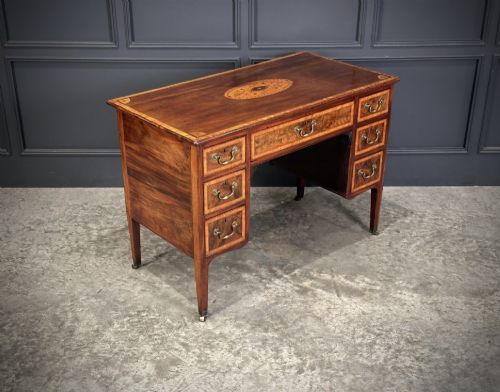
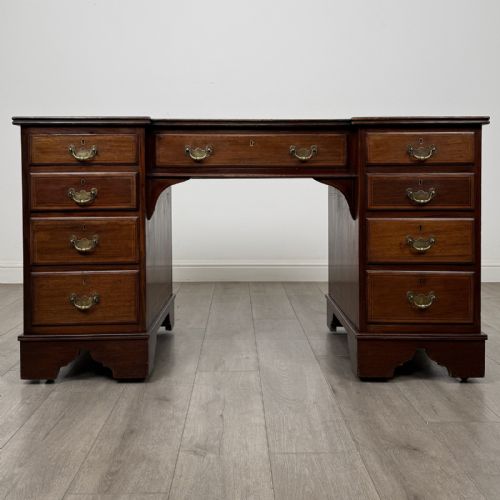
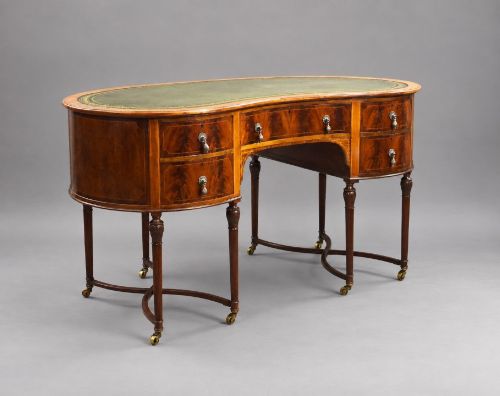
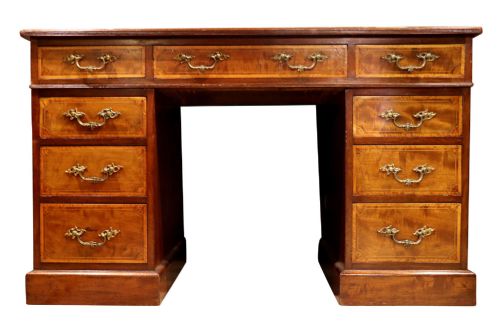
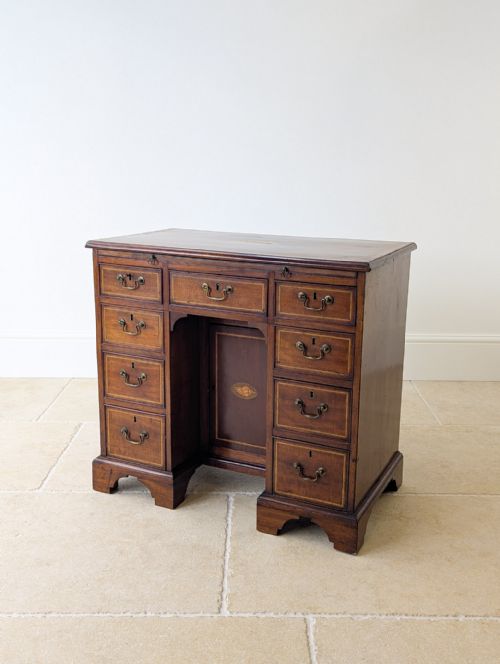


Inlaid Office Table
An inlaid office table brings refined cabinetwork to daily correspondence, combining disciplined wood surfaces with decorative banding.
Inlaid Office Table
An inlaid office table represents a functional writing surface distinguished by decorative wood or metal details set flush into the primary timber. These pieces span periods from the Georgian era through the Victorian and Edwardian decades, alongside the Sheraton Revival movement.
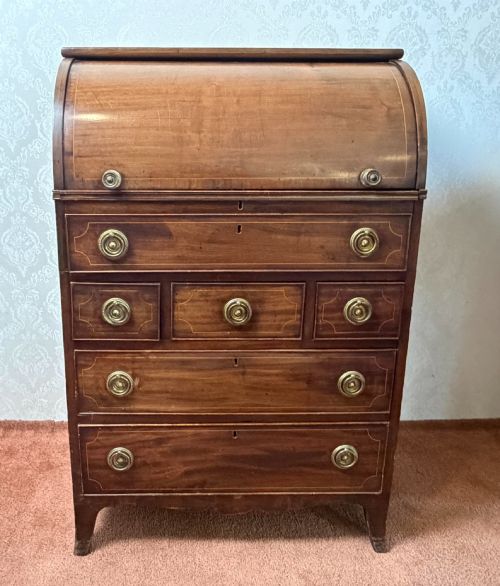
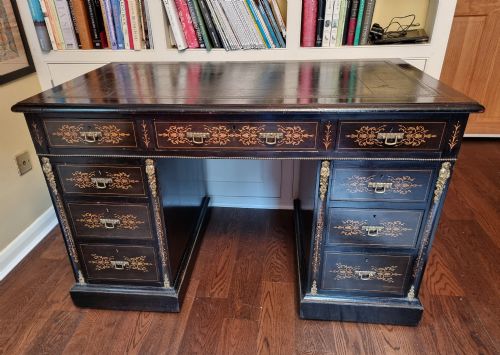
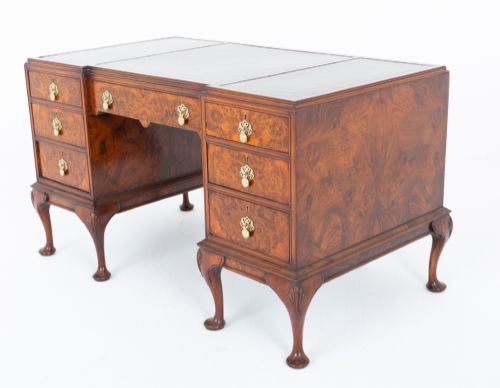
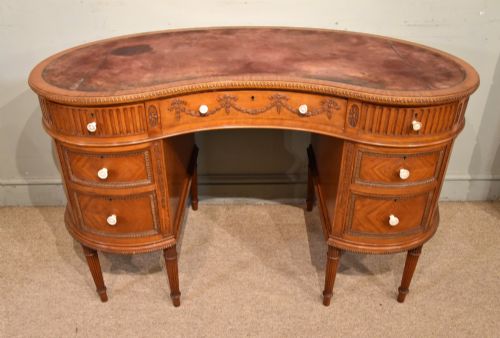
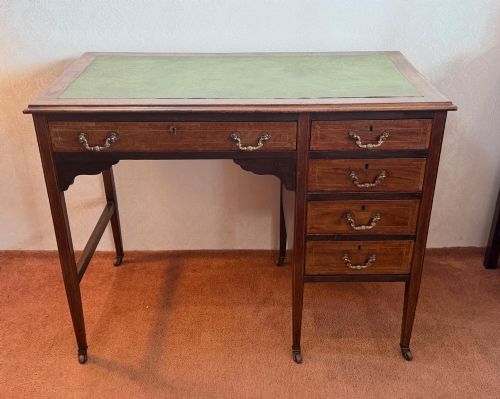
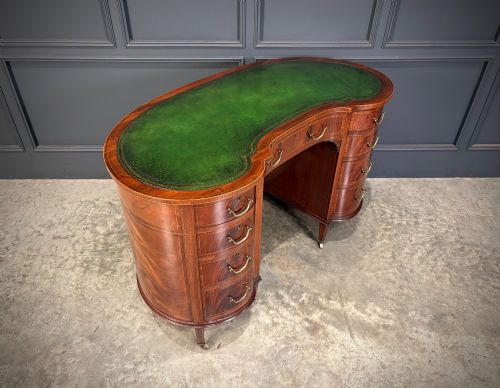
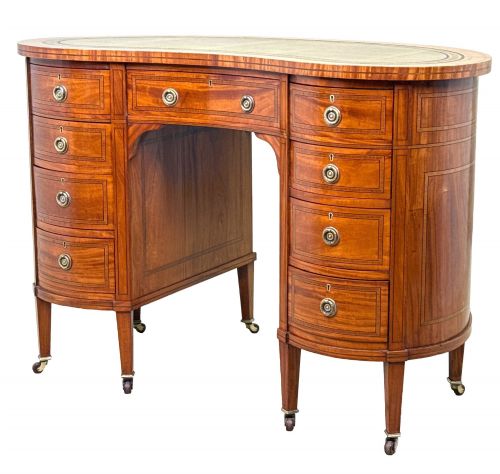
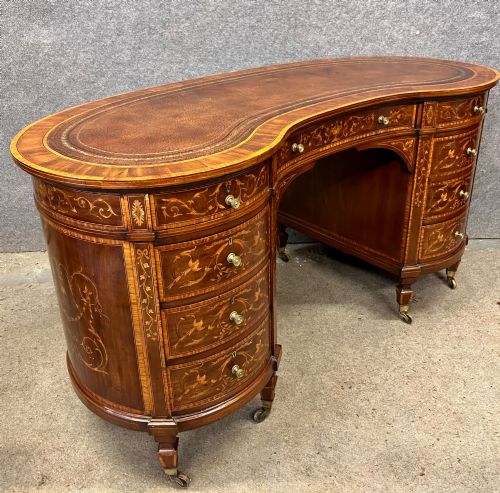
The varieties encountered most frequently on this page include mahogany pedestal desks, kidney-shaped writing tables in satinwood or flame mahogany, and compact kneehole desks. Makers often employed walnut, rosewood, and burr walnut to form the core structures.
Originating primarily from British workshops, these tables served administrative and correspondence duties in period homes and offices. They range from modest writing tables to substantial twin pedestal desks fitted with leather writing surfaces.
Materials and construction methods
Cabinetmakers constructed these tables using solid foundational timbers such as mahogany, walnut, and rosewood, frequently faced with decorative veneers including flame mahogany, burr walnut, and satinwood. Crossbanding and stringing defined the perimeters of drawers and tops.
Marquetry inlay utilised varied woods to create floral or geometric motifs, while brass fittings provided hardware accents such as ring handles and escutcheons. Leather writing surfaces, often coloured red, were inset into the timber tops and tooled with gilt borders.
Several desks manage to keep their original red leather inserts intact, surviving a century of ink spills and daily letters.
Distinctions in construction and finish
Quality rests in the precision of the timber selection and the execution of the inlay work, where tight joints and balanced grain patterns separate superior examples from routine manufacturing. The crispness of marquetry cutting and the integration of secondary woods inside the drawers reveal the maker's discipline.
Hardware originality, such as stamped brass handles and locks bearing maker signatures, elevates a piece significantly. The retention of original leather writing inserts and untouched patination on the polished mahogany or satinwood surfaces further mark higher-tier examples.
Edwards & Roberts·Maple & Co·Wolfe & Hollander·Gill & Reigate·James Shoolbred of London
The Inlaid Office Table Glossary
- Marquetry
- Decorative patterns formed by fitting together small pieces of veneer into a wood ground. This technique creates pictorial or geometric designs across tabletops.
- Pedestal desk
- A form comprising two freestanding pedestals of drawers supporting a single desktop. It provides extensive storage beneath the writing surface.
- Crossbanding
- A strip of veneer applied perpendicularly to the grain of the main surface around the edge of a tabletop or drawer front. It frames the central timber panel.
- Kneehole desk
- A compact desk featuring a central recess for the user's legs flanked by banks of small drawers. These tables suit smaller rooms.
- Stringing
- Thin inlay lines of contrasting wood or light-colored timber used to outline drawers and borders. This linear detail defines Sheraton Revival styling.
Inlaid Office Table: Frequently Asked Questions
What is an inlaid office table?
An inlaid office table is a antique desk or writing surface embellished with decorative wood veneers, stringing, or marquetry. These pieces were built for writing, administration, and correspondence in period homes and offices.
They combine functional drawer arrangements with ornamental cabinetwork, utilising timbers like mahogany, satinwood, and walnut.
How do I date an inlaid office table?
Dating relies on stylistic clues, construction methods, and timber choices seen across Georgian, Victorian, and Edwardian examples. Sheraton Revival pieces from the late nineteenth century often mimic eighteenth-century designs using distinct veneer techniques.
Secondary woods inside drawers and the presence of maker stamps or brass hardware help confirm the era of manufacture.
How do I care for the leather top?
Leather writing surfaces require gentle cleaning with a slightly damp cloth followed by a neutral leather cream to prevent cracking. Avoid harsh chemical cleaners or excessive moisture on both the leather and surrounding wood veneer.
Maintaining stable room humidity protects the gilt tooling and keeps the inset hide supple over decades of use.
Where were these tables used?
These tables served primarily in private libraries, studies, and domestic offices for managing correspondence and household accounts. Larger pedestal versions stood in professional chambers for daily administrative work.
Smaller kidney-shaped writing tables were often placed in reception rooms or bedrooms for personal letter writing.