
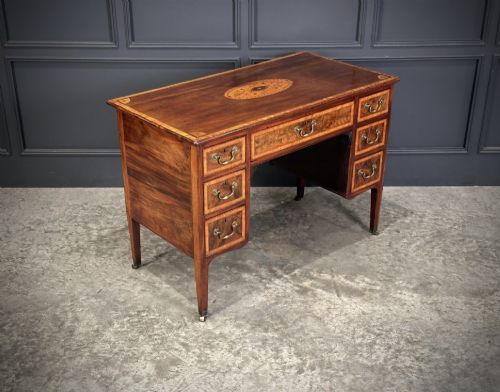
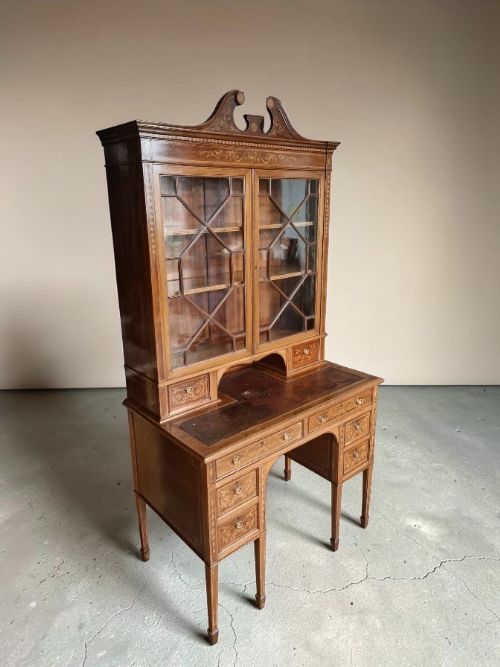
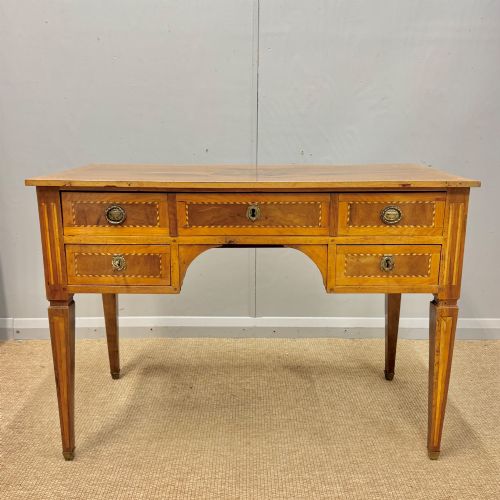


Marquetry Kneehole Desk
A marquetry kneehole desk combines intricate wood inlay with a central recessed recess, offering a striking centrepiece for a study.
Marquetry Kneehole Desk
A marquetry kneehole desk is a fitted writing table featuring a central recess flanked by banks of drawers, embellished with detailed wood veneer patterns. These pieces span several distinct periods, including the eighteenth century, the Victorian era, and the Edwardian period.
The versions most commonly met on this page are Edwardian and Victorian creations, often reviving earlier Georgian or French neoclassical styles. Alongside traditional writing desks, related forms such as dressing tables and freestanding pedestal desks appear within the selection.
Makers such as Gill & Reigate, Edwards and Roberts, and James Shoolbred produced notable examples of these desks during the nineteenth and early twentieth centuries. The overarching characteristic remains the combination of finely figured timber surfaces with complex floral or geometric pictorial inlays.
How these desks were made
Cabinetmakers constructed the carcases of these desks using dense timbers such as mahogany and walnut, frequently applying veneers of satinwood or fruitwood across the exterior surfaces. Fine pictorial and geometric marquetry patterns were meticulously hand-cut and fitted into the primary wood ground.
Mounts of cast brass or ormolu often accent the corners, handles, and keyhole escutcheons, particularly on pieces influenced by French Louis revival styles. Writing surfaces commonly feature inset panels of tooled leather, whilst interior components integrate glass or secondary softwood drawer linings.
Some Edwardian ladies' writing desks include hidden stationery compartments designed to keep secret correspondence safely tucked away from prying eyes.
What varies in quality
The standard of a marquetry kneehole desk rests largely on the complexity and precision of the wood inlay work across the top and drawer fronts. Tighter joints, crisply cut contrasting veneers, and deeply figured timbers distinguish superior examples from simpler production.
Internal construction details, such as the use of solid secondary woods within the drawer boxes and the retention of original brass hardware, mark the difference between workshop output and standard trade execution.
Gill and Reigate·Edwards and Roberts·James Shoolbred
The Marquetry Kneehole Desk Glossary
- Marquetry
- A decorative technique where small pieces of veneer are assembled to form pictorial or geometric patterns on a wooden surface.
- Kneehole
- A desk or table design featuring a central recessed space for the legs beneath the main writing surface.
- Satinwood
- A lustrous, yellowish timber frequently utilised for contrasting veneers and fine inlay work.
- Ormolu
- Gilt bronze mounts applied to furniture for decorative enrichment, common in French revival pieces.
Marquetry Kneehole Desk: Frequently Asked Questions
What is a marquetry kneehole desk?
A marquetry kneehole desk is a formal writing table featuring a central recessed space for seating and intricate wood veneer inlay across its surfaces.
These pieces typically incorporate multiple drawers flanking the central void and reflect design influences ranging from eighteenth-century Georgian to Edwardian revival styles.
How do I date a kneehole desk?
Dating relies on examining the underlying construction timber, the style of the hardware, and the specific characteristics of the marquetry work.
Victorian and Edwardian iterations often revive earlier Georgian or French motifs, whilst eighteenth-century originals display distinct timber ageing and hand-cut joinery methods.
Where should I place a freestanding desk?
A freestanding desk is finished on all sides, allowing it to sit centrally within a room rather than pushed directly against a wall.
This placement showcases the rear marquetry panels and polished timber surfaces which would otherwise be hidden from view.
How do I care for inlaid wood surfaces?
Inlaid surfaces require consistent indoor humidity levels and protection from direct sunlight to prevent the delicate veneer woods from drying out or lifting.
Periodic application of suitable furniture wax helps nourish the timber and maintain the subtle sheen of the polished finish.