
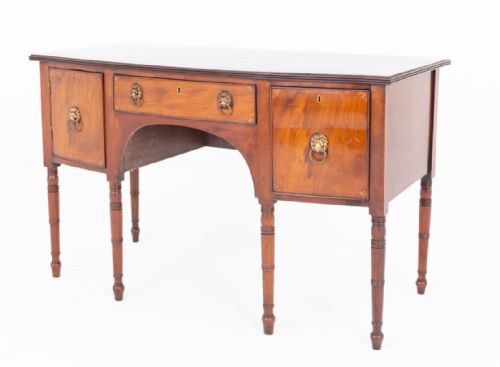
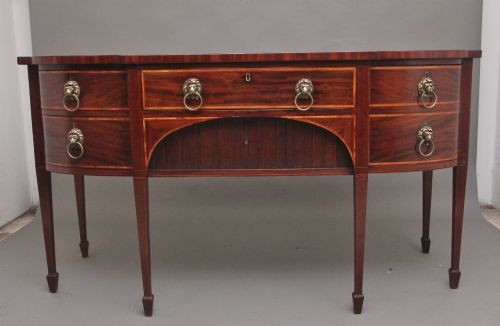
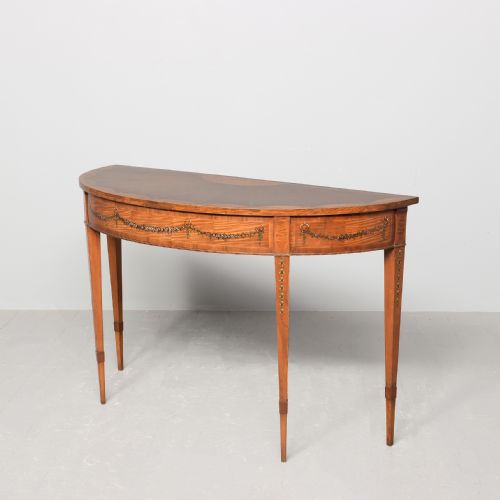
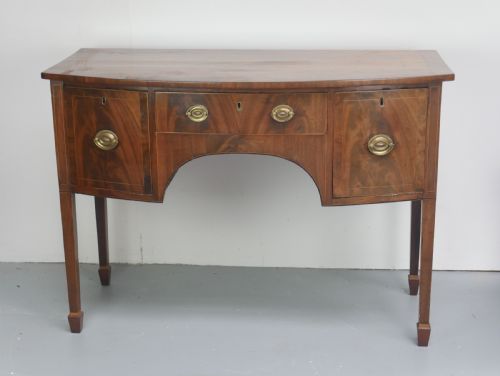


Inlaid Mahogany Serving Table
An inlaid mahogany serving table brings structural elegance and fine timber grain into a dining space, offering a surface designed for hospitality.
Inlaid Mahogany Serving Table
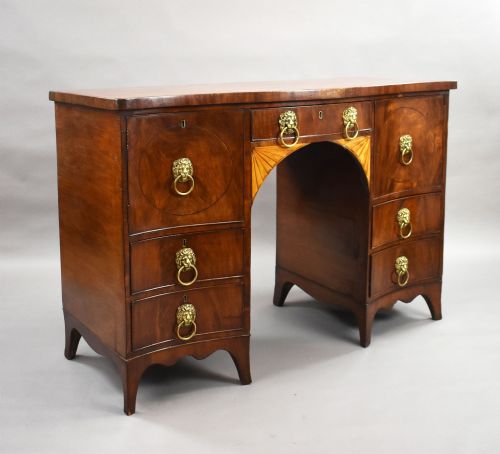
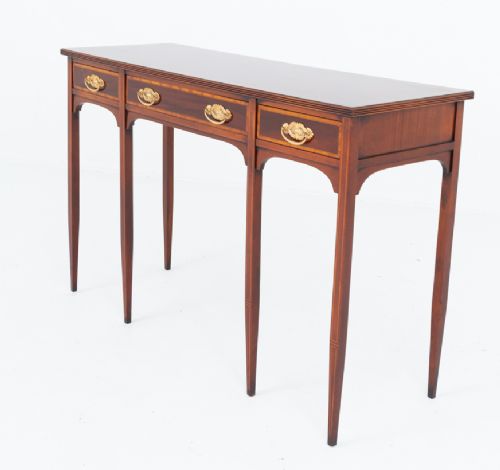
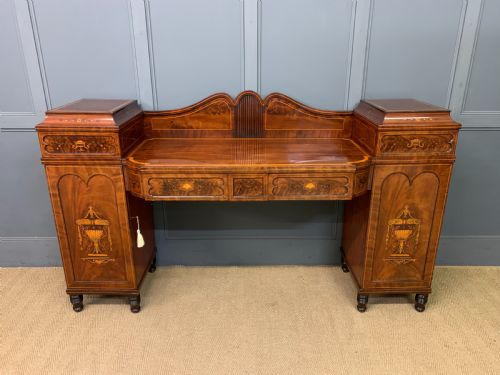
When you search for an inlaid mahogany serving table, you encounter a variety of forms including sideboards, console tables, and serpentine servers spanning the Georgian, Regency, and Edwardian periods. The pieces appearing most frequently range from late eighteenth-century George III serpentine servers to Edwardian interpretations built in the Sheraton Revival style.
Makers produced these tables to assist with dining room service, incorporating multiple drawers, drop sides, or integrated trays alongside standard console layouts. While early examples tend to feature strict geometric proportions and timber-lined drawers, later Edwardian pieces often adopt lighter proportions and occasional table formats.
Materials and Construction
Cabinet makers utilised solid and veneered mahogany as the primary structural timber, often selecting figured or flame grains for maximum visual impact on drawer fronts and top surfaces. This dark timber provided a robust canvas for detailed contrasting ornamentation.
Inlay work relied on lighter botanical materials such as satinwood and boxwood, supplemented by dark stringing in ebony and functional brass mounts or handles. Artisans embedded these linear and botanical motifs directly into the mahogany surface to delineate borders and focal panels.
Listings feature mahogany serving tables spanning the Georgian, Regency, and Edwardian periods, utilising satinwood, boxwood, and brass inlay.
Assessing Quality
The distinction between standard utility items and exceptional pieces rests upon the precision of the timber selection and the integration of the inlay. Superior specimens display continuous grain matching across structural sections and crisp, tightly fitted botanical stringing without gaps or resin filler.
Internal construction standards further separate the tiers, evidenced by secondary timbers like oak drawer linings and hand-cut dovetail joints. Greater refinement is visible where the cabinet maker achieves fluid serpentine or bowfront curves without compromising the stability of the carcass.
Edwards & Roberts·George Smith·George Oakley
The Inlaid Mahogany Serving Table Glossary
- Serpentine
- A front profile characterised by a central concave curve flanked by convex curves, or the reverse. This undulating shape requires advanced woodworking skill to execute properly.
- Bowfront
- A convex, outwardly curved front elevation popular on dining furniture from the Georgian period onward. It softens the linear appearance of a standard rectangular server.
- Stringing
- Thin strips of contrasting wood inlaid into channels cut into the primary timber. It creates delicate geometric borders around drawer fronts and table tops.
- Satinwood
- A lustrous, hard timber native to the tropics, utilised extensively for contrasting inlay and veneering. Its golden yellow colour provides sharp visual separation from dark mahogany.
- Breakfront
- A piece of furniture whose front projects forward in sections, typically with a central block advancing beyond the flanking wings. It adds architectural depth to large serving tables.
Inlaid Mahogany Serving Table: Frequently Asked Questions
How do I date an inlaid mahogany serving table?
Dating relies on examining the secondary timbers inside the drawers, the style of the brass hardware, and the complexity of the inlay work. Georgian and Regency pieces typically show hand-cut joinery and heavy figuring, whereas Edwardian revivals employ lighter structural proportions and machine-cut elements.
Changes in silhouette also provide clues, as strict straight fronts and bold serpentine curves dominate the eighteenth century, while delicate oval trays and two-tier tea trolleys emerge by nineteen-hundred.
Were these tables used in dining rooms?
Serving tables functioned primarily as auxiliary surfaces during large meals, holding dishes, decanters, and silverware before staff transferred them to the main dining table. They occupied wall space in formal dining rooms and halls.
Later Edwardian variants adapted this hospitality role into domestic settings by incorporating removable glass trays and drop sides for serving tea or drinks.
What is the difference between a sideboard and a serving table?
Traditional serving tables operate primarily as open console or side tables with fewer internal compartments, whereas sideboards incorporate substantial banks of deep drawers and cupboards for storage. Many Georgian and Regency servers sit on four or six legs without enclosed cabinetry beneath.
As the nineteenth century progressed, the two forms frequently merged in terminology, leading to overlapping descriptions in historical records and modern listings.
How should I care for antique mahogany timber?
Maintaining antique mahogany requires keeping the surface away from direct heat sources and strong sunlight, which can dry out the timber and fade the rich colour. Regular dusting with a soft, dry cloth prevents particulate accumulation without introducing moisture.
Applying microcrystalline wax periodically helps nourish the polish and protect the delicate satinwood and boxwood inlay from atmospheric changes.