
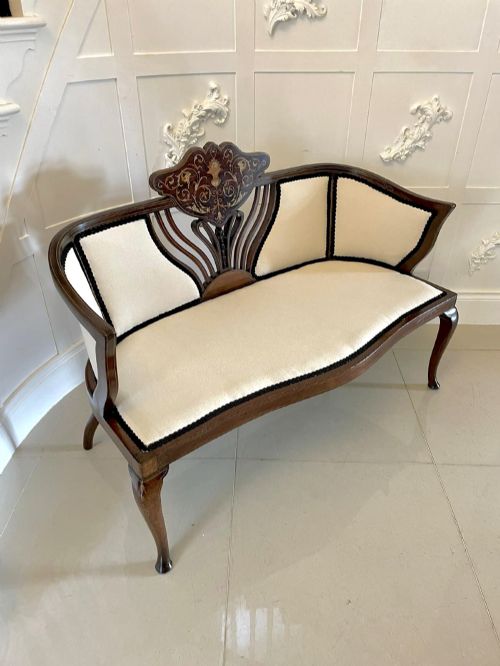
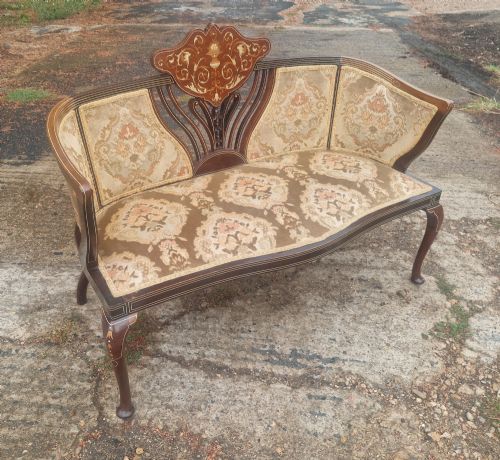


Inlaid Mahogany Salon Sofa
An inlaid mahogany salon sofa brings formal nineteenth and early twentieth century reception rooms to life with subtle timber contrast.
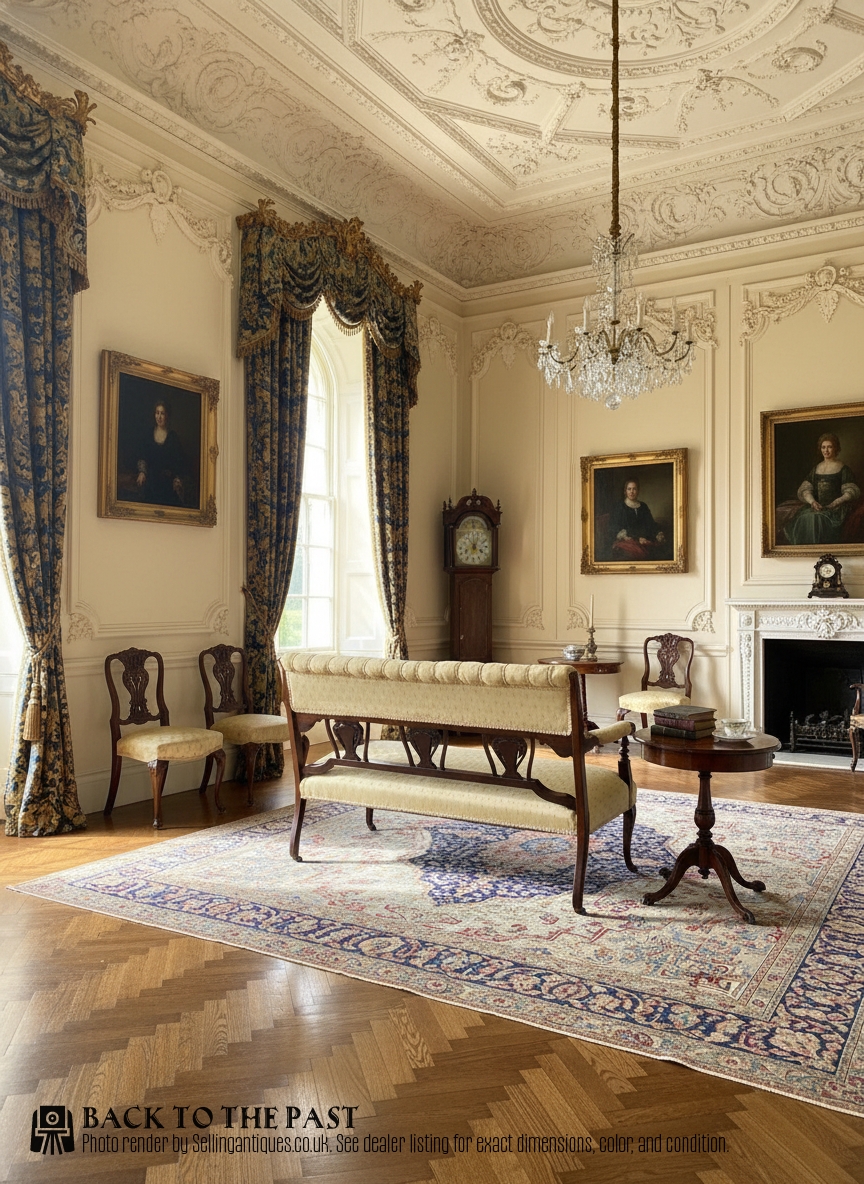
Inlaid Mahogany Salon Sofa
An inlaid mahogany salon sofa provides formal seating across Edwardian and Victorian periods, appearing in single two-seater formats, tub-shaped frames, and larger three-piece parlour or salon suites.
You are most likely to meet Edwardian examples dated around 1900 alongside late Victorian pieces from the 1880s and 1890s, built as settees, couches, and end-of-bed sofas.
The form spans straightforward two-seat settees to elaborate matching salon suites that include armchairs and triple-chair sofa configurations.
How they were made
Frames rely upon solid mahogany as the primary timber, finished with intricate satinwood, boxwood, and marquetry inlay work.
Decoration incorporates contrasting lighter wood veneers and bone details set directly into the mahogany ground.
Upholstery options range from damask and patterned fabric to plain covers intended for re-upholstering.
Some Edwardian settees doubling as end-of-bed seats feature bone inlay alongside satinwood.
What varies in quality
The precision and complexity of the satinwood and boxwood inlay separate standard workshop production from finer cabinet work.
Frame configuration dictates tier, with matching salon suites and tub-shaped settees demanding more sophisticated joinery than simple two-seat couches.
The Inlaid Mahogany Salon Sofa Glossary
- Marquetry
- A decorative technique where small pieces of wood veneer are fitted together to form pictorial or geometric patterns on a surface. This method creates the detailed ornamentation seen on the timber panels.
- Satinwood
- A durable, lustrous yellowish timber native to India and Sri Lanka used extensively for contrasting inlay work. It provides the bright decorative highlights against darker mahogany.
- Parlour suite
- A matching set of seating furniture, typically comprising a sofa and matching armchairs designed for a formal reception room. These suites unify the interior style of a period home.
- Settee
- A medium-sized upholstered seat with back and arms designed for two or more people. The form serves as an alternative term for a salon sofa.
- Damask
- A reversible figured fabric traditionally woven with patterns visible on both sides. Upholstery of this kind covers the sprung seats of Victorian and Edwardian frames.
Inlaid Mahogany Salon Sofa: Frequently Asked Questions
Where did people put salon sofas?
These sofas sat in formal reception rooms, parlours, and drawing rooms where guests were received. They offered decorative seating that suited social gatherings.
Today, they function well in sitting rooms, large bedrooms as end-of-bed seating, or hallways as statement pieces.
Are these sofas comfortable for daily lounging?
Victorian and Edwardian salon furniture prioritised upright posture and formal entertaining over deep relaxation. The seats are typically firm and supportive rather than slouchy.
Re-upholstered examples can offer adjusted padding, though the low backs and rigid frames remain true to their period design.
How do I identify an Edwardian piece?
Edwardian items, usually dating around 1900, often display lighter satinwood inlay and Sheraton Revival influences. The overall frames tend to look slender and graceful compared to earlier furniture.
Victorian pieces from the 1880s frequently show heavier proportions and darker timber finishes.
What is an end of bed sofa?
An end of bed sofa is a compact settee designed to sit at the foot of a bed. These pieces provide a convenient place to sit while dressing.
Historical examples adapted standard salon sofa forms into narrower dimensions specifically for bedroom placement.
Can I find matching chairs?
Many listings include complete salon suites or parlour suites that pair the sofa with matching armchairs or tub chairs. These matched sets share identical mahogany frames and inlay patterns.
Individual settees also appear frequently on their own without the accompanying chairs.