

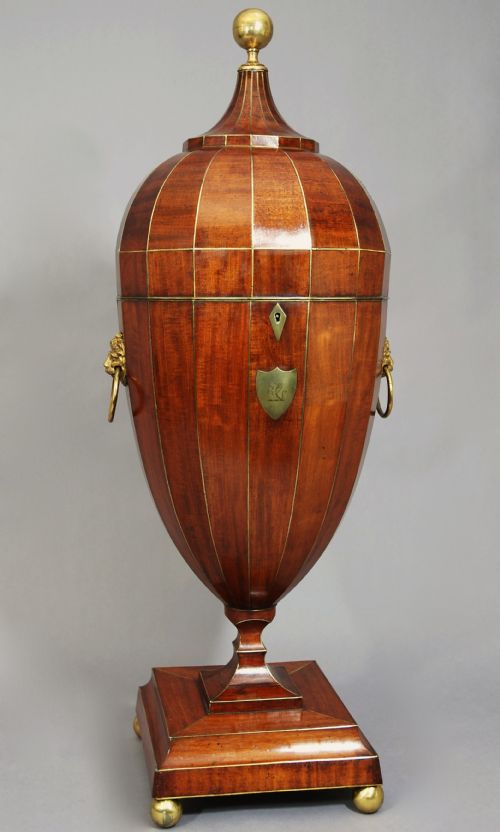


Inlaid Knife Box
An inlaid knife box is a sloping wooden receptacle for dining cutlery, prized for its architectural form and sharp marquetry.
Inlaid Knife Box
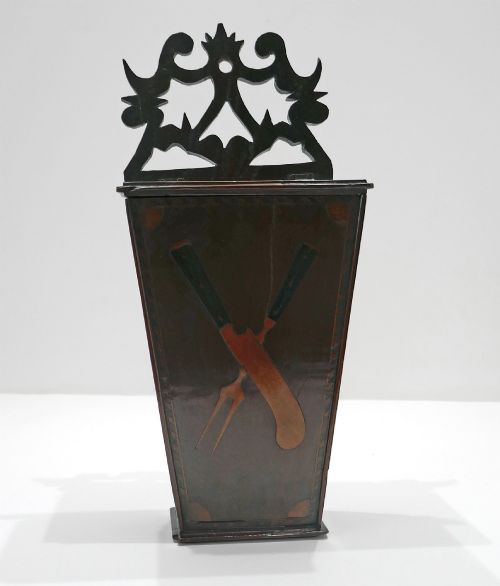
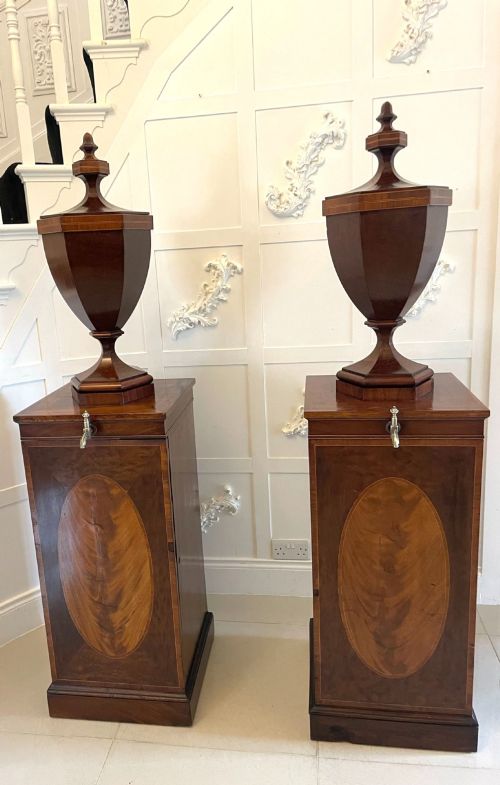
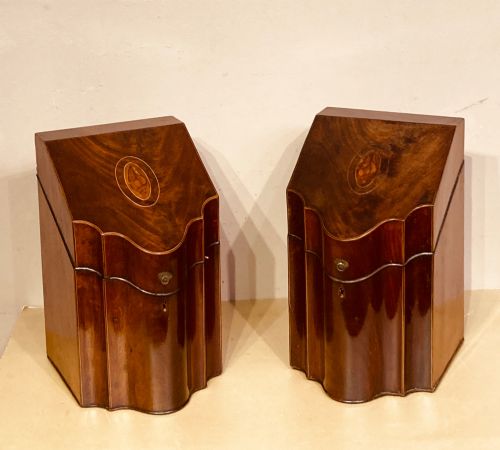
The inlaid knife box belongs primarily to the Georgian and George III periods, designed to stand upon sideboards and dining room tables to house flatware. These pieces take the form of distinctive sloping lids or classical urns, reflecting the formal dining habits of the eighteenth century. Buyers find both individual examples and matched pairs constructed to flank a dining room.
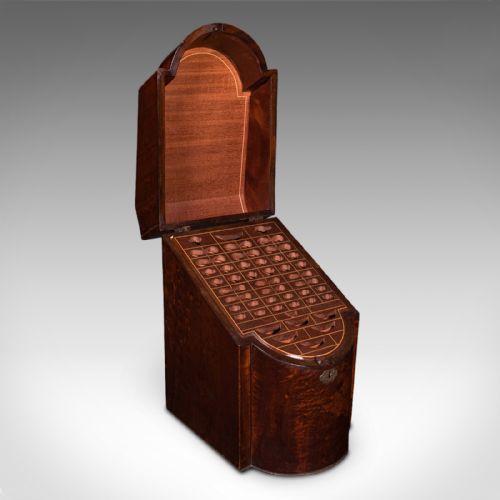
While many retain their original fitted interiors for knives, several examples adapt over time into stationery boxes or letter holders. The inventory ranges from classic mahogany serpentine fronts to satinwood silver-mounted boxes and walnut canteens. A minority of later Victorian interpretations and Portuguese coromandel pieces also appear alongside the dominant eighteenth-century English items.
How they were made
Cabinetmakers construct the primary body using solid mahogany, walnut, or satinwood, often shaped into serpentine or urn profiles. The exterior surfaces receive delicate contrasting stringing and geometric motifs utilising boxwood, ebony, and general wood inlay.
Brass hardware, including escutcheons, side carrying handles, and delicate hinges, provides structural reinforcement and functional operation. Metal mounts secure the lids and interior fittings, while internal partitions organise individual cutlery pieces.
Inlaid Knife Box Retail Price Guide 2026
Typical asking prices for inlaid knife box among the pieces listed under this phrase on Sellingantiques today, from the lower quarter to the upper quarter. They describe what is for sale here now, not the wider market.
Listings feature eighteenth-century and Victorian periods, utilising mahogany, satinwood, walnut, and coromandel with boxwood and ebony inlay.
What varies in quality
The precision of the boxwood and ebony inlay defines the visual standard of the piece, separating crisp geometric borders from simpler, coarser execution. Grain selection in the primary mahogany or satinwood veneer also determines the depth of the finished surface.
Structural complexity influences value, particularly where makers achieve difficult serpentine curves or turn timber into symmetrical pedestal urns. The presence of intact interior partitions or original brass work elevates an example above those altered or stripped of their fittings.
The Inlaid Knife Box Glossary
- Serpentine front
- A furniture front curved with a convex centre flanked by concave wings. This graceful contour defines the finer Georgian knife boxes.
- Stringing
- Thin inlaid lines of contrasting wood set flush into the surface of a panel. Boxwood and ebony create these sharp linear borders.
- Cutlery urn
- A classical vase-shaped vessel used on sideboards for storing flatware during the eighteenth century. These grand forms often stand on matching pedestals.
- Escutcheon
- A flat plate of brass surrounding a keyhole to protect the surrounding wood. They frequently double as decorative focal points on the sloping lid.
Inlaid Knife Box: Frequently Asked Questions
What were inlaid knife boxes used for?
These boxes held table knives, forks, and spoons on the sideboard before footmen transferred them to the dining table. Wealthy households displayed them as symbols of status and order.
Over the centuries, many owners repurposed the fitted interiors to hold stationery, letters, or small collectables as dining customs shifted.
How do I date a Georgian knife box?
Examine the timber quality, secondary woods inside, and the style of the brass hardware. George III examples often feature rich mahogany with precise boxwood stringing.
Construction methods inside the box, such as hand-cut dovetails and original lining papers, provide further clues to the manufacturing decade around eighteen hundred.
Are pairs harder to find than single boxes?
Surviving pairs remain significantly scarcer because furniture gets separated during centuries of inheritance and house moves. Matching pairs originally flanked sideboards in grand dining rooms to create symmetry.
Finding two identical boxes with matching wood grain and inlay patterns represents a much rarer discovery for collectors today.
Can I use these boxes for modern cutlery?
Many modern flatware sets prove too long or wide for the historic internal slots carved into the wood. Some boxes retain unpartitioned spaces that accommodate smaller items easily.
Owners frequently choose to display them empty as decorative sculptures or utilise them for storing letters and modern desk accessories.