

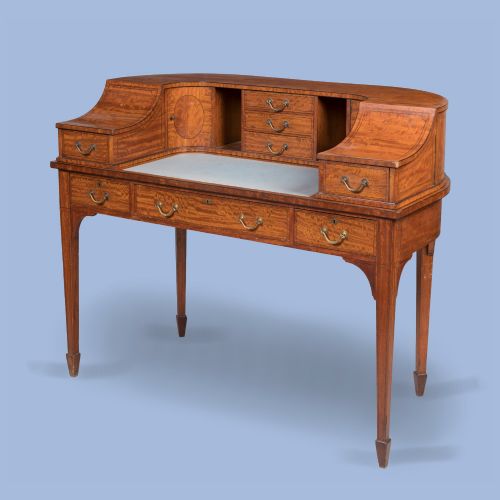


Inlaid Carlton House Desk
An inlaid carlton house desk brings curved superstructure drawers and fitted writing surfaces together in a distinguished form developed for formal correspondence.
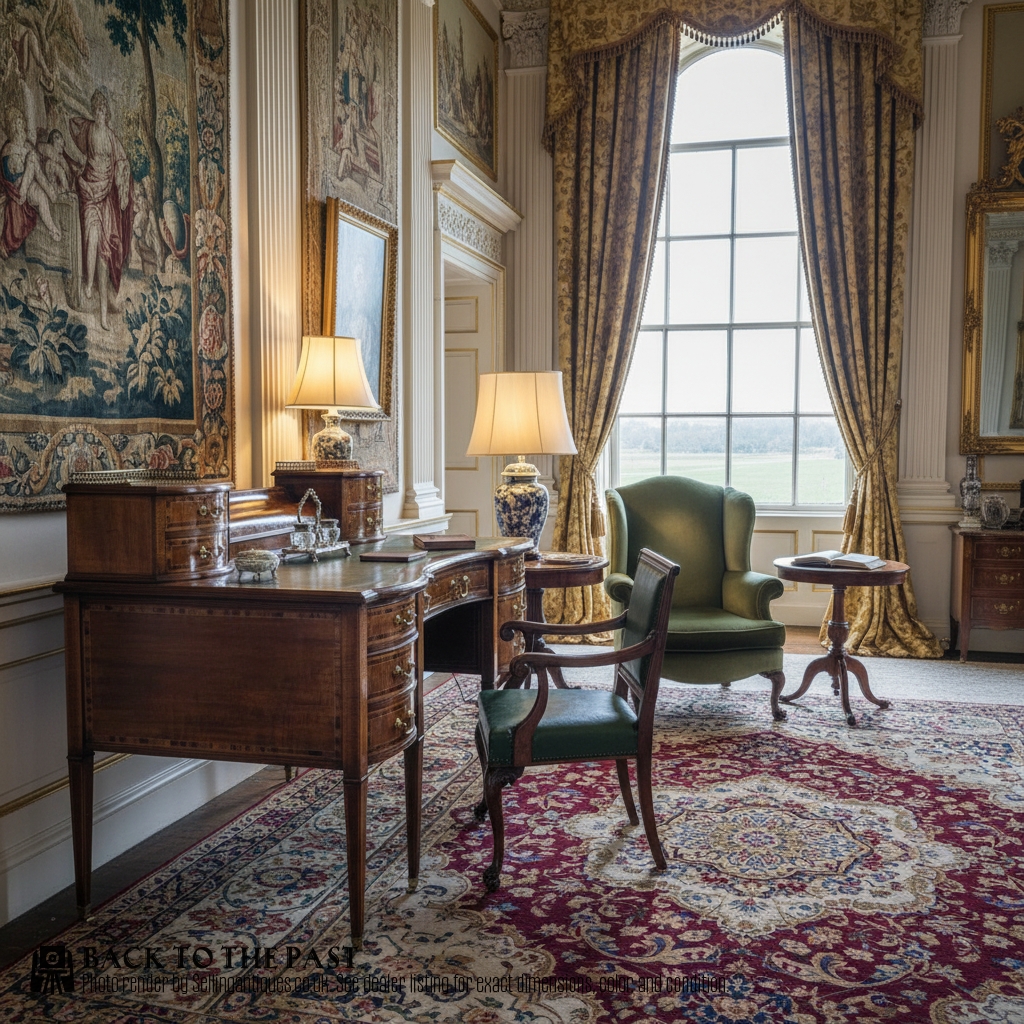
Inlaid Carlton House Desk
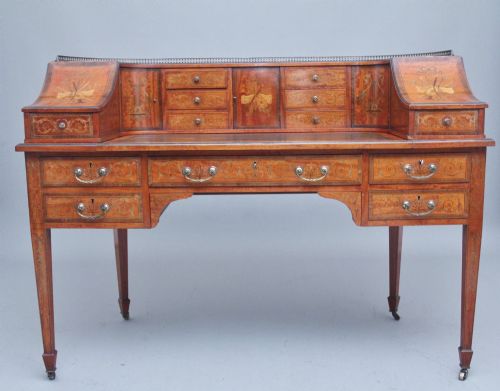
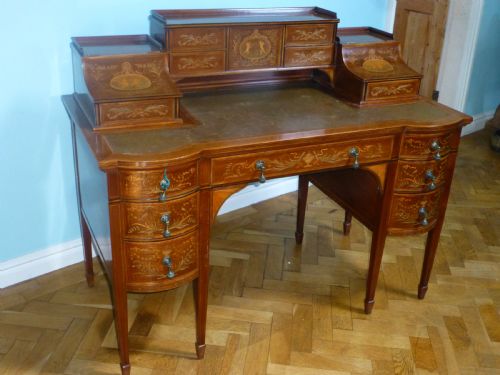
An inlaid carlton house desk is a substantial writing table featuring a curved superstructure of small drawers and compartments wrapping around the rear and sides of the writing surface. The form originates in the eighteenth century and appears frequently in Edwardian and Victorian revivals.
The examples seen here belong largely to the Edwardian period and the nineteenth century, executed in Sheraton Revival and Neoclassical styles. They range from compact satinwood writing pieces to large mahogany pedestal desks with elaborate marquetry.
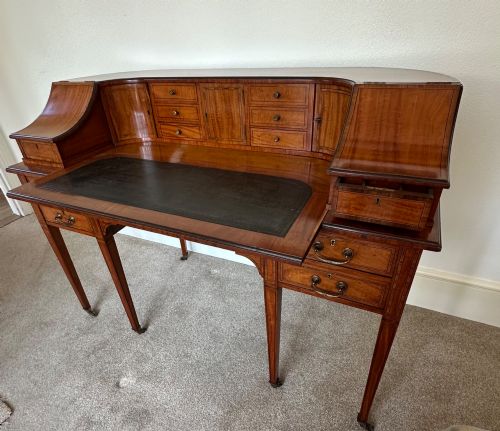
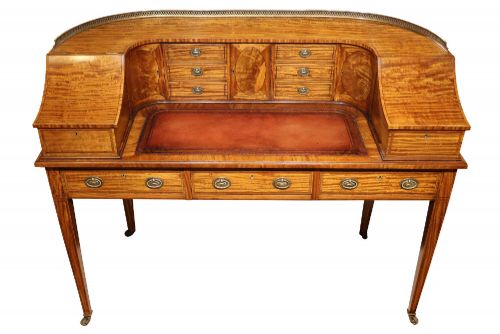
Buyers encounter both freestanding library pieces finished on all sides and variations with leather-lined writing surfaces designed to face into a room. The characteristic horse-shoe arrangement of drawers provides numerous pigeonholes and small compartments for correspondence.
Materials and Construction
Cabinetmakers constructed these desks using a solid timber framework of mahogany, oak, or satinwood, frequently applying contrasting veneers and elaborate wood inlay or marquetry across the curved superstructure and drawer fronts. Satinwood and mahogany form the primary visible surfaces, whilst secondary timbers such as oak line the drawer interiors.
Details such as crossbanding in kingwood, original brass handles, and fitted leather writing panels define the construction methods recorded in the archive. Marquetry panels incorporate various tinted and shaded woods to create floral or classical urn motifs across the curved back.
Listings feature mahogany, satinwood, and kingwood timbers paired with brass handles and leather writing inserts.
Assessing the Workmanship
Quality in an inlaid carlton house desk rests on the crispness of the marquetry, the selection of figured timber veneers, and the joinery of the complex curved superstructure. Superior examples display finely detailed wood inlay, precise crossbanding, and well-figured satinwood or mahogany grains that follow the contours of the desk.
The interior architecture of the small drawers and the inclusion of original brass hardware separate workshop standards. Pieces bearing attribution to established makers often exhibit denser marquetry work and more intricate internal stationery compartments.
Edwards and Roberts·Gillows of Lancaster·Maple of London·Maple and Co·Jas Shoolbred
The Inlaid Carlton House Desk Glossary
- Carlton House desk
- A writing desk with a curved superstructure of drawers and pigeonholes enclosing the rear and sides of the writing surface. The design is traditionally attributed to the residence of the Prince of Wales.
- Marquetry
- Decorative patterns formed by the insertion of different woods, veneers, or shell into a solid wood backing. This technique creates pictorial or geometric designs across drawer fronts and curved superstructures.
- Crossbanding
- A narrow strip of veneer applied around the border of a panel with the grain running perpendicular to the centre. It frames the primary wood surface on tabletops and drawer fronts.
- Superstructure
- The tiered arrangement of small drawers, compartments, and pigeonholes mounted above the main writing surface. In this form, it follows a curved or horseshoe layout.
- Sheraton Revival
- A late nineteenth and early twentieth century design movement drawing inspiration from the neoclassical furniture of George Sheraton. It utilises light timbers like satinwood and delicate inlay.
Inlaid Carlton House Desk: Frequently Asked Questions
What is a carlton house desk?
A carlton house desk is a formal writing table characterised by a curved bank of small drawers and compartments rising above the writing surface on three sides. The layout provides numerous pigeonholes for stationery while maintaining a compact footprint.
First appearing in the eighteenth century, the form gained popularity during the Victorian and Edwardian eras through revival styles that utilised satinwood and detailed marquetry.
Were these desks used for writing?
These desks served as private writing tables for correspondence, letter-writing, and managing personal accounts in formal drawing rooms and studies. The numerous small drawers and pigeonholes kept writing paper, ink, and sealing wax organised.
The inset leather writing surface provided a flat, durable plane for pens, whilst the curved superstructure kept reference materials within arm's reach.
How do I identify an Edwardian example?
Edwardian versions often feature bright satinwood veneers, extensive floral marquetry, and lighter overall proportions than their eighteenth-century predecessors. They frequently adopt the Sheraton Revival style with neoclassical motifs.
Makers from this period, including large London retailers, produced these desks with oak-lined drawers and fine brass hardware while retaining the traditional horseshoe superstructure.
Are these desks freestanding?
Many examples are finished with polished veneer on the reverse, allowing them to sit away from a wall in the centre of a room. This freestanding capability makes the detailed marquetry and curved back fully visible from any angle.
Buyers should examine the back panel to confirm whether the timber and inlay quality match the front of the desk.