
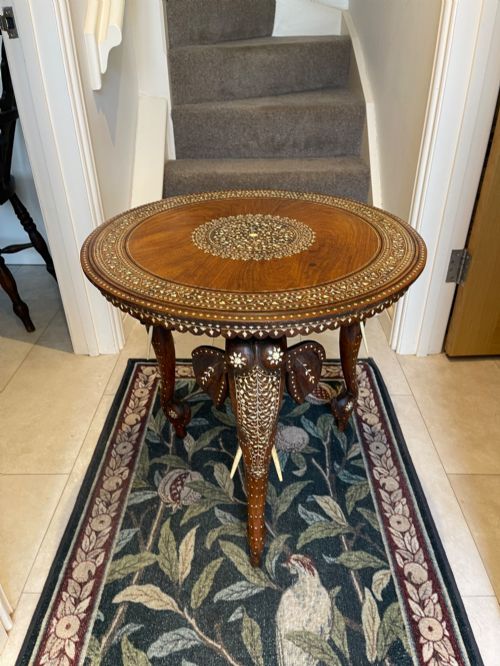


Indian Elephant Head Table
These carved wooden pieces are an indian elephant head table, bringing distinct colonial character and intricate craftsmanship into a room.
Indian Elephant Head Table
An indian elephant head table typically manifests as a side table, occasional table, coffee table, plant stand, or pedestal, shaped by Anglo-Indian, Anglo-Indian Colonial, and Anglo-Burmese Colonial traditions. These works emerge from production centres such as Hoshiarpur and the Bombay Presidency, dating across the nineteenth century and into the early twentieth century, spanning periods from 1840 to 1920.
The most common formats met on this page are occasional and side tables featuring carved hardwood structures supported by elephant head legs. Makers utilised octagonal, rectangular, and circular tops to showcase regional woodworking skills.
Materials and construction
Craftsmen built these tables using dense timbers including teak, rosewood, and general hardwood, carved into elaborate figural supports and panel tops. These surfaces frequently receive intricate surface enrichment through bone inlay and ebony inlay work.
Structural elements rely on traditional joinery combined with deep relief carving, where the elephant heads form the structural legs of the tripod or four-legged base. Brass components appear selectively in supporting hardware or decorative accents.
Every carved trunk holds a slightly different expression, depending on which workshop finished the day's carving.
Assessing craftsmanship
The choice of primary timber also dictates the tier of the piece, with solid rosewood and finely figured teak sitting apart from standard hardwood variants. The integration between the carved animal supports and the upper surface determines the structural harmony of the table.
Bombay Presidency·Hoshiarpur
The Indian Elephant Head Table Glossary
- Anglo-Indian
- A descriptive term for furniture made in India during the British colonial period, combining European furniture forms with local decorative motifs and carving techniques.
- Hoshiarpur
- A Punjabi city renowned for intricate woodwork, specifically known for dense geometric and floral carving incorporating bone and ebony inlay.
- Bone Inlay
- A decorative technique where small pieces of animal bone are shaped and set flush into recesses within the wooden surface to form patterns.
- Pedestal
- A tall, freestanding support structure used to display objects, often matching the smaller occasional table formats in regional carving style.
- Teak
- A durable tropical hardwood selected by colonial-era makers for its stability and resistance to splitting during intricate carving.
Indian Elephant Head Table: Frequently Asked Questions
What woods were used?
Makers utilised dense tropical timbers native to the region, predominantly teak and rosewood, alongside general carved hardwoods. These woods provided the necessary structural strength for intricate relief carving without splitting.
Selected examples incorporate contrasting details in ebony and bone inlay to highlight the geometric and floral patterns across the surface.
Where were they made?
Production centred in specific regions of the Indian subcontinent during the colonial era, notably within the Bombay Presidency and the northern town of Hoshiarpur. These centres developed distinct regional styles encompassing Anglo-Indian and Anglo-Burmese traditions.
Workshops in these areas combined traditional local woodworking techniques with European furniture forms suited to the export market.
How do I date an antique?
Dating relies on examining the timber species, the style of the carving, and the complexity of any inlay work. Pieces span the nineteenth century up to the 1920s, with earlier examples displaying denser hardwoods and hand-mixed patination.
Structural assembly methods and the specific colonial style classification further narrow the period of manufacture.
How do I use one?
These tables function well as occasional pieces, side tables, or plant stands in a living space, providing a stable surface for lamps or decorative objects. Their distinct figural supports allow them to serve as focal points within a room.
Care should be taken to place them away from direct heat sources to protect the inlaid sections and solid timber tops.