

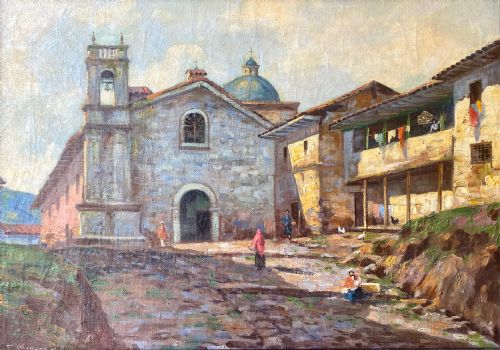


Impressionist Church Landscape
Impressionist church landscape works capture rural and urban spires through loose brushwork and atmospheric light, bringing historic ecclesiastical architecture into domestic interiors.
Impressionist Church Landscape
An impressionist church landscape brings together loose painterly execution and sacred architecture, capturing religious buildings within village, urban or rural settings. These works record places of worship from Yorkshire, Richmond, London and continental European scenes.
The pieces on this page span several decades, starting from the late nineteenth century through to the mid twentieth century. Creators apply oil paint or watercolour to canvas, canvas board, wood and paper to render these atmospheric scenes.
Buyers encounter variations ranging from large scale canvases depicting urban parish churches to smaller watercolour studies of country chapels. The common thread remains the interplay of light and shadow across ecclesiastical stonework using distinct post-impressionist or British impressionist approaches.
Materials and techniques
Artists build these compositions primarily using oil paint on canvas or canvas board, relying on viscous pigments to create textured surfaces that catch the light. Others employ watercolour applied directly to paper or wood supports, capturing translucent effects across sky and stone.
Brushwork remains loose and expressive rather than tight or academic, characteristic of the impressionist and modern British styles seen across the selection. Pigments are often laid down rapidly en plein air or developed in the studio from initial sketches to capture transient atmospheric conditions around the church building.
Impressionist Church Landscape Retail Price Guide 2026
Typical asking prices for impressionist church landscape among the pieces listed under this phrase on Sellingantiques today, from the lower quarter to the upper quarter. They describe what is for sale here now, not the wider market.
One featured painter shared a close bond with Walter Sickert, bringing a distinct continental café society atmosphere straight to the rural churchyard.
Distinctions in quality
Quality rests upon the confidence of the brushwork and the artist's command of light, where superior examples convey atmosphere and spatial depth with economy of line. Weaker works tend to rely on rigid draughtsmanship that stifles the movement inherent in the impressionist tradition.
The strength of the composition and the handling of the surrounding landscape relative to the church architecture separate accomplished works from routine topographical views. Stronger pieces integrate the steeple or nave into the broader chromatic scheme rather than treating the building as an isolated illustration.
William Greaves·Kershaw Schofield·Rowland Henry Hill·Maurice Asselin·Jeffrey Pratt·Henri Therme
The Impressionist Church Landscape Glossary
- Canvas board
- A rigid board surfaced with primed artists' canvas, offering a stable yet portable support for oil and acrylic painters.
- Post-Impressionism
- An artistic movement following impressionism that extends its use of vivid colours and thick application while placing greater emphasis on geometric forms and expressive content.
- Watercolour
- A paint consisting of pigment suspended in a water-soluble vehicle, traditionally applied to paper to achieve luminous transparent washes.
- British Impressionism
- A stylistic development adopted by late nineteenth and early twentieth century artists working in Britain who embraced French plein air techniques and broken brushwork.
Impressionist Church Landscape: Frequently Asked Questions
How do I date an impressionist church landscape?
Dating relies primarily on the recorded period of the work, the costume of any figures included in the composition, and the stylistic traits of the framing and stretcher bars.
Signatures, artist registry records and stylistic markers such as post-impressionist or modern British handling also help narrow the decade of creation.
Where should I hang these paintings?
These works suit well-lit spaces where natural daylight can interact with the oil or watercolour pigments without direct exposure to harsh sun.
Pairing them with neutral walls allows the atmospheric tones of the church architecture and surrounding landscape to command visual attention.
What is the difference between canvas and paper works?
Canvas and canvas boards generally carry heavier oil paint layers with palpable texture, whereas works on paper typically utilise watercolour for lighter, more translucent effects.
Both supports reflect the exploratory techniques of impressionist artists working across different mediums.
Are all these pieces British views?
The selection includes both British scenes, such as Yorkshire parishes and London street views, alongside continental European village settings.
Each location reflects the specific regional interpretation of impressionist and modern painting methods prevalent during the active decades.