
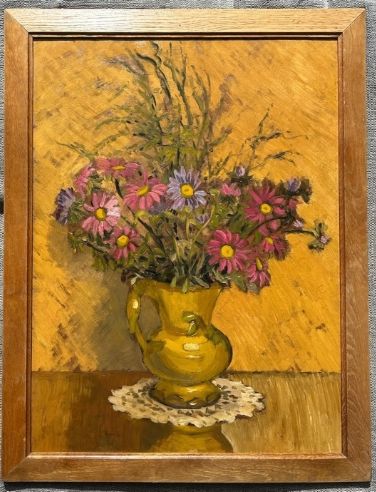
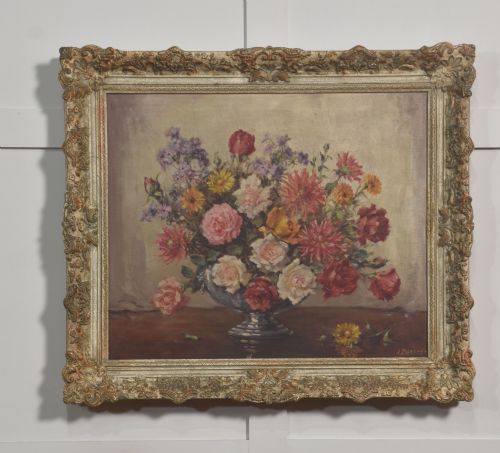
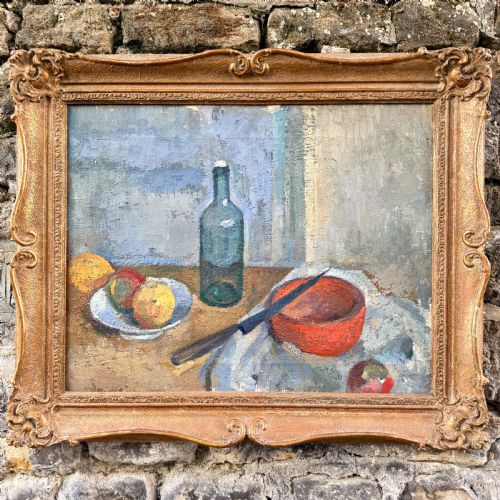
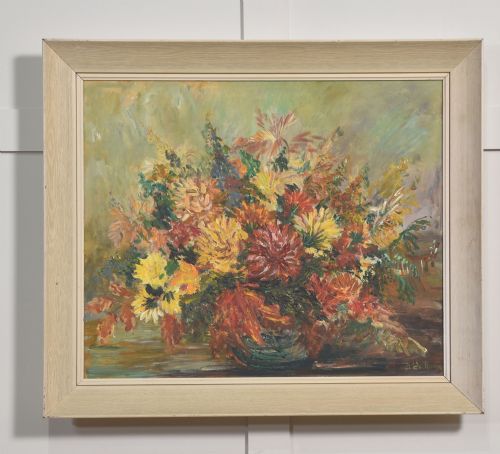


Impasto Oil Still Life
An impasto oil still life brings tactile depth and thick, sculptural pigment directly to your wall, capturing everyday objects with physical presence.
Impasto Oil Still Life
An impasto oil still life uses thick applications of pigment to render flowers, fruit, and domestic objects with a pronounced three-dimensional texture. You are looking at works ranging from the nineteenth century through the mid twentieth century, encompassing Post-Impressionism, Expressionism, and Mid-Century Modernism.
The most common formats on this page are oil on canvas and oil paint on board, often set within gilt or wooden frames. Subjects lean towards floral arrangements in vases, bowls of fruit, and botanical studies executed by named artists and anonymous hands alike.
These paintings emerge from diverse European and British traditions, spanning French Modernist works to Modern British compositions. Each piece records the hand of the painter through visible brushstrokes and spatula work that lift the pigment off the surface.
How they were made
Artists built these compositions using oil paint applied thickly with brushes or palette knives onto stretched canvas or wooden board. This method allowed the pigment to retain ridges, swirls, and peaks that cast real shadows across the picture plane long after drying.
Supports varied between traditional woven canvas and rigid wooden boards, sometimes paired with plaster elements or gilt frames to complement the painted surface. The combination of slow-drying oil medium and dense pigment application ensured lasting stability for the raised textures.
Listings feature works executed on both canvas and board, utilising oil paint alongside gilt and plaster framing materials from the nineteenth and twentieth centuries.
What varies in quality
Quality rests in the confidence and control of the thick paint application, where the pigment describes form and light rather than merely sitting on the support. Stronger works demonstrate a deliberate harmony between heavy texture and underlying composition, avoiding muddy colour mixing.
The integration of the support and framing also dictates the calibre of the piece, with well-preserved canvases and period wood or gilt surrounds maintaining the integrity of the artwork. Superior examples reveal a distinct artistic voice, whether through expressionist distortion or post-impressionist colour relationships.
Kenneth Cozens·I. Berezny·D. L. Williams·Sir Matthew Smith·Horst·Elizabeth T. Sutcliffe·Bertoldo Taubert·Georges Rouault
The Impasto Oil Still Life Glossary
- Impasto
- Paint applied thickly to a canvas or board, leaving the marks of the brush or palette knife standing proud of the surface. This technique creates a tactile relief that catches the light.
- Post-Impressionism
- An artistic movement following impressionism that extended its use of vivid colours and thick paint while placing greater emphasis on geometric forms and expressive content. Artists working in this manner moved beyond naturalistic depiction.
- Expressionism
- A modernist style where the artist seeks to depict subjective emotions rather than objective reality through distorted forms and heavy pigment. The approach prioritises psychological impact over precise botanical or domestic accuracy.
- Board
- A rigid flat panel used as a painting support instead of woven fabric. Painters often applied oils directly to wood or composite boards for stability.
- Gilt
- A thin layer of gold leaf or gold paint applied to frame surfaces to ornament the perimeter. It provides a reflective border that isolates the painted subject from the wall.
Impasto Oil Still Life: Frequently Asked Questions
What is an impasto oil still life?
An impasto oil still life is a painting where oil paint is laid down in thick, heavy layers to depict inanimate objects like flowers, fruit, and vessels. The physical buildup of pigment creates a textured surface that stands out from the canvas or board.
These works range from nineteenth-century studies to mid-twentieth-century modernist interpretations. They rely on tactile presence rather than smooth blending to capture light and form.
How do I hang a heavy textured painting?
Paintings with thick impasto and heavy wooden or gilt frames require sturdy picture hooks fixed securely into wall studs or masonry. Ensure the hanging wire and D-rings on the back are rated to support the weight of the specific board or canvas.
Keep these works away from direct heat sources and high-moisture areas to protect the oil paint and any wooden framing elements from warping or cracking over time.
How do I tell an original painting from a print?
Examine the surface under a strong side light to check for the physical peaks and valleys of dried oil paint. An original impasto piece will show three-dimensional brush or palette knife marks that catch the light, whereas a print remains flat.
Inspect the edges of the canvas or board to confirm the presence of woven fabric or wood grain beneath the layers of pigment. Signatures and stretcher marks on the reverse further indicate an original studio work.
What periods do these paintings come from?
The available pieces span the nineteenth century through the 1920s, 1930s, 1940s, 1950s, and 1960s. Each decade brings distinct stylistic shifts, moving from earlier academic realism towards Post-Impressionism, Expressionism, and Mid-Century Modernism.
Mid-century examples often feature abstracted forms and vibrant palettes, while older works tend towards traditional floral arrangements and muted tones.