
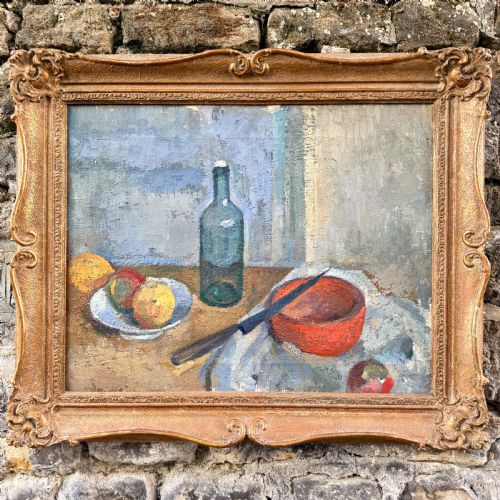


Terracotta Still Life Artwork
Terracotta still life artwork brings together painted studies of earthenware pots and fruit, capturing domestic forms across the nineteenth and twentieth centuries.
Terracotta Still Life Artwork
When you search for terracotta still life artwork, you encounter painted compositions focusing on pottery vessels alongside botanical elements. The pieces span from the Victorian period through to the mid-twentieth century.
The selections available here feature oil paintings on canvas alongside watercolours on paper. Artists recorded potted plants and floral arrangements in various European and modernist styles.
Academic realism sits beside post-impressionism and mid-century European modernism within these listings. Works range from nineteenth-century botanical studies to avant-garde encaustic compositions.
Materials and methods
Artists employed oil paint and watercolour on canvas or paper to build these still life studies. Encaustic paint also appears in the twentieth-century avant-garde works.
Many of these paintings retain their original wood frames, sometimes finished with gilt. The physical support systems vary from stretched canvas to works on paper behind glass.
Listings span from the nineteenth century to the nineteen-sixties, incorporating oil paint, watercolour, and encaustic on canvas and paper.
Assessing the quality
Quality rests in the handling of light across the earthenware surfaces and the sureness of the brushwork. Stronger works display confident spatial arrangement and considered colour harmonies.
The depth of the composition and the artist's command over the chosen medium dictate the distinction between standard decorative studies and accomplished fine art.
Girieud·Grace Hastie·Annie Mary Youngman·Tschacbasov
The Terracotta Still Life Artwork Glossary
- Encaustic paint
- Pigment mixed with hot beeswax that is applied to a surface. This medium creates a distinct textured finish seen in certain modernist works.
- Academic realism
- A style of painting produced under the influence of European academies. It emphasises accurate observation and traditional techniques.
- Post-Impressionism
- A French art movement that developed roughly between certain decades. Artists rejected naturalistic depiction in favour of expressive forms and colours.
- Fauvism
- An early twentieth-century movement characterised by strong colours and painterly qualities. Practitioners prioritised painterly independence over representational accuracy.
Terracotta Still Life Artwork: Frequently Asked Questions
What periods do these paintings come from?
The available pieces stretch from the Victorian era into the mid-twentieth century. This timeline covers several distinct artistic movements.
You will find nineteenth-century botanical watercolours alongside modernist oil paintings from the nineteen-sixties.
How are these artworks framed?
Many works retain period wood frames that complement the canvas or paper inside. Some frames feature gilt decoration characteristic of their respective eras.
Framing styles alter depending on the decade, shifting from ornate Victorian moulding to simpler mid-century profiles.
What mediums were used?
Artists utilised oil paint on canvas as the primary medium for these still life studies. Watercolour on paper and encaustic paint also appear in the selection.
Each medium creates a different surface texture, from the smooth application of watercolours to the heavier impasto of oils.
How do I identify modernist works?
Modernist pieces often feature simplified forms, flattened perspective, and non-naturalistic colour choices. Works from the nineteen-twenties and nineteen-sixties show these tendencies clearly.
Fauvist and mid-century European examples demonstrate a departure from the strict representation seen in Victorian botanical studies.