
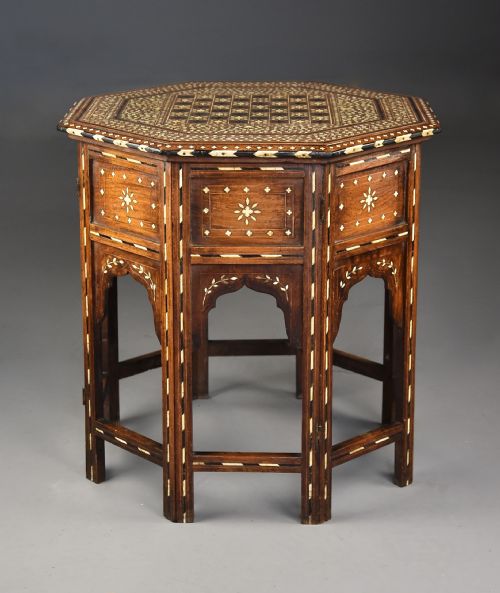
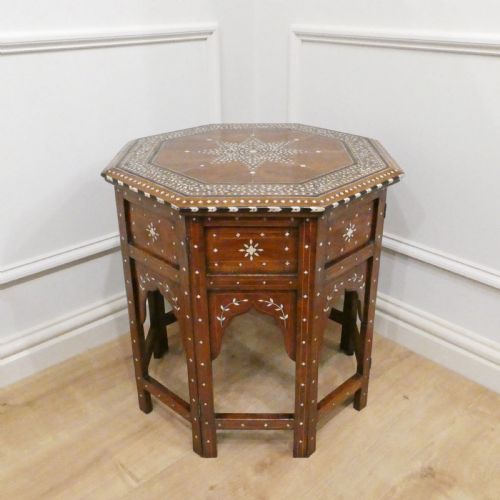
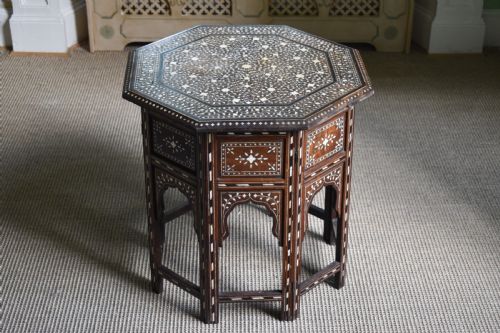


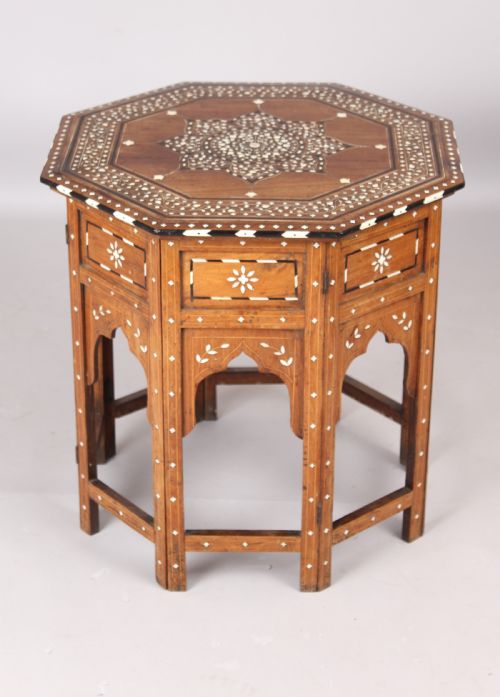


Hoshiarpur Octagonal Side Table
These hoshiarpur octagonal side table pieces bring intricate Anglo-Indian craftsmanship into a room, offering distinct geometric form and detailed surface work.
Hoshiarpur Octagonal Side Table
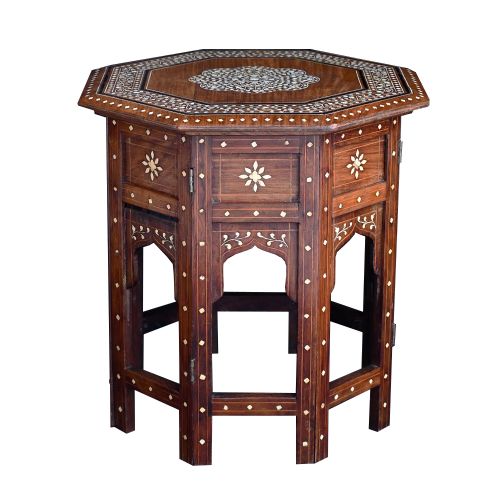
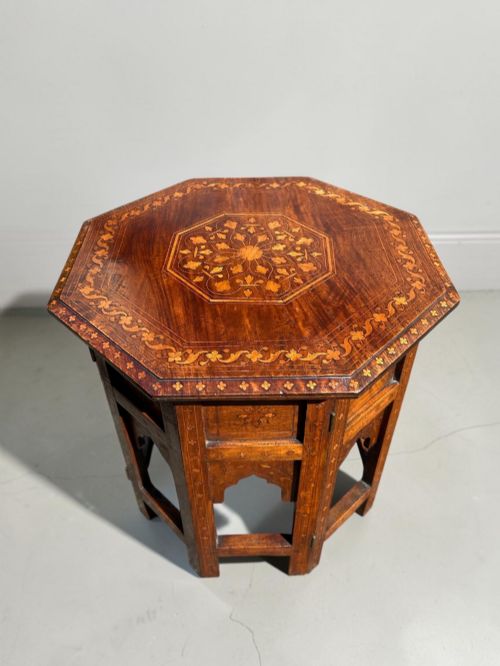
A hoshiarpur octagonal side table is an Anglo-Indian occasional piece defined by its eight-sided top and geometric form. These tables emerge primarily from the nineteenth century and the early twentieth century, spanning decades such as eighteen-ninety and nineteen-hundred.
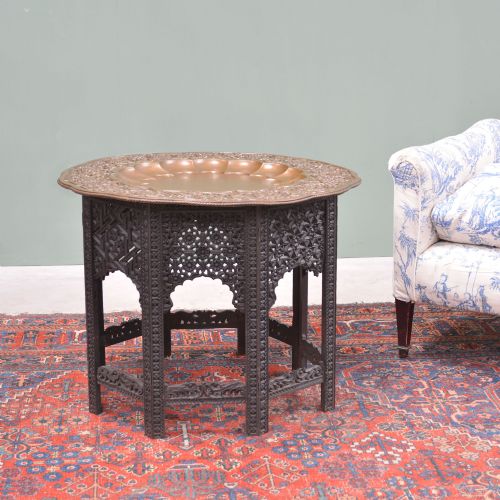
The objects seen here function mainly as side tables, occasional tables, or tray top tables. Buyers encounter forms ranging from small occasional pieces to large antique octagonal examples and folding star designs.
Originating within the Anglo-Indian style, these tables combine traditional Indian woodworking techniques with British colonial demand. They serve as practical surfaces while displaying dense surface decoration across rosewood, teak, and padauk bodies.
How they were made
The construction relies on dense hardwoods such as rosewood, teak, ebony, sandalwood, and padauk. Artisans shape these timbers into sturdy frames that support complex multi-part surfaces.
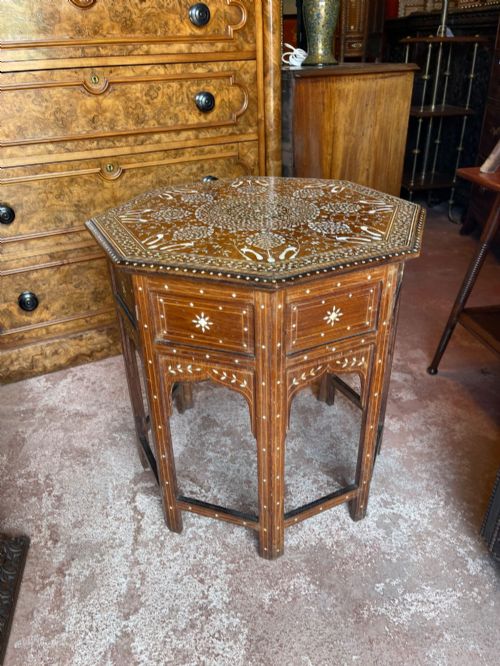
Makers integrate extensive inlay work using bone, brass, copper, and wood inlay. This meticulous detailing fills the carved wooden recesses to create contrasting patterns across the octagonal tops.
Several tables fold away entirely into flat stars, proving that nineteenth-century artisans understood small-space living just as well as we do.
What varies in quality
Quality rests upon the precision of the surface inlay and the crispness of the carved details. Tables featuring dense, well-fitted bone or brass elements demonstrate superior craftsmanship compared to simpler iterations.
The choice of timber also dictates the standard of the piece, with heavier hardwoods like rosewood and teak providing greater structural integrity than softer woods. The complexity of the folding mechanisms and the alignment of the octagonal geometry further distinguish finer examples.
The Hoshiarpur Octagonal Side Table Glossary
- Anglo-Indian
- A style describing furniture made in India during the British colonial period, combining local craftsmanship with British tastes.
- Bone inlay
- A decorative technique where small pieces of bone are set flush into carved recesses within the wooden surface.
- Occasional table
- A small, movable table designed for specific, intermittent use rather than central placement in a room.
- Padauk
- A dense tropical hardwood known for its reddish-brown colour, utilised in select nineteenth-century tables.
Hoshiarpur Octagonal Side Table: Frequently Asked Questions
What is a hoshiarpur table?
A hoshiarpur table is an Anglo-Indian occasional piece featuring intricate surface decoration and an eight-sided top.
These items originate from the town of Hoshiarpur in Punjab, renowned for its skilled woodcarving and inlay traditions.
How old are these tables?
The pieces available date predominantly from the nineteenth century through to the early twentieth century.
Specific dates recorded in the evidence range from eighteen-ninety and nineteen-hundred up to nineteen-twenty.
What materials are used?
Construction utilises hardwoods including rosewood, teak, ebony, sandalwood, and padauk as the primary structural body.
Surfaces are then decorated using bone inlay, wood inlay, brass, and copper elements.
Are these tables folding?
Certain examples feature collapsible or folding designs intended for practical storage and movement.
These folding variants often incorporate star-shaped octagonal top patterns characteristic of the Anglo-Indian style.