
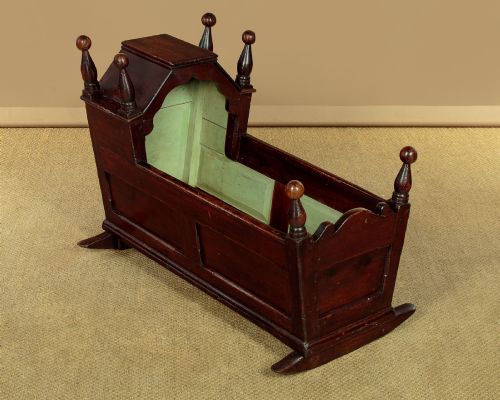


Hooded Rocking Crib
A hooded rocking crib is a traditional infant's bed on rockers with an integrated canopy, offering both gentle movement and shelter.
Hooded Rocking Crib
A hooded rocking crib provides an enclosed sleeping space for an infant, combining the secure overhead shelter of a hood with the soothing motion of curved floor rockers. Buyers seeking a hooded rocking crib will find pieces ranging from sturdy country furniture to formal cabinet-maker pieces.
The selections available span multiple centuries, with particular emphasis on 17th century styles, Georgian examples, and Victorian interpretations. Oak and pine dominate the forms, frequently constructed with panelled sides or traditional canopies.
Makers historically produced these cradles for domestic nurseries, utilising local timbers and regional joinery techniques. The surviving examples demonstrate how nursery furniture adapted across centuries from vernacular country workshops to urban retailers.
Materials and construction methods
Timbers such as oak and pine form the structural core of these pieces, shaped through traditional joinery including panelled construction and pegged joints. Master craftsmen utilised native hardwoods to build rigid frames capable of sustaining centuries of rocking motion.
Surface treatments vary from natural waxed grain and historic paint finishes to applied decorative carvings. Certain Victorian variations incorporate cane panels, glass, or upholstered elements alongside the primary wooden framework.
Assessing quality and construction
Quality in a hooded rocking crib rests upon the integrity of the timber framing and the proportion of the hood relative to the cradle body. Early examples display hand-planed panels and precise joinery that distinguish them from later revival pieces.
The preservation of original surface finishes, whether historic paint or aged patinated oak, dictates the character of the piece. Subtle details such as integrated hood structures and the sweep of the original rockers separate standard utilitarian items from finer examples.
The Hooded Rocking Crib Glossary
- Hood
- A protective canopy built over the head of the crib to shield the infant from draughts. This architectural element defines the silhouette of the piece.
- Rockers
- The curved wooden bases attached to the bottom of the cradle to allow a gentle swaying motion. These are essential for the rocking function.
- Panelling
- Wooden sheets fitted within a structural frame using grooves and tenons to prevent warping. This technique provides the primary walls of early oak cradles.
- Cane
- Woven rattan material used to create breathable panels on the sides of later cribs. It introduces a lighter texture to the heavier wooden framework.
Hooded Rocking Crib: Frequently Asked Questions
What is a hooded rocking crib?
A hooded rocking crib is a traditional infant bed featuring an integrated overhead canopy and curved wooden rockers at the base.
These pieces were designed to keep infants safe from draughts while allowing parents to soothe the child with a gentle rocking motion.
How were these cribs used historically?
Families placed these cribs in domestic chambers and nurseries to provide a secure, portable sleeping space for newborns.
The rocking function helped settle infants, while the overhead hood offered protection from household air currents.
What woods were used for these cribs?
Traditional makers utilised accessible regional timbers, most commonly oak and pine, though mahogany appears in later examples.
These hardwoods provided the structural strength necessary for daily domestic use and continuous movement.
How do I identify a 17th century style crib?
Seventeenth century style cribs typically feature heavy oak construction, field panelling, and geometric joinery.
Many examples reflect later revival periods while maintaining the robust proportions and vernacular detailing of earlier centuries.
Can these cribs still be used for babies?
These historical pieces are primarily collected and displayed as decorative antiques rather than modern nursery furniture.
Contemporary safety standards for infant sleep differ significantly from the manufacturing methods of past centuries.