
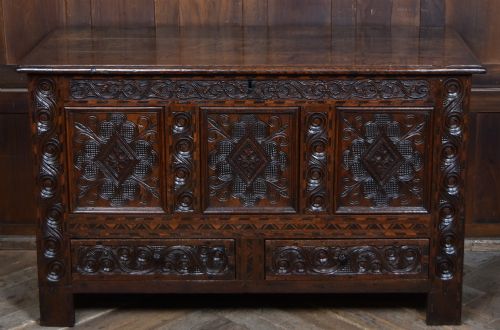
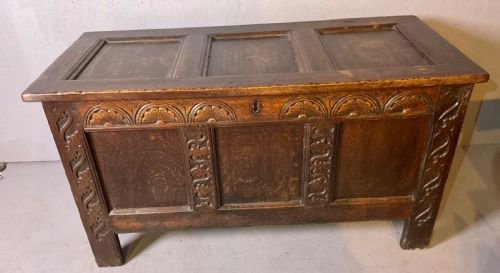


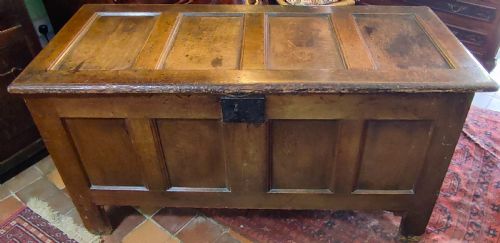


Historic Oak Storage Chest
A historic oak storage chest brings heavy timber and centuries of domestic utility directly into a modern room.
Historic Oak Storage Chest
A historic oak storage chest takes several forms across the 16th, 17th, and 18th centuries, appearing as boarded coffers, joined Lancashire coffers, mule chests, sword chests, and Bible boxes. These heavy wooden containers served households primarily for holding textiles, valuables, and documents before fitted closets became common.
Visitors browsing this selection will most frequently encounter boarded and carved 17th-century coffers alongside later 18th-century variants. Forms range from simple boarded constructions to complex joined furniture incorporating internal drawers and carved friezes.
Originating predominantly from English workshops, these pieces span the Tudor, Elizabethan, Jacobean, and Georgian eras. Alongside standard coffers, the category also encompasses related domestic storage forms such as oak court cupboards and blanket chests.
Materials and construction methods
Makers built these pieces primarily from solid oak, utilising its dense grain and structural strength to create robust storage furniture designed to endure for generations. Wood inlay added decorative surface contrast to the natural timber grain on select pieces.
Metal hardware played a crucial structural and functional role, with iron, wrought iron, and brass utilised for hinges, straps, and locking mechanisms. Joinery techniques varied from early boarded joints held with pins to sophisticated panel-and-frame construction.
One listed Bible box includes three internal secret drawers, keeping precious scriptures hidden beneath the main writing slope.
Distinctions in quality and execution
The sophistication of the carved ornamentation largely separates standard utility pieces from finer examples, with crisply executed geometric patterns or figural motifs indicating greater workshop skill. The integrity of the original timber framing and the survival of primary structural elements heavily influence desirability.
Hardware retention also shapes the character of a piece, as original ironwork, brass fittings, and working locks provide a truer representation of the maker's output. Furthermore, the complexity of form - such as the inclusion of internal drawers or sophisticated joined panels - distinguishes simpler boarded boxes from elaborate Lancashire coffers and mule chests.
The Historic Oak Storage Chest Glossary
- Coffer
- A heavy wooden box with a lid used for storage, often considered the precursor to the modern chest of drawers. Early examples are frequently constructed from thick boards or joined frames.
- Mule chest
- A storage chest featuring one or more drawers at the base beneath the main compartment. This form bridges the gap between traditional coffers and early drawer-based furniture.
- Joined construction
- A method of furniture making utilising pegged mortise and tenon joints to frame panels rather than relying on simple boards. This technique accommodated seasonal wood movement and increased structural stability.
- Frieze
- The wide horizontal band at the upper section of a piece, frequently decorated with carved patterns, running ornament, or dates. On these items, the frieze often displays the highest concentration of decorative carving.
- Boarded construction
- An early and straightforward method of box-making where wide planks of timber are fastened directly together at the edges using nails, pins, or dowels.
Historic Oak Storage Chest: Frequently Asked Questions
What were historic oak storage chests used for?
These robust containers held valuable household textiles, garments, linen, and important documents securely away from damp floors and pests. In domestic settings, they frequently doubled as seating benches or tables when not accessed for storage.
Specialised variants like sword chests or Bible boxes held specific personal possessions and sacred texts, protecting them from damage in communal households.
How do I date an oak coffer?
Dating relies heavily on observing construction methods, joinery types, and decorative styles characteristic of specific periods such as the Elizabethan, Jacobean, or Georgian eras. Early boarded construction generally precedes sophisticated joined framing, while carved motifs often reflect the prevailing style of the maker's century.
Hardware styles, tool marks, and occasional carved dates or initials also provide physical clues to the decade of manufacture.
How do I care for historic oak furniture?
Keep wooden storage chests away from direct heat sources, radiators, and rapid humidity fluctuations to prevent the ancient oak from drying out or splitting. Maintaining a stable indoor climate protects both the timber panels and the original iron or brass hardware.
Apply traditional beeswax sparingly to nourish the dry wood surface and preserve the natural patina developed over centuries of handling.
What is the difference between a coffer and a chest?
While terms often overlap, a coffer traditionally denotes a more robust, securely locked box intended for valuables or travel, frequently featuring boarded or heavily joined construction. Chests generally encompassed a wider variety of blanket and storage boxes used domestically for everyday textiles.
In historical terminology, many heavy oak storage pieces were documented simply as coffers regardless of their exact internal layout.
Where were these pieces made?
The pieces recorded here originated primarily within English workshops and regional furniture-making traditions spanning the sixteenth through the eighteenth centuries. Local craftsmen utilised native English oak harvested from regional woodlands to construct these durable household items.
Specific regional styles, such as Lancashire joined work, point to distinct provincial furniture-making centres across the country.