
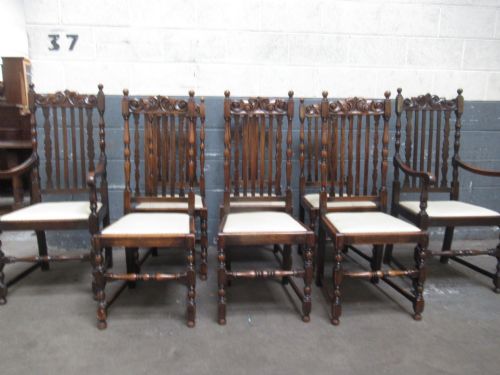


Highback Dining Chairs
Highback dining chairs command attention with towering proportions that anchor a room, uniting functional seating with striking vertical design.
Highback Dining Chairs
Highback dining chairs are prominent seating forms defined by extended vertical backrests, designed to provide support while creating a dramatic architectural silhouette around the table. The options gathered here span centuries of design, encompassing substantial oak iterations from the seventeen-hundreds up through nineteen-twenties revivals.
Alongside standard side chairs, the selection includes matched armchairs and occasional accent seating. Whether adopting the curved lines of the early eighteenth century or the linear styling of the arts and crafts movement, these chairs serve as focal points in any dining arrangement.
Materials and construction
Makers relied primarily on sturdy hardwoods such as oak, mahogany, walnut, and beech to support the elevated vertical stress inherent in tall backrests. These timbers were frequently joined using traditional mortise and tenon methods, ensuring the structural integrity needed for daily dining use.
Surfaces were brought to life through carving, wood inlay, and japanning, complemented by functional details like brass hardware. Upholstered variants integrated supportive elements covered in fabric, velvet, leather, or woven cane panels.
One surviving seventeen-hundreds chair wears a coat of japanned finish, proving that historic dining seats could be delightfully glossy.
Assessing quality and finish
Quality in these tall-backed seats rests on the proportion between the soaring vertical frame and the stability of the base. Finer examples display crisp, hand-carved details and seamless timber matching across entire matched sets.
The choice of primary wood and secondary materials dictates durability, with dense oak and well-figured mahogany representing the upper echelon of construction. Original surface patination and intact upholstery elements further separate standard production items from exceptional workshop creations.
Brights of Nettlebed
The Highback Dining Chairs Glossary
- Barley twist
- A type of furniture turning resembling a twisted rope, commonly found on the legs and stretchers of seventeenth-century and revival dining chairs.
- Carolean revival
- A nineteenth-century style imitating the ornate, carved walnut and oak aesthetics of the reign of King Charles the Second.
- Japanning
- A European imitation of East Asian lacquerwork, applied to wooden furniture surfaces to produce a dark, glossy, decorative finish.
- Wood inlay
- A technique where pieces of contrasting timber are inserted into recesses in the primary wood surface to form decorative patterns.
- Cane
- Plant material woven into an open mesh pattern to form lightweight backrests or seat inserts on dining chairs.
Highback Dining Chairs: Frequently Asked Questions
How do I choose the right set size?
Consider the scale of your dining table and the physical space available in the room. Highback chairs visually crowd small areas, so ensure adequate clearance around each seat.
Most sets appear in groupings of four, six, or eight, allowing you to match the seating capacity to your daily needs and entertaining habits.
Are these chairs comfortable for long dinners?
The tall backrests offer considerable upper and lower back support compared to standard low-profile dining seats. Upholstered and cushioned variants provide additional comfort for extended gatherings.
Wood-panelled or cane backs rely on ergonomic angles and posture, making them well-suited for formal dining environments.
How do I date a highback chair?
Examine the primary wood species, construction joinery, and stylistic ornamentation visible on the frame. Oak and japanned finishes often point towards seventeenth-century origins or later revivals, while mahogany frequently suggests eighteenth or nineteenth-century craftsmanship.
Art Nouveau and Edwardian iterations display distinct linear motifs and decorative carving styles characteristic of the turn of the twentieth century.
Can I mix these with modern tables?
The strong vertical lines of highback seating create a striking contrast against contemporary glass, metal, or plain wooden tables. Selecting matching woods helps bridge the gap between antique seating and modern dining surfaces.
Pairing a uniform set of chairs with a minimalist table allows the historical character of the frames to stand out.