
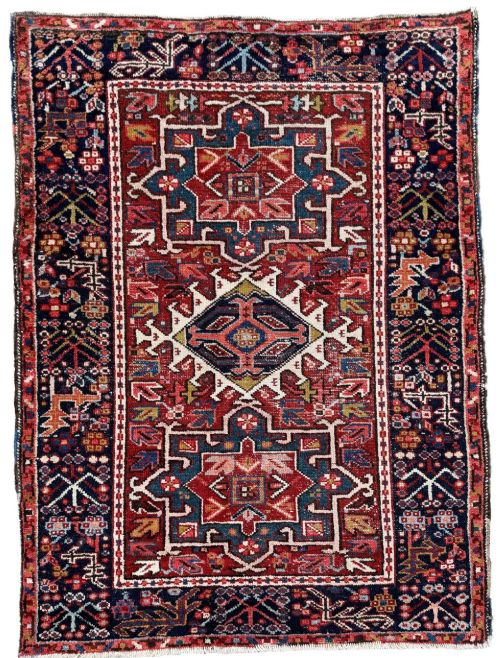
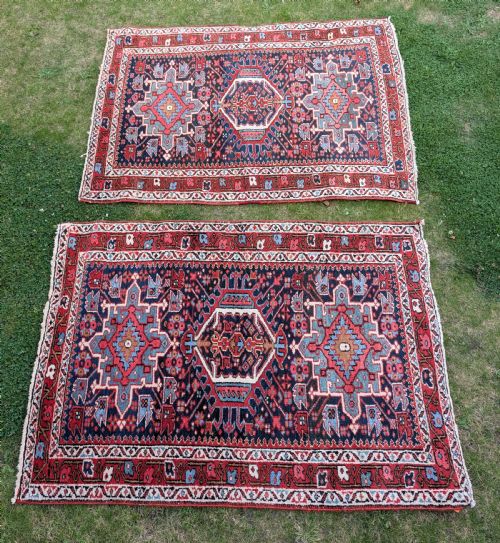
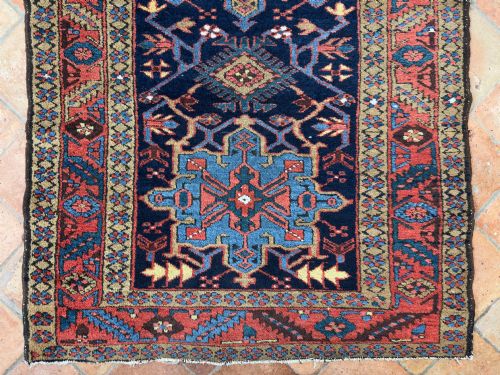
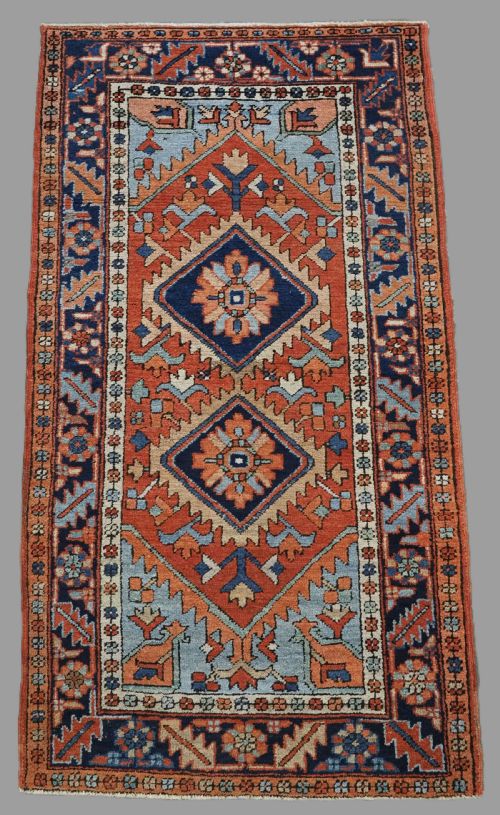


Heriz Karaja Rug
A heriz karaja rug brings geometric village character and dense wool to a floor from north west Persia.
Heriz Karaja Rug
When you examine a heriz karaja rug, you are looking at village-woven Persian floor coverings originating from the north west of the country. These pieces date from the late nineteenth century through to the early decades of the twentieth century, specifically spanning the 1880s to the 1920s.
The most common formats you will encounter on this page are individual rugs and narrow hallway runners. Alongside these smaller dimensions, larger carpets and gallery formats appear, showing the broader output of the weaving region.
How they were made
Every example recorded here is produced using hand-knotted wool on a cotton foundation. This traditional method creates a dense, resilient pile capable of withstanding heavy daily use.
The materials rely on the natural properties of local wool, which takes dye deeply and wears evenly across the surface over decades of foot traffic.
The listings span from the 1880s to the 1920s, utilising hand-knotted wool and cotton across village formats.
What varies in quality
The distinction between standard examples and the finest pieces rests upon the crispness of the geometric drawing and the saturation of the dye. Greater precision in the knotting allows the angular medallion designs to appear sharper against the field.
Dye variation also plays a decisive role, as rich, intense colouration elevates the visual impact of the village patterns. The handling of the wool fleece determines how well the pile retains its structural integrity and depth of tone.
The Heriz Karaja Rug Glossary
- Heriz Karaja rug
- A hand-knotted wool floor covering originating from north-west Persia, known for robust village construction and geometric patterns.
- Runner
- A long, narrow carpet format designed specifically for hallways and corridors. These pieces typically measure under a metre in width while stretching several metres in length.
- Kelleh
- A large, elongated gallery carpet format used in expansive spaces. It provides a grander scale than a standard area rug.
- Hand-knotted wool
- A textile construction technique where individual tufts of wool are tied by hand to a warp and weft foundation. This creates a durable pile with distinct front and reverse sides.
Heriz Karaja Rug: Frequently Asked Questions
Where were these rugs made?
These pieces originate from the north-west region of Persia, specifically village and regional workshops associated with Heriz and Karaja weaving traditions.
The makers utilised local materials and traditional geometric designs distinct to the district.
How do I use a runner in a hallway?
A narrow runner fits long, confined spaces such as corridors, entrance halls, and galley layouts. The restricted width accommodates foot traffic while framing the floorboards.
Ensure you place a suitable underlay beneath the wool pile to prevent slipping on hard surfaces.
What is the difference between a rug and a carpet?
Rugs are smaller floor coverings designed for specific seating areas or compact rooms. Carpets cover larger floor areas and often anchor entire rooms of furniture.
Both formats employ the same hand-knotted wool construction.
How do I date an antique village rug?
Dating relies on stylistic markers, wool characteristics, and natural dye palettes typical of specific decades. Pieces from the late nineteenth century often display deeper, varied tones.
Twentieth-century examples transition into slightly different regional wool preparations and standard chemical or mixed dye usage.