
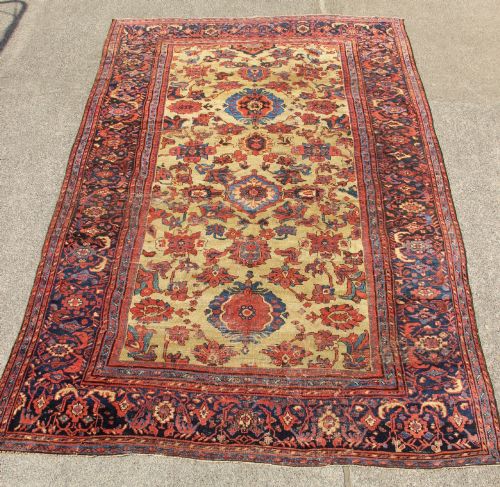
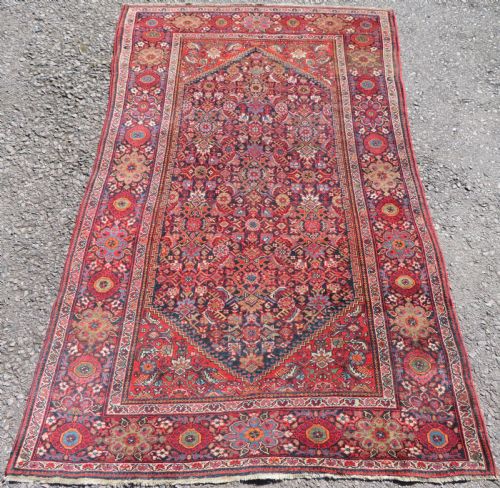


Herati Pattern Wool Rug
A herati pattern wool rug brings centuries of Persian village and town weaving tradition directly onto your floor through its intricate floral trellis design.
Herati Pattern Wool Rug
When you search for a herati pattern wool rug, you are looking at floor coverings defined by a distinctive motif composed of a central rosette enclosed by a diamond lattice, flanked by curved lancet leaves often likened to fish. The pieces on this page span from the nineteenth century into the early twentieth century, originating from Persian weaving centres and tribal regions such as Fereghan, Malayer, Senneh, Bidjar and Afshar.
The format ranges from small village pushtis and scatter rugs to generous gallery carpets and long kellehs. You are most likely to encounter traditional Persian room-sized or scatter formats displaying either an all-over repeating herati layout or the motif arranged around a central medallion.
How they were made
These textiles are constructed using natural wool for the pile, foundations and wefts, frequently combined with cotton warp threads in town workshops to ensure structural stability. Weavers knotted the wool by hand onto the vertical looms, using symmetrical or asymmetrical knots depending on the specific tribal or urban origin.
The wool itself provides a dense, resilient surface that absorbs natural dyes deeply, allowing the intricate geometry of the herati motif to maintain clarity across decades of use.
Listings span from the nineteenth century up to the nineteen-thirties, constructed entirely in wool and cotton.
What varies in quality
The standard of a weaving depends upon the density of the knotting and the precision with which the curved lines of the herati motif are rendered. Finer knot counts allow complex floral details and lattice work to appear sharp and well-defined.
Material selection also dictates the grade, as high-grade wool yields a softer handle and a more luminous depth of colour, whereas coarser village pieces prioritise sturdy utility over intricate curvilinear refinement.
Malayer village·Senneh weavers·Bidjar workshops·Afshar tribes
The Herati Pattern Wool Rug Glossary
- Herati pattern
- A repeating decorative motif consisting of a central flowerhead inside a diamond, flanked by curved leaves. It remains one of the most enduring designs in Persian carpet history.
- Kelleh
- A long, narrow carpet format traditionally used in Persian domestic interiors. These pieces typically measure substantially longer than they are wide.
- Pushti
- A small Persian mat or rug, often used as a cushion or placed on a small section of the floor. They frequently display dense village or tribal patterns.
- Warp
- The vertical foundation threads stretched tightly on the loom before knotting begins. Cotton and wool are the primary materials found in these listings.
- Kilim
- A flat-woven carpet produced without a raised pile. These items rely entirely on the interweaving of warp and weft threads to create the design.
Herati Pattern Wool Rug: Frequently Asked Questions
What is the herati pattern?
The herati pattern is a traditional Persian design featuring a central flower surrounded by a diamond lattice and curved leaves. It has been woven across various regions for centuries.
The motif appears in both all-over repeating formats and centred layouts within town carpets and village tribal rugs alike.
Where were these rugs made?
These textiles originate from nineteenth and early twentieth-century Persia, spanning specific weaving centres and tribal areas. Towns like Senneh and Bidjar produced distinct variations.
Nomadic and village groups such as the Afshar and Malayer also adapted the design within their own local weaving traditions.
How do I care for wool rugs?
Wool rugs require gentle regular vacuuming without a rotating brush roll to protect the pile. Professional cleaning is recommended when dirt settles deep into the foundation.
Keeping the textile out of direct, harsh sunlight helps preserve the natural dyes used in the wool over time.
How are different origins identified?
Origins are typically told through structural characteristics, including knot density, materials used in the foundation, and colour palettes. Village pieces often display bolder, more geometric interpretations.
Town carpets from centres like Fereghan show finer detail and a more fluid rendering of the curvilinear lattice work.