




Hepplewhite Style Commode
These hepplewhite style commodes bring refined serpentine lines and figured timbers into a room, offering both practical storage and classical elegance.

Hepplewhite Style Commode
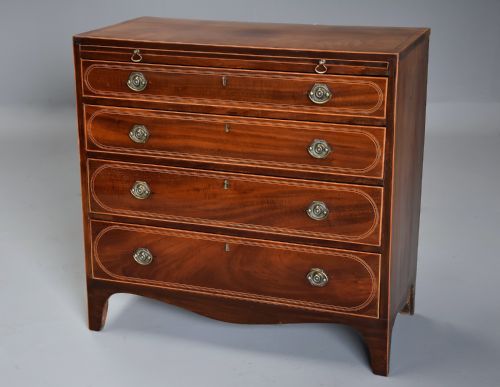
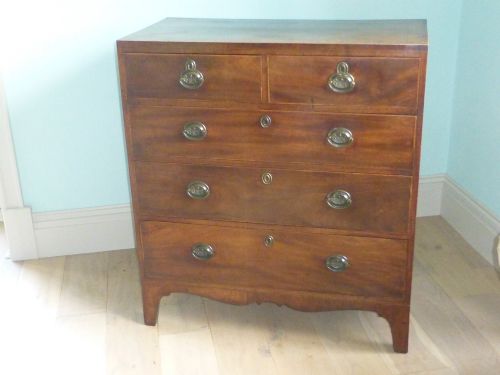
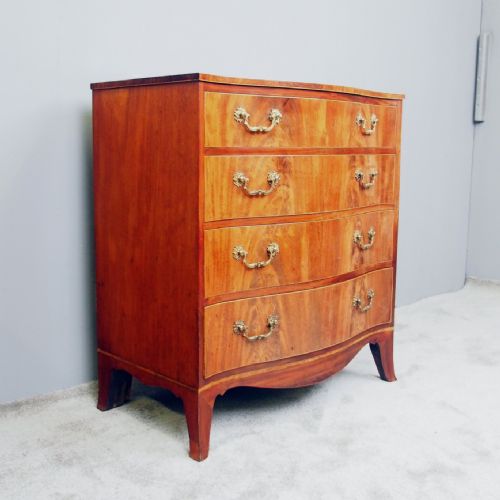
A hepplewhite style commode is a refined storage piece, most frequently appearing here as a serpentine or bowfront chest of drawers dating from the Georgian period through to Edwardian revivals. These cabinets draw upon the graceful proportions and classical forms popular in the late eighteenth century, interpreted by later makers in both original eighteenth-century workshops and nineteenth-century revival periods.
The primary forms you will encounter on this page include serpentine chests of drawers, bedside cabinets, writing cabinets, and side cupboards. Their silhouettes are defined by gentle curves and tapered supports rather than heavy square corners, bringing a lighter architectural presence to domestic interiors.
How they were made
Cabinetmakers relied on rich solid timbers and veneers, predominantly working with mahogany and flame mahogany veneer to create deep visual movement across the drawer fronts and top surfaces. Selected sections were enhanced with contrasting satinwood inlay and boxwood stringing, creating delicate geometric borders that frame the principal panels.
Structural integrity was paired with decorative metalwork through the use of cast brass handles and escutcheons. Drawers were constructed with traditional hand-cut dovetails, while curved fronts required specialist shaping of the solid timber and veneer layers to achieve the signature serpentine outline.
Hepplewhite Style Commode Retail Price Guide 2026
Typical asking prices for hepplewhite style commode among the pieces listed under this phrase on Sellingantiques today, from the lower quarter to the upper quarter. They describe what is for sale here now, not the wider market.
Listings span the Georgian period, the nineteenth century, and Edwardian revivals, uniting mahogany, satinwood, and brass.
What varies in quality
Quality in these commodes rests upon the selection of timber figures and the precision of the contrasting inlay work. Superior examples display carefully matched flame mahogany veneers that flow naturally across the drawer fronts, complemented by crisp boxwood and satinwood stringing without lifting or misalignment.
The handling of the serpentine curve marks the difference between standard and exceptional pieces. Finer cabinets maintain fluid, symmetrical movement across the front and sides, paired with substantial brass hardware and well-proportioned bracket feet that ground the piece harmoniously.
Druce & Co
The Hepplewhite Style Commode Glossary
- Serpentine
- A furniture front characterised by a wavy outline with a convex centre flanked by concave curves. This shaping requires considerable woodworking skill to execute cleanly in solid mahogany.
- Flame mahogany
- A distinct veneer cut from the fork of the mahogany tree where the branch meets the trunk. It creates a vivid, feather-like flame pattern prized for principal drawer fronts.
- Stringing
- A narrow inlay of contrasting wood, such as boxwood, set flush into the surface of the primary timber. It outlines panels and drawer edges in classical cabinetmaking.
- Bowfront
- A convex, outwardly curved furniture front that swells forward from the corners. This form softens the profile of a standard chest of drawers.
- Dovetail
- A traditional interlocking joint used to secure drawer corners together. Hand-cut variations indicate earlier or more bespoke craftsmanship.
Hepplewhite Style Commode: Frequently Asked Questions
What is a serpentine commode?
A serpentine commode is a low cabinet or chest of drawers featuring a wavy front profile with outward and inward curves. This shape requires advanced woodworking techniques to achieve balanced proportions.
Such pieces were designed to serve both functional storage roles and decorative display functions within principal rooms of the house.
How do I spot a revival piece?
Revival pieces, dating from the Victorian and Edwardian eras, often combine eighteenth-century stylistic cues with machine-assisted construction methods or specific secondary timbers. Examining the interior linings and drawer joints helps clarify the manufacturing period.
Comparing the timber patination and hardware style against known eighteenth-century benchmarks also assists in distinguishing original work from later interpretations.
Where should I place a bedside cabinet?
Bedside cabinets and small cupboards function well beside low bed frames where their enclosed storage keeps surfaces clear. Their finished backs and detailed side panels allow them to sit openly within a bedroom scheme.
Ensure you measure the height of your mattress against the cabinet surface to maintain comfortable daily access.
How do I care for mahogany surfaces?
Mahogany responds best to occasional applications of traditional beeswax, which nourishes the timber and maintains a soft sheen without building up heavy chemical layers. Avoid placing these pieces in direct sunlight or near heat sources to prevent the veneers from drying out.
Dusting regularly with a soft, dry cloth protects the delicate boxwood inlay and brass mounts from unnecessary wear.