


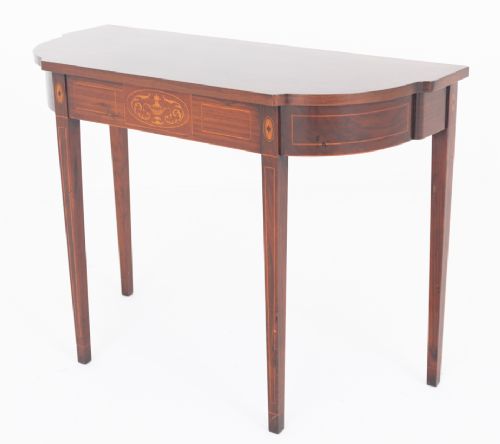
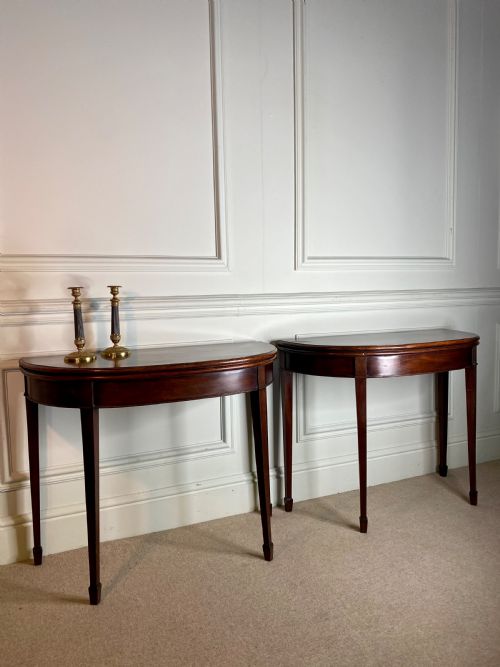

Hepplewhite Demilune Table
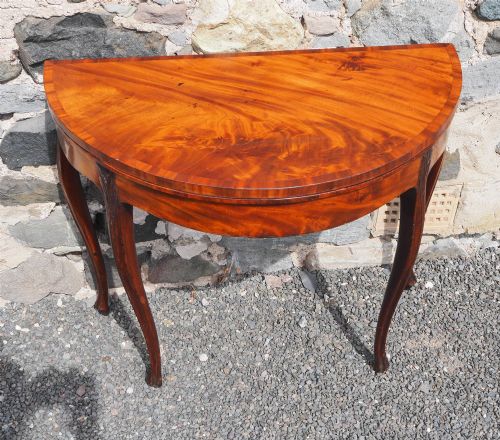
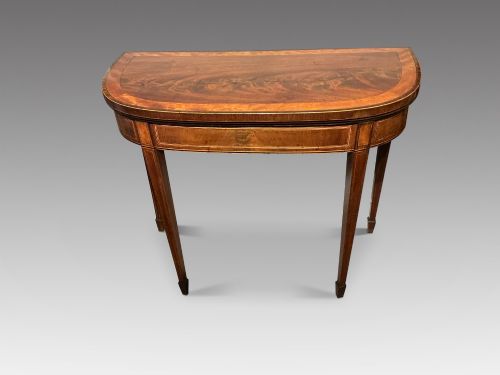
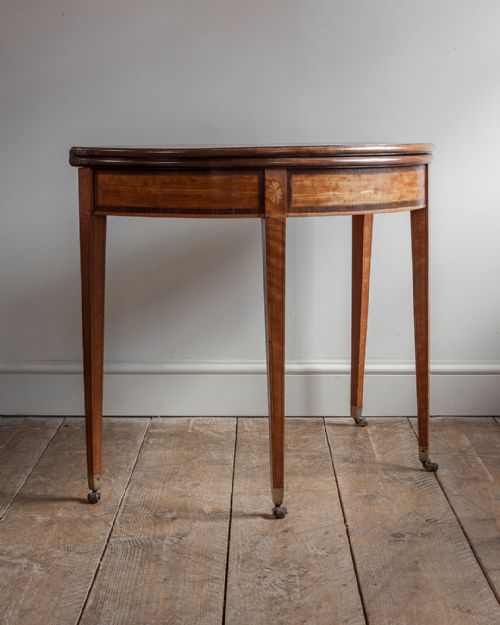
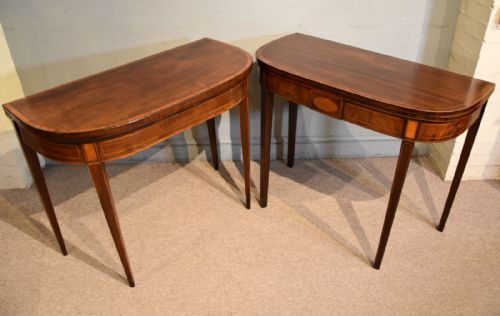
A hepplewhite demilune table offers a graceful crescent silhouette that fits snugly against a wall while adding distinct classical character to a room.
Hepplewhite Demilune Table
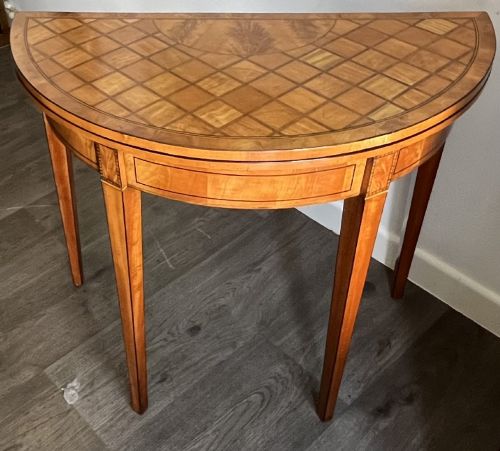
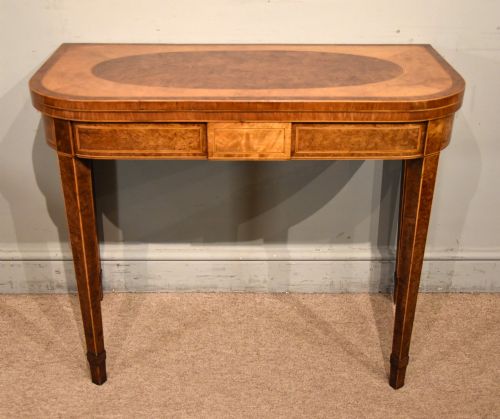
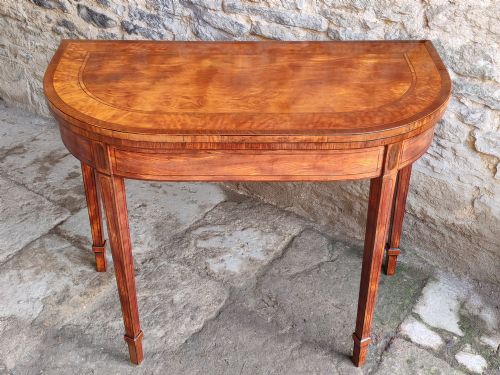
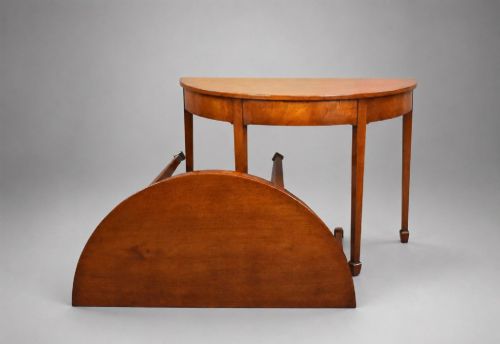
When you search for a hepplewhite demilune table, you encounter half-moon console, card, and tea tables spanning the eighteenth century through later revival periods. These pieces serve primarily as functional side surfaces or folding tables designed to rest against parlour walls.
The selections on this page draw predominantly from Georgian origins alongside Edwardian and later twentieth-century revivals. Mahogany and satinwood form the core of the physical evidence, often enhanced by boxwood inlay and rosewood crossbanding.
Forms vary between simple folding card tables, tea tables with swivel tops, and fixed console tables. The overarching style adheres closely to Georgian neoclassical design principles established during the period.
Materials and Construction
Cabinet makers utilised dense native hardwoods such as mahogany and oak alongside exotic imported veneers like satinwood and rosewood. These timbers were selected for their stability and capacity to take a fine polished finish.
Surface decoration relies heavily on contrasting stringing and banding using boxwood inlay. Joinery techniques from the period ensured sturdy framing for folding leaves and slender tapered legs characteristic of the style.
Hepplewhite Demilune Table Retail Price Guide 2026
Typical asking prices for hepplewhite demilune table among the pieces listed under this phrase on Sellingantiques today, from the lower quarter to the upper quarter. They describe what is for sale here now, not the wider market.
Table forms represented here include fold-over card tables, D-shaped tea tables, and fixed console tables.
Assessing Quality and Execution
The distinction between standard workshop production and superior cabinet work lies in the crispness of the boxwood inlay and the selection of figured timber veneers. Finer examples display balanced grain matching across the curved top and carefully proportioned tapered legs.
Construction integrity in the folding mechanisms and the alignment of the hinged leaves separate well-preserved specimens from heavily altered pieces. The subtlety of neoclassical motifs and hand-painted details further elevate the standing of individual items.
The Hepplewhite Demilune Table Glossary
- Demilune
- Half-moon shape. This curving profile allows tables to sit flush against a wall while occupying minimal floor space.
- Crossbanding
- A strip of veneer applied to the border of a table top with the grain running perpendicular to the centre panel. This technique creates a neat framing effect.
- Card Table
- A folding table designed for evening games. These typically feature a baize-lined interior and a fold-over top supported by a swinging rear leg.
- Stringing
- Thin inlaid lines of contrasting wood used to outline geometric panels and table edges. Boxwood is frequently utilised for this purpose.
- Neoclassical
- A style inspired by classical antiquity that gained prominence during the Georgian period. It emphasises symmetry, straight tapered legs, and restrained ornamentation.
Hepplewhite Demilune Table: Frequently Asked Questions
Where should I place a demilune table?
These tables suit narrow entrance halls, living room perimeters, or beneath large wall mirrors where their curved profile softens rigid corners.
Because they sit flat against a wall, they provide a convenient surface for lamps or decorative objects without obstructing pathways.
How do fold-over card tables function?
The hinged top unfolds to double the surface area, resting upon a pivoting rear leg or gateleg mechanism that swings out to bear the weight.
Historically, these were swung open only during card games and kept closed against the wall at other times.
What is the difference between original and revival periods?
Original pieces date from the eighteenth century around the Georgian era, displaying period-specific construction methods and authentic timber ageing.
Revival versions, produced during Edwardian times or the twentieth century, emulate these earlier aesthetics using slightly different internal framing.
How do I identify satinwood?
Satinwood is a dense hardwood known for its pale golden yellow colour and distinctive chatoyant sheen that reflects light across the grain.
It was frequently used as a primary veneer on finer eighteenth-century and revival table tops.