

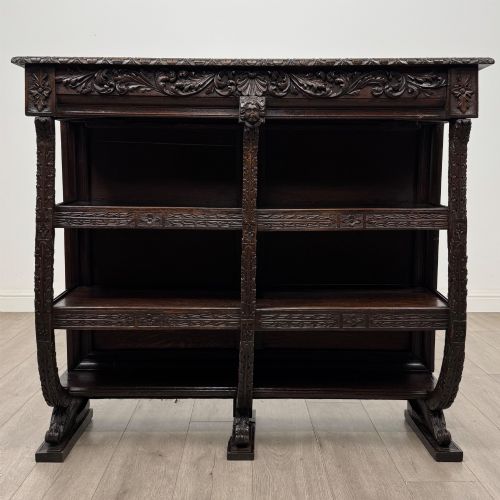


Heavy Oak Shelves
Heavy oak shelves bring genuine substance and architectural weight to a room, offering sturdy timber and deep carving built to last.
Heavy Oak Shelves
Heavy oak shelves and bookcases anchor a room with substantial timber and functional storage for large libraries or display collections. When searching for heavy oak shelves, buyers encounter substantial bookcases, wall shelves, and open library units built primarily during the nineteenth century.
The pieces on offer span the Victorian era, the 1870s, the 1880s, and extend back to the seventeenth century for wall shelf formats. Most examples take the form of open library bookcases, breakfront configurations, or carved wall-mounted shelving.
Makers and cabinetmakers drew upon Victorian, Renaissance Revival, and Gothic Revival styles to embellish these heavy timber constructions. Buyers are most likely to meet large nineteenth-century open bookcases featuring extensive hand carving.
How they were made
Makers utilised solid oak as the primary structural material, relying on its dense grain to support heavy volumes without sagging. Secondary materials appear sparingly, with glass used for front panels where specified and brass employed for functional hardware.
Cabinetmakers shaped these pieces using traditional hand-carving techniques to apply Renaissance Revival and Victorian Gothic ornamentation directly to the timber. Adjustable shelving mechanisms and breakfront layouts required precise joinery to handle the considerable weight of the oak.
Heavy Oak Shelves Retail Price Guide 2026
Typical asking prices for heavy oak shelves among the pieces listed under this phrase on Sellingantiques today, from the lower quarter to the upper quarter. They describe what is for sale here now, not the wider market.
Some nineteenth-century library shelves still bear the faint, comforting scent of pipe tobacco absorbed during decades spent inside country house studies.
What varies in quality
Quality in heavy oak shelves rests upon the depth, crispness, and artistic ambition of the carved ornament applied to the timber. Pieces originating from prominent commissions or country house libraries exhibit superior proportion and more elaborate architectural detailing.
The choice of timber stock and the structural integrity of the breakfront or open framework dictate the long-term durability of each piece. Superior examples maintain tight joints and well-figured grain that responds successfully to the substantial scale of the design.
The Heavy Oak Shelves Glossary
- Breakfront
- A piece of furniture whose central section projects forward from the flanking wings. This architectural arrangement creates dynamic shadow and depth across the façade of large bookcases.
- Renaissance Revival
- A nineteenth-century design style drawing inspiration from sixteenth-century classical architecture and ornament. It manifests in heavy carved relief, pilasters, and formal symmetry.
- Gothic Revival
- An architectural and decorative style mimicking medieval Gothic forms with pointed arches and tracery. On these pieces, it translates into solemn, vertical lines and dark oak patination.
- Plate rack
- A wall-mounted or freestanding shelving unit designed specifically to display plates upright. These frames utilise timber grooves to hold ceramic pieces securely.
- Open bookcase
- A shelving unit lacking front doors, designed for immediate access to books. This form became particularly popular for institutional and private libraries during the Victorian period.
Heavy Oak Shelves: Frequently Asked Questions
How do I support heavy books safely?
Solid oak construction naturally provides the robust weight capacity required for large volumes and heavy reference books. Adjustable shelving systems allow you to configure vertical spacing to distribute the load evenly across the structure.
Ensure the unit stands on a level floor and, where necessary given the height, secure the bookcase to the wall to prevent tipping under heavy loads.
Are these shelves difficult to move?
These pieces consist of dense, solid oak and often feature grand proportions, making them exceptionally heavy to transport. Many large library bookcases do not dismantle easily, requiring careful planning and multiple pairs of hands for relocation.
Measure doorways and ceiling heights in your room before purchase to ensure the assembled timber unit fits through your access routes.
How do I care for nineteenth-century oak?
Maintain the timber by dusting regularly with a dry, soft cloth to prevent grit accumulation in the deep carvings. Avoid placing oak furniture in direct sunlight or near heat sources, which can dry out the historic wood and cause splitting.
Apply a traditional beeswax polish sparingly when the surface appears dry, buffing it gently to preserve the natural lustre of the grain.
How do I date a carved oak bookcase?
Examine the style of the carving and the construction methods visible on the interior and reverse of the carcass. Nineteenth-century pieces frequently combine machinery-assisted preparation with hand-finished Victorian or Gothic Revival detailing, while seventeenth-century wall shelves display earlier hand- Hewn peg joinery.
Look for tool marks, backboards, and hardware types to help distinguish between an 1870s library piece and an earlier antique.