
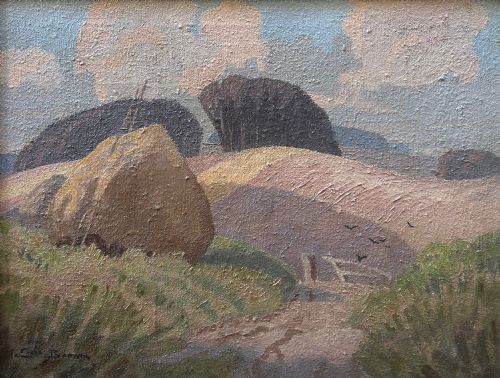


Haystack Landscape Painting
A haystack landscape painting captures the rural rhythm of harvest time through the quiet presence of stacked straw and rural fields.
Haystack Landscape Painting
A haystack landscape painting records the agricultural scenes of the nineteenth and twentieth centuries, showing fields, farmhouses, and rural laborers at work. These works capture the seasonal harvest across British and French countryside settings.
The most common examples on this page are oil paintings on canvas and wood panel, alongside watercolours on paper. They range from Victorian views to twentieth-century realist and impressionist interpretations.
The subjects focus on country life, featuring stacked hay, cornfields, and pastoral settings handled by regional artists and continental painters alike.
Materials and Technique
Artists relied primarily on oil paint applied to canvas or wood panel, as well as watercolour on paper. These materials allowed painters to render natural light and atmospheric conditions in the open air.
Gilt wood frames frequently complete these pieces, providing a traditional border that reflects the period of creation. The brushwork varies from tight Victorian detail to looser impressionist applications.
A duck picnic occasionally interrupts the harvest.
Evaluating Quality
Quality rests in the artist's handling of light, shadow, and spatial depth within the rural composition. Stronger works demonstrate a confident command of tone that brings the harvest scene to life.
The handling of the painted surface, whether through impasto texture in oils or delicate washes in watercolour, distinguishes accomplished regional pieces from standard decorative works.
William Greaves·Helmut Reuter·Arthur Walker Redgate·Frederick W. Jackson·Wilmot Pilsbury·Fred Lawson·Émile Bouche·J. Lawrence Hart·Walter Wallor Caffyn·John Dobby Walker·David Cox Jnr·Mary Backhouse Bigland
The Haystack Landscape Painting Glossary
- Impasto
- Paint applied thickly to a canvas or panel, standing out from the surface to catch physical light and create texture. This technique is often seen in French impressionist works.
- Watercolour
- A paint consisting of pigment suspended in a water-based solution, typically worked on paper to achieve translucent effects. It was widely used for rapid landscape studies.
- Panel
- A flat piece of wood used as a rigid support for oil painting before canvas became standard. It provides a stable surface for detailed brushwork.
- Gilt wood
- Wood carved and coated with gold leaf or gold-coloured metallic finish to form a decorative picture frame. These frames often match the age of the artwork.
- Pastoral
- A genre of art depicting the rural countryside, farms, and agricultural labour in an idealized or rustic manner. Haystacks form a central motif in these scenes.
Haystack Landscape Painting: Frequently Asked Questions
What is a haystack landscape painting?
A haystack landscape painting is an artwork depicting agricultural scenes centred around harvested hay. These pieces record rural life and farming landscapes from the nineteenth and twentieth centuries.
They offer a window into historical farming practices and rural topography through the eyes of regional and impressionist artists.
How were these paintings created?
Artists used oil paint on canvas or wood panel, and watercolour on paper, to capture outdoor light and rural scenery. Many were painted in the open air to observe natural weather and seasonal shifts.
Brush techniques range from fine Victorian detail to looser impressionist and post-impressionist applications.
How do I date a haystack painting?
Dating relies on stylistic clues, artist signatures, framing, and the physical materials used in the support and pigments. Victorian works display different handling compared to twentieth-century realist pieces.
Examine the back of the canvas or panel for signatures, dates, exhibition labels, and framer stamps that provide historical context.
Where were these rural scenes painted?
These landscapes were painted across various rural regions in Britain, including Yorkshire and Hampshire, as well as continental locations like Brittany and Provence.
Artists travelled to farming communities to record local harvests, hayfields, and rural laborers at work.
How should I care for an oil painting?
Keep oil paintings away from direct sunlight and extreme fluctuations in temperature and humidity to protect the canvas and paint layers. Dust the surface gently with a soft, dry brush when needed.
Avoid using water or chemical cleaners on the painted surface or the gilt wood frame.