



Harvest Landscape Oil
A harvest landscape oil captures the golden labour of the fields, bringing agricultural tradition and natural light directly onto the wall.
Harvest Landscape Oil
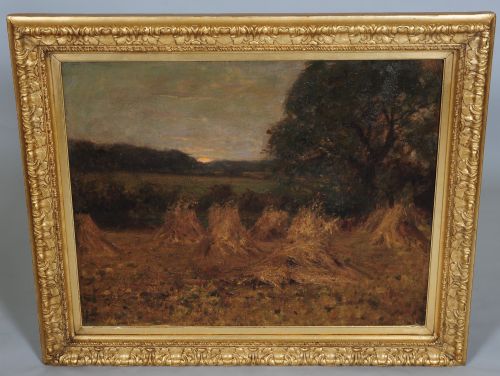
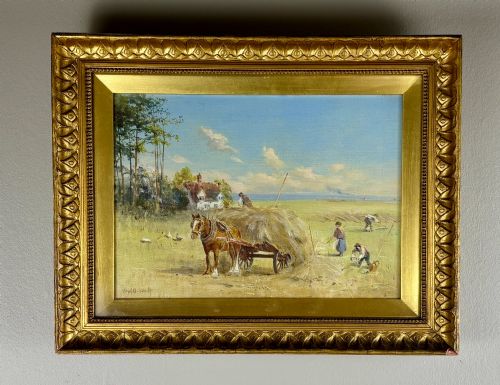
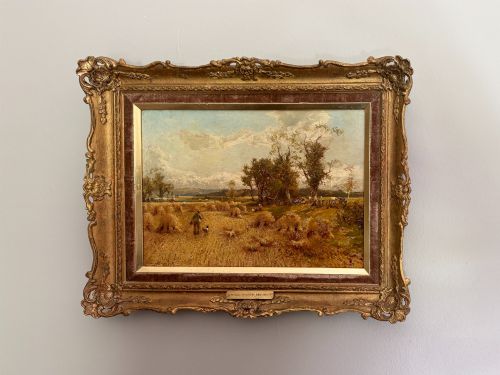
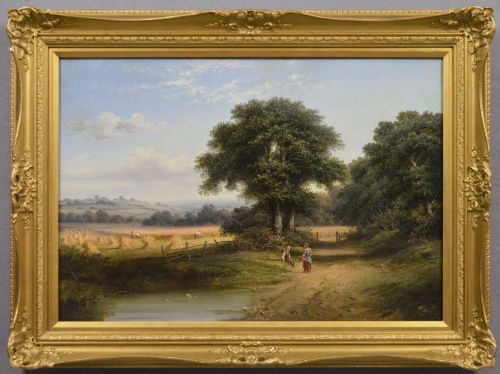
A harvest landscape oil depicts rural scenes of agricultural work, typically featuring haymaking, cornfields, and figures gathering crops during the nineteenth and twentieth centuries. These paintings capture a vanished agrarian rhythm through oil paint applied to canvas or wood panel, often housed in period frames.
The most common examples on this page date from the Victorian and Edwardian periods, extending into mid twentieth-century interpretations. They range from intimate pastoral views of English river valleys to broader Scottish and continental depictions of farm labourers at work.
Subject matter frequently includes hayricks, cornfields, horses, and figures resting near the harvest, reflecting a deep Victorian and Edwardian preoccupation with rural naturalism and impressionist realism.
How They Were Made
Artists painted primarily with oil paint on stretched canvas or prepared wood panels, building texture with brushwork and occasionally palette knives. This medium allowed painters to capture the changing light of late summer fields and the earthy tones of soil and wheat.
Harvest Landscape Oil Retail Price Guide 2026
Typical asking prices for harvest landscape oil among the pieces listed under this phrase on Sellingantiques today, from the lower quarter to the upper quarter. They describe what is for sale here now, not the wider market.
Several harvest scenes manage to include remarkably well-behaved farm dogs sitting patiently beside nineteenth-century haymakers.
What Varies in Quality
Quality rests in the handling of light and atmospheric perspective, distinguishing a flat record from a canvas that conveys the oppressive heat or low sun of late summer. Superior brushwork creates convincing depth in fields and skies, whereas weaker compositions rely on stiff formulae.
The integration of human figures and animals within the landscape marks another distinction, as skilled painters render farmworkers and horses with anatomical accuracy and natural postures. Frame preservation also plays a part, with original giltwood frames enhancing the integrity of the piece.
Walter Heath Williams·Henry John Boddington·William Grant Murray·James William Booth·Henry H Parker·Helmut Reuter·Herbert Royle·Frederick J Knowles·Joseph Paulman·Henry John Kinnaird·Frederick William Jackson·Arthur Walker Redgate·George Cole·William Greaves·William Savage Cooper·Joseph Thors·Alfred Augustus Glendening Snr·William Kay Blacklock·John Clayton Adams·John Gilbey Bowles·Carsten Henrichsen·J Brooke·Hamilton Jay·Bertha Rhodes Carrick·Charles H Passey
The Harvest Landscape Oil Glossary
- Canvas
- A heavy woven fabric stretched across a wooden frame to serve as a sturdy surface for oil paint.
- Giltwood
- Wood carved and coated with gold leaf or metallic paint, frequently used for ornate Victorian picture frames.
- Impressionism
- A style of painting emphasising immediate visual impressions through unblended colour and short brush strokes, visible in late nineteenth and early twentieth century works.
- Wood Panel
- A rigid flat wooden support used by artists before stretched canvas became universal, or alongside it in smaller works.
Harvest Landscape Oil: Frequently Asked Questions
What periods do these paintings cover?
The works span from the mid nineteenth century through the Edwardian era and into the mid twentieth century. Styles shift from Victorian pastoral and rural naturalism towards British and Scottish impressionism.
Dates on these pieces stretch across several decades, showing how artists returned persistently to agricultural themes as industrialisation transformed the countryside.
How should I care for an oil painting?
Keep paintings away from direct sunlight and sudden changes in temperature or humidity, which can crack both the oil paint and the wooden stretcher. Dust the surface gently with a soft, dry brush without applying pressure.
Avoid using water or chemical cleaners on the canvas or the giltwood frame. Professional conservators should handle any deeper cleaning or varnish removal.
Are these paintings signed by the artists?
Many pieces feature artist signatures or monograms, often placed discreetly in a lower corner of the canvas. Documentation from period exhibitions or dealer records occasionally accompanies signed works.
Unsigned paintings also appear, attributed through stylistic comparisons, subject matter, and the specific geographic regions depicted in the landscape.
What subjects besides wheat fields appear?
Artists frequently painted haymaking scenes, featuring hayricks, horse-drawn carts, and farmworkers taking breaks near rivers or coastlines. Hop-picking and peat harvesting also feature in specific regional depictions.
Skies range from bright midday glare to approaching storms and quiet autumn sunsets over valleys and cornfields.