
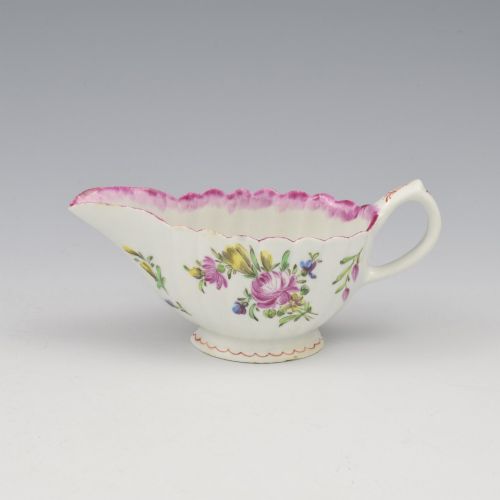
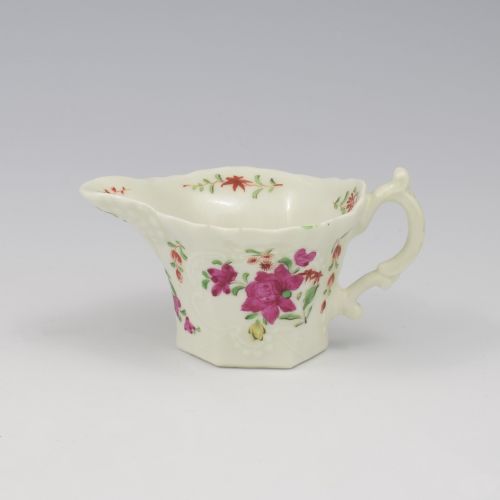
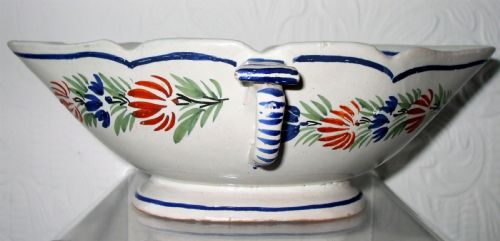


Hand Painted Sauceboat
A hand painted sauceboat brings centuries of dining craft to the table, combining sculptural forms with delicate ceramic painting.
Hand Painted Sauceboat
A hand painted sauceboat is a small vessel designed for serving gravies, sauces, or cream at the dining table, appearing in forms such as sauceboats, cream boats, and jugs. When you search for a hand painted sauceboat, you encounter pieces originating from eighteenth and nineteenth century production centres.
The selection on this page centres heavily upon eighteenth century porcelain, featuring notable English factories like Bow, Worcester, Chelsea Derby, and Derby alongside Chinese Export wares. Alongside these porcelain examples, nineteenth century pieces include French faience double sauceboats bearing the HB mark from Quimper.
Forms vary from fluted and hexagonal profiles to whimsical lettuce leaf designs and dolphin ewers with lamprey handles. Decoration ranges from blue and white transfer prints and cobalt glazes to polychrome Chinese figures, famille rose armorials, and Kakiemon quail patterns.
How they were made
These vessels are fashioned from soft paste porcelain, hard porcelain, earthenware, or faience, shaped through moulding or throwing before receiving their initial firing. Potters then apply manual brushwork using enamel pigments, cobalt glaze, or underglaze blue, capturing intricate motifs directly onto the ceramic body.
A subsequent glazing and firing process seals the pigments beneath a vitreous coating, imparting the characteristic glossy sheen found on eighteenth and nineteenth century serveware. Artisans in English factories and French workshops utilised hand-mixed mineral colours, leading to subtle variations in tone across individual pieces.
Some eighteenth century potters turned mundane kitchen grease catchers into swimming marine fantasies complete with wriggling lamprey handles.
What varies in quality
Quality in these serveware pieces rests upon the crispness of the moulded form and the precision of the hand painted brushwork. Early soft paste porcelain examples with complex relief work, such as lamprey handles or lettuce leaf texturing, demonstrate superior sculptural ambition from the potter.
The clarity of the cobalt glaze or the vibrancy of enamel palettes distinguishes standard production from finer cabinet pieces. Furthermore, the sophistication of painted details - whether intricate Chinese figures, armorials, or Quoil patterns - dictates the artistic standing of each boat.
Bow Porcelain·Chelsea Derby·Quimper French Faience
The Hand Painted Sauceboat Glossary
- Soft-paste porcelain
- An artificial porcelain body composed of white clay and glass frit, fired at lower temperatures than true hard-paste porcelain. This material creates a warm, creamy translucency typical of eighteenth century English factories.
- Faience
- Tin-glazed earthenware produced widely in France and continental Europe. It offers an opaque white surface that accepts painted enamel decoration with distinct softness.
- Famille rose
- A palette of opaque enamels introduced in Chinese ceramics during the Qing dynasty, dominated by pink or rose tones mixed from gold. It appears frequently on export porcelain destined for European dining tables.
- Kakiemon
- A Japanese enamel style characterised by asymmetrical floral, bird, and quail motifs on a milky white porcelain ground, which eighteenth century European factories imitated closely.
- Cobalt glaze
- A deep blue metallic oxide pigment applied under or over the glaze before firing, yielding rich blue tones that withstand high kiln temperatures without fading.
- Dolphin ewer
- A sculptural vessel form incorporating a sea creature or dolphin motif into the body, often featuring a scrolled handle shaped like a lamprey.
Hand Painted Sauceboat: Frequently Asked Questions
What is a cream boat?
A cream boat is a smaller variation of the sauceboat, historically intended for serving cream rather than savoury gravies or sauces at the table. These compact vessels share the same delicate painted decoration and moulded forms as their larger counterparts.
Potters shaped them with spouts and handles suited for pouring dairy products during tea or breakfast service. They represent an intimate subset of eighteenth century serveware.
How do I date an 18th century sauceboat?
Dating relies upon examining the ceramic body, the composition of the glaze, and the stylistic attributes of the hand painted decoration. Soft-paste porcelain bodies often display characteristic translucency and minor kiln flaws unique to early production methods.
Maker marks, where present, alongside specific pattern names like Doughnut Tree or Mandarin figures, help narrow the decade of creation. Comparing the moulded handle and spout shapes against known factory periods provides further chronological context.
Were these pieces used for dining?
These vessels were created primarily for functional dining use among wealthy households during the Georgian and Regency eras. They held gravies, drawn butter, sauces, or cream, forming part of coordinated table services.
Over time, many surviving examples transitioned from active dining service into cabinet display pieces due to their fragile porcelain and faience construction. Their intricate hand painted designs made them prized decorative objects as well as practical tableware.
What is Chinese Export porcelain?
Chinese Export porcelain refers to ceramics manufactured in China specifically for European and American markets during the Qing dynasty, particularly the Qianlong period. These pieces frequently combined traditional Chinese manufacturing techniques with European shapes and armorial commissions.
Sauceboats in this style exhibit distinct famille rose enamels or blue and white painting tailored to Western dining customs. They highlight global trade routes and cross-cultural design exchanges in the eighteenth century.