

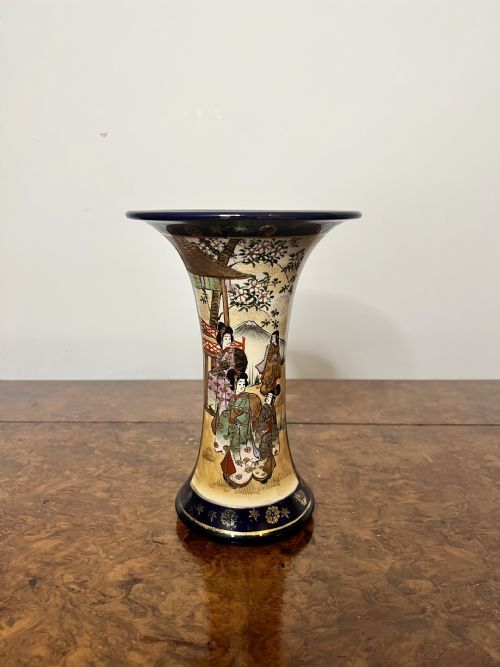


Hand Painted Satsuma Vessel
A hand painted satsuma vessel brings together fine earthenware, intricate enamel, and rich gilding from the Meiji and Taisho periods.
Hand Painted Satsuma Vessel
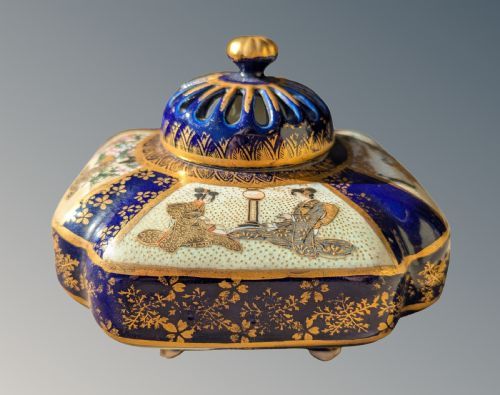
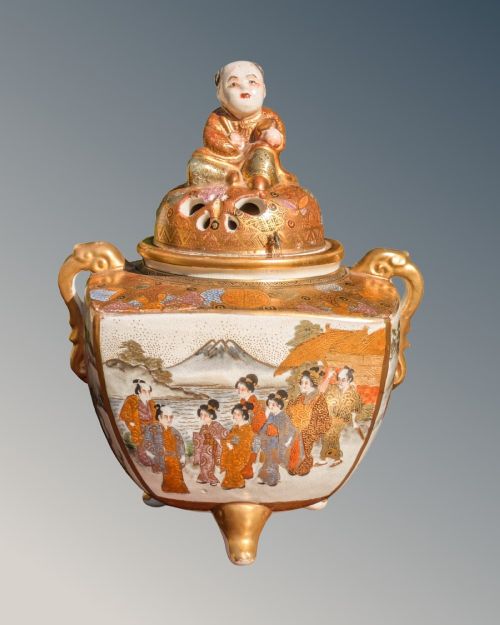
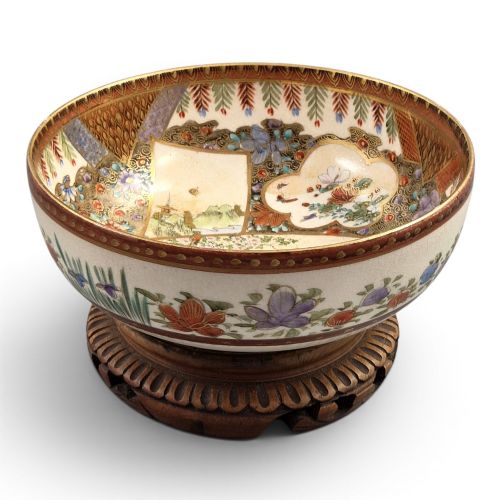
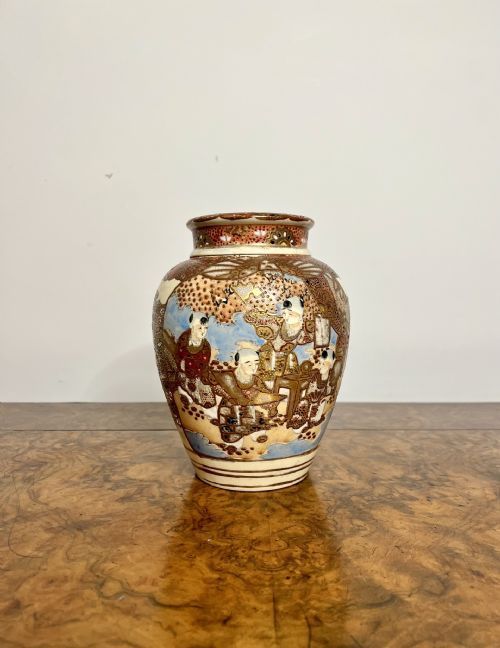
A hand painted satsuma vessel is a ceramic object originating from Japan, commonly appearing here as vases, incense burners, bowls, and tea caddies dating from the nineteenth century into the early twentieth century. When searching for a hand painted satsuma vessel, collectors encounter forms ranging from monumental bowls and lidded jars to miniature vases and intricate koro.
The pieces on this page span the Meiji and Taisho periods, as well as the Victorian era, reflecting the distinct aesthetic output of Japanese workshops operating around eighteen-ninety to nineteen-twenty. Makers produced these items using earthenware and porcelain bases, decorated with meticulous hand-painted details that often depict figural processions, battle scenes, and family scenes.
Vessels take many shapes, including globular vases, footed bowl burners, ginger jars, and natsume tea caddies, each demonstrating specific utility or purely decorative intent. The presence of handles, covers, and intricate signatures connects these items directly to historical production centres such as Kyoto.
Materials and Construction
Artisans constructed a hand painted satsuma vessel using earthenware or porcelain, forming the clay body before applying specialised glazes that provided the characteristic crackle surface. This absorbent ceramic base was then ready to receive detailed polychrome enamel pigments.
The ornamentation relied heavily on gold leaf, gilding, and raised enamel work to create elaborate borders, robes, and backgrounds. Painters executed miniature figural scenes and motifs by hand, occasionally incorporating the Shimazu mon or artist signatures directly into the design before a final firing.
Listings feature items dated across the nineteenth century, nineteen hundred, nineteen ten, and nineteen twenty, spanning the Meiji and Taisho periods.
Assessing Quality and Execution
Quality in a hand painted satsuma vessel rests upon the precision and complexity of the enamel work and the fineness of the gilding. Superior examples display exceptionally controlled brushwork in miniature figural processions or battle scenes, where every facial expression and piece of armour remains crisp.
The reputation of the workshop also dictates standing, with pieces carrying marks from notable makers such as Kinkozan, Kizan, Kozan, and Chosei commanding particular attention for their superior clay bodies and artistic depth. Furthermore, the overall preservation of the delicate gilt lines and the clarity of the underlying glaze crackle influence the standing of any given piece.
Kizan·Kinkozan·Kozan·Chosei
The Hand Painted Satsuma Vessel Glossary
- Koro
- An incense burner featuring a body, a perforated lid, and often small feet. These vessels were utilised in traditional settings and frequently display intricate openwork or handles.
- Natsume
- A small tea caddy traditionally used in Japanese tea ceremonies. This form is named after the jujube fruit due to its rounded profile.
- Meiji Period
- The era in Japanese history spanning from eighteen sixty-eight to nineteen twelve. Pieces from this time are celebrated for their highly detailed decorative arts.
- Shimazu Mon
- The heraldic crest of the Shimazu clan, featuring a cross within a circle. This mark often appears on high-quality items associated with the Satsuma domain.
- Gilding
- The application of gold leaf or gold paint to the surface of the ceramic. This technique highlights borders, robes, and background motifs.
Hand Painted Satsuma Vessel: Frequently Asked Questions
What is a satsuma vessel?
A satsuma vessel is a Japanese ceramic item made from earthenware or porcelain, traditionally decorated with elaborate hand-painted enamel and gold leaf.
These pieces encompass forms such as vases, incense burners, and tea caddies created during the nineteenth and early twentieth centuries.
How do I identify a Meiji period piece?
Meiji period pieces can be identified by their distinct artistic styles, historical signatures, and the manufacturing methods typical of the era between eighteen sixty-eight and nineteen twelve.
Makers from this time often incorporated dense figural processions, intricate gilding, and specific workshop marks into their ceramics.
What is a koro used for?
A koro is a traditional incense burner designed with a fitted lid to allow scented smoke to escape during use.
Many surviving examples function primarily as decorative art objects while retaining their original structural form and pierced covers.
Where were these vessels made?
These ceramic items originated in Japan, with significant production occurring in workshops located around Kyoto.
Master artisans and specific kilns produced items for both domestic use and export during the late nineteenth and early twentieth centuries.