
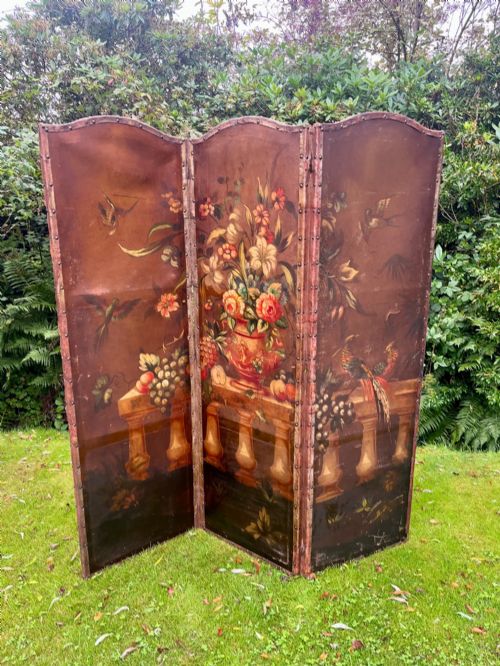

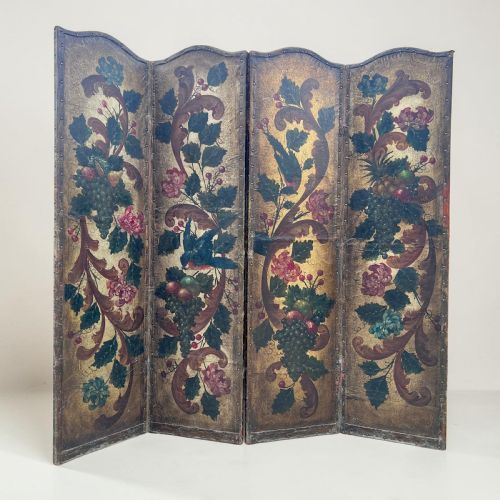
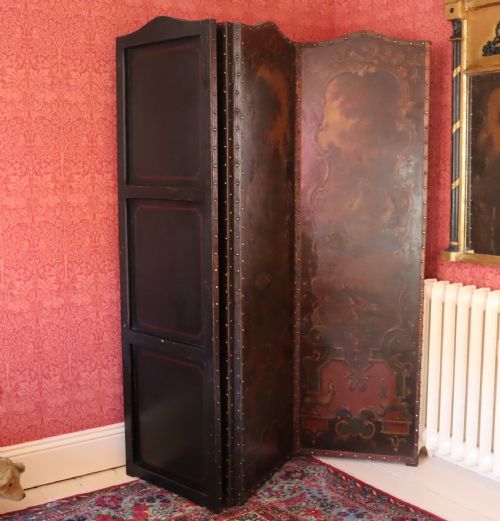


Hand Painted Folding Screen
A hand painted folding screen divides a room with rich brushwork and folding panels, offering both functional privacy and striking wall art.
Hand Painted Folding Screen
A hand painted folding screen creates immediate architectural division in a space while introducing layered pigment and brushwork to an interior. The selection here spans multiple periods, including the eighteenth, nineteenth, and early twentieth centuries, drawing on traditional country house, continental baroque, and Chinese republic eras.
The dominant forms on this page are multi-panel folding screens and room dividers that range from three to four folds. These pieces utilise hinges to allow flexible placement across a floor plan, shifting between flat decorative backdrops and angled partitions.
Origins represented in the evidence stretch from France and Spain to China, India, and Burma, bringing distinct regional painting traditions and structural motifs together. Buyers encounter everything from green and black lacquer grounds to gilt embossed surfaces and simple timber frames.
Materials and construction
Makers constructed the structural framework using sturdy timbers, building panels that could support heavy layers of paint, canvas, or leather. Brass hardware frequently joins the leaves together, allowing smooth articulation across multiple folds.
Surface preparation involved applying oil paint, gold leaf, and lacquer directly onto wood, canvas, or heavy leather substrates. Artisans then executed detailed hand-painted scenes, occasionally employing fretwork or embossing techniques to add physical depth to the finished panel.
Some screens fold away quietly when guests arrive, hiding a messy corner with centuries of accumulated artistry.
Assessing quality and execution
Quality in a hand painted folding screen rests upon the finesse of the brushwork and the stability of the substrate, whether wood, leather, or lacquer. Stronger pieces display confident, detailed application of oil paint or gold leaf that holds its visual weight across every panel.
The integrity of the hinges and the weight-bearing capacity of the individual leaves dictate how well the piece functions as a divider over time. Finer examples maintain structural rigidity within the timber or fretwork while retaining rich surface patination.
The Hand Painted Folding Screen Glossary
- Cordoban leather
- Heavy leather treated with embossing and gilt work, originating from Spanish tanning traditions. It provides a durable, textured surface for elaborate painting.
- Chinoiserie
- European artistic style reflecting Chinese motifs and decorative techniques. This style appears frequently on screens finished in lacquer or oil paint.
- Fretwork
- Ornamental design created by cutting patterns through wood. This technique adds lightness and intricate detail to upper or lower panel sections.
- Lacquer
- Protective and decorative finish applied in multiple coats to create a hard, glossy surface. It often serves as a deep black or coloured background for painted scenes.
Hand Painted Folding Screen: Frequently Asked Questions
How do I place a folding screen?
Position the screen at an angle to create a stable freestanding partition that catches natural light across its painted panels.
Ensure the hinges allow the leaves to fold in both directions so you can adjust the footprint to suit the room.
What materials are common on these screens?
Common materials include wood, leather, canvas, lacquer, brass, and gold leaf.
Painters applied oil paint directly onto these prepared surfaces to build up figurative and decorative compositions.
How do I identify a Victorian screen?
Victorian examples frequently utilise heavy leather or timber panels decorated with hand-painted floral or figurative motifs.
Examine the construction methods and hardware to confirm nineteenth-century origin alongside period stylistic cues.
Can these screens function as wall art?
Many buyers unfold these pieces completely and place them flat against a wall to display the painted artwork.
This approach turns the room divider into a prominent focal point similar to a large canvas.