





Chinese Folding Screen
These pieces of chinese folding screen work as architectural room dividers, dressing screens, and fire screens, bringing layered lacquer and carved detail to an interior.
Chinese Folding Screen
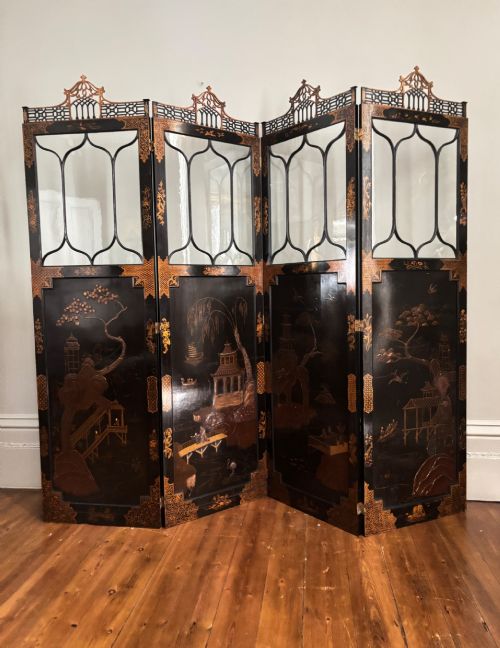
A chinese folding screen functions primarily as a room divider, dressing screen, or fire screen, standing across domestic spaces to divide floors or frame corners. The pieces gathered here span from the eighteenth century through the nineteenth and twentieth centuries, including Regency and Victorian interpretations alongside export and traditional forms.
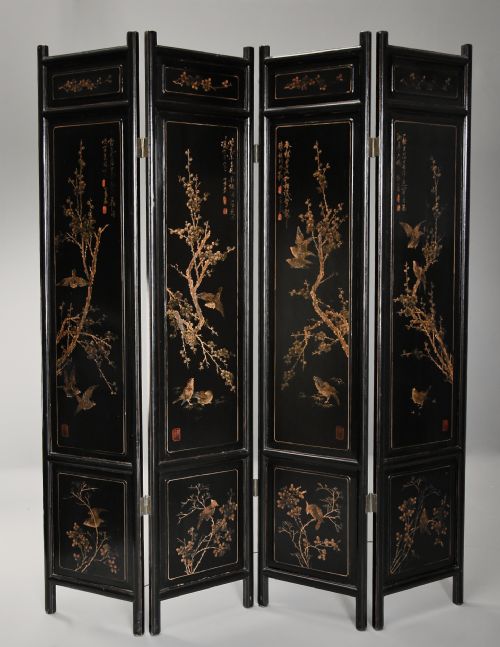
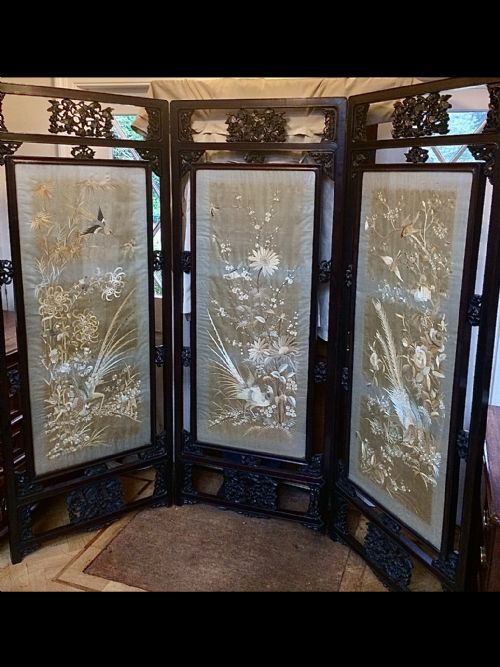
Most examples rely on multiple folding leaves or panels, ranging from compact three-fold dressing screens up to grand eight-fold architectural barriers. Surface decoration typically draws upon Chinoiserie, Qing Dynasty, and Chinese Republic Era aesthetics, incorporating black lacquer, gilt highlights, and carved motifs.
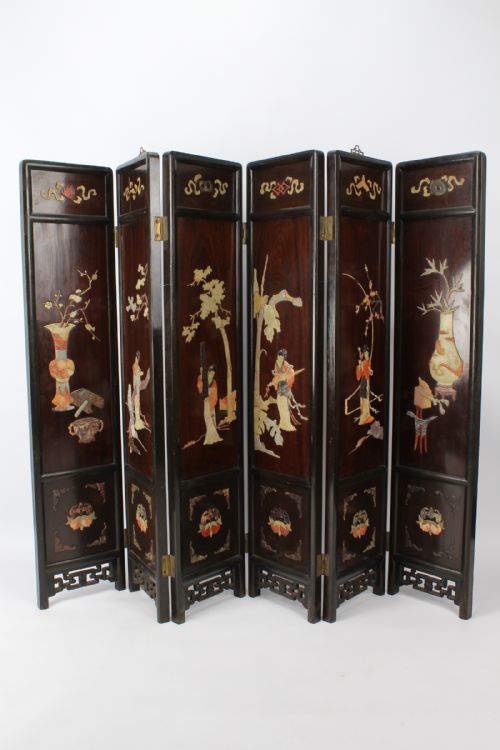
Buyers meet diverse regional and stylistic variations, including Coromandel lacquer panels with deep incised work, hardstone-mounted surfaces, and papier mâché Dressing screens. The selection encompasses both freestanding room dividers and lower domestic fire screens designed for hearth placement.
How they were made
Makers constructed the core structure from timber, utilising hardwood and general wood frames to support multiple hinged leaves. Surfaces were then built up with coats of lacquer, often finished in black or coloured grounds.
Decoration relied on skilled hand application, incorporating gold leaf for highlights, mother-of-pearl for iridescent inlay, and applied hardstones to create relief imagery. Carving techniques shaped wood and lacquer surfaces into dragons, figures, and floral scenes, while Coromandel pieces employed incised lacquer work filled with pigments.
Some screens served as fire screens, standing politely near the hearth to shield faces from the blaze.
What varies in quality
Quality rests heavily on the depth and precision of the carving and the complexity of the surface programme. Finer pieces display deeply incised Coromandel work or meticulous hardstone and mother-of-pearl inlay rather than flat painted decoration.
The density and preparation of the lacquer layers dictate durability and visual depth, with superior panels showing a smooth, polished finish that has aged uniformly. Structural integrity in the hinges and the weight of the underlying hardwood frame also separate standard production from exceptional examples.
The Chinese Folding Screen Glossary
- Coromandel lacquer
- A Chinese incised lacquer technique where designs are cut into a built-up ground, filled with colour, and sealed. This method produces a rich, textured surface often seen on large multi-panel screens.
- Chinoiserie
- European decorative style reflecting Chinese artistic influences, popular during the eighteenth and nineteenth centuries. It appears frequently on domestic dressing and fire screens made in Britain.
- Hardstone
- Minerals such as jade, agate, or soapstone carved and mounted onto screen panels. These stones add tangible relief and subtle colour variation to lacquered grounds.
- Leaf
- An individual panel of a folding screen connected to adjacent sections by hinges. Screens in this category range from three leaves up to eight.
- Papier mâché
- A composite material made from paper pulp or layers of paper bound with adhesive, used for lightweight screen bodies. Victorian interpretations frequently utilised this base beneath black lacquer.
Chinese Folding Screen: Frequently Asked Questions
How do I use a chinese folding screen in a modern room?
These panels work well to zone large open-plan spaces, create privacy in a bedroom, or act as a decorative backdrop behind furniture.
Position the screen with the leaves angled slightly for stability, allowing the hinges to support the weight across the floor.
What is the difference between a dressing screen and a room divider?
Dressing screens generally feature fewer leaves and were traditionally used for changing clothes in private chambers.
Room dividers tend to have six or eight panels and provide a more substantial architectural barrier across a wider floor area.
How should I care for lacquered wood surfaces?
Keep screens away from direct sunlight and steady heat sources to prevent the lacquer from drying out or cracking.
Dust gently with a dry, soft cloth and avoid chemical polishes that can damage the historical finish.
How can I tell an 18th-century screen from a 20th-century piece?
Earlier examples often exhibit deep Coromandel carving and natural wear patterns consistent with centuries of use.
Twentieth-century pieces frequently show different hardware, machine-cut framing elements, or distinct export-era stylistic markers.