

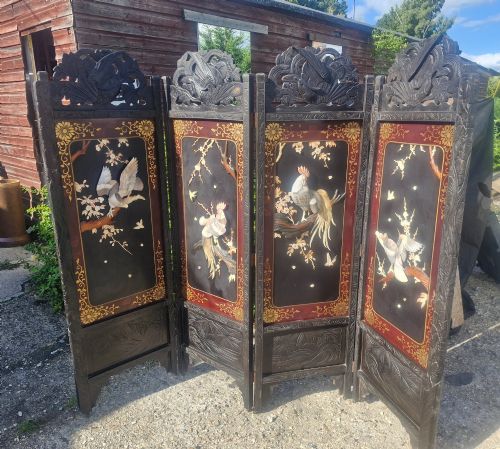
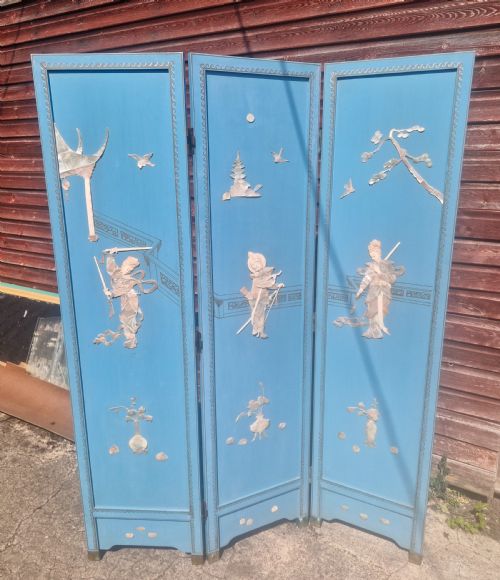


Carved Lacquer Floor Screen
These carved lacquer floor screen pieces bring deep relief, rich pigments and substantial room division to any interior.
Carved Lacquer Floor Screen
A carved lacquer floor screen acts as a substantial architectural divider within a room, deploying multiple hinged panels to create privacy or backdrop. When searching for a carved lacquer floor screen, buyers encounter folding formats ranging from three to eight panels.
The examples recorded here span the eighteenth century through to the mid-twentieth century, encompassing Chinese Qing Dynasty work, Japanese Meiji pieces, Burmese production, and later Chinoiserie interpretations. Forms include dressing screens and large room dividers that utilise wood as a structural core.
Chinese Coromandel lacquer screens with multiple folds appear alongside Japanese folding screens featuring deep carved bone figures. The variety includes inlaid black lacquer surfaces, painted decorations, and hardstone-mounted panels created for export and domestic markets.
How they were made
Maker workshops built the core structures from wood or hardwood, applying successive layers of lacquer to form a stable canvas for decoration. Artisans then carved deeply into the built-up lacquer ground to reveal contrasting coloured layers beneath.
Surface enrichment involved applied bone, mother-of-pearl, and hardstone elements secured into recesses, alongside detailed pigment painting. Brass hardware typically joined the folding panels together to allow flexible movement across multiple folds.
Carved Lacquer Floor Screen Retail Price Guide 2026
Typical asking prices for carved lacquer floor screen among the pieces listed under this phrase on Sellingantiques today, from the lower quarter to the upper quarter. They describe what is for sale here now, not the wider market.
Current listings feature screens spanning from the eighteenth century through the 1950s, utilising lacquer, hardwood, bone, and hardstone.
What varies in quality
The depth and crispness of the carved lacquer define the upper tier of execution, where intricate figures and landscapes retain sharp edges and clear relief. Lesser examples present shallower carving with softer definition in the motifs.
The complexity of the materials integrated into the surface distinguishes finer panels, such as the skilful combination of hardstone, bone, and mother-of-pearl inlay. The structural integrity of the wooden core and the original quality of the lacquer finish also set individual pieces apart.
The Carved Lacquer Floor Screen Glossary
- Lacquer
- A durable resin applied in multiple coats to a wooden substrate to form a smooth, protective surface. It provides the essential base for carving and polishing.
- Coromandel
- A type of Chinese incised lacquer where the design is cut into the lacquer ground and filled with colours or left plain. This technique creates a distinctive flat, polychrome effect across large panels.
- Chinoiserie
- European artistic style reflecting Chinese motifs and decorative techniques, popular in various periods. It frequently employs black lacquer and gilt decoration on folding screens.
- Meiji
- Japanese imperial period spanning from 1868 to 1912, noted for highly detailed craftsmanship. Pieces from this era often incorporate carved bone and precise painted elements.
- Hardstone
- Dense decorative minerals such as jade or agate used for inlaid ornamentation. Artisans cut and mounted these stones into the lacquer ground to add natural colour and texture.
Carved Lacquer Floor Screen: Frequently Asked Questions
How do I use a floor screen at home?
These folding screens function well as movable partitions to zone large spaces, or placed flat against a wall as a decorative backdrop. They provide architectural presence without requiring permanent structural changes to a room.
Ensure the hinges move freely and place the panels so the weight distributes evenly across the floor to maintain stability.
What is the difference between Chinese and Japanese screens?
Chinese examples often feature Coromandel lacquer or deep incised polychrome decoration across multiple folding panels. Japanese pieces from the Meiji era frequently emphasise carved bone figures and painted pictorial scenes.
Examining the motifs and the application of materials helps clarify the specific regional origin and stylistic period.
How many panels do these screens usually have?
The configurations vary from three-fold dressing screens up to eight-fold room dividers. Larger eight-panel examples create substantial visual boundaries, while three or four-panel versions suit more compact spaces.
Consider the available floor space and the intended span of the display before selecting a specific panel count.
How do I identify the age of a lacquer screen?
Dating relies on stylistic markers, construction methods, and the specific materials recorded in the woodwork and lacquer layers. Eighteenth-century examples contrast with early twentieth-century export pieces and mid-century interpretations.
Reviewing the secondary elements like brass hardware and inlay types assists in establishing the approximate period of manufacture.