

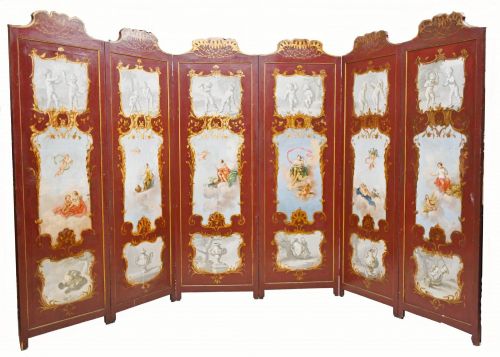
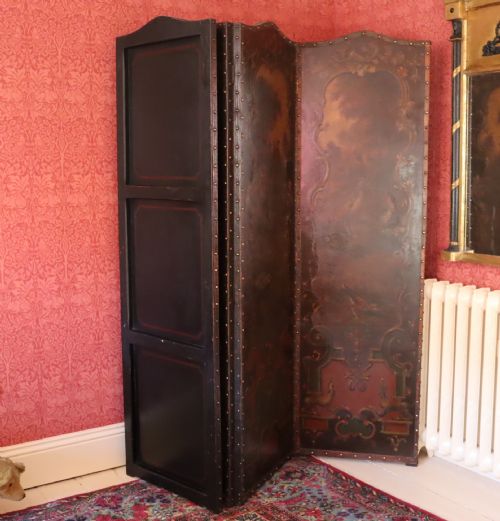


Hand Painted Draught Screen
These hand painted draught screen examples divide a room with oil paint, lacquer and leather across multiple panels.
Hand Painted Draught Screen
A hand painted draught screen stands as a folding barrier designed to block cold air and section off large interiors. Buyers encounter folding screens and room dividers spanning the eighteenth century through to the early twentieth century.
The selections on this page range from nineteenth century European leather and timber panels to Chinese lacquer work and Indian fretwork. Most pieces utilise three or four folds linked by hinges to form a stable zig-zag partition.
Continental Baroque, Victorian Rococo Revival and Chinese Export Art Deco styles appear alongside traditional country house items. Each hand painted draught screen brings distinct painted decoration directly onto canvas, leather or wood.
Materials and construction
Craftsmen built the framework from timber or wood, supporting flexible panels of leather, canvas or lacquer. Brass components often joined the panels together while gold leaf added metallic highlight to painted surfaces.
Makers applied oil paint directly onto prepared leather or canvas surfaces, creating rich pictorial scenes. Some examples incorporate fretwork carving into the wooden frames alongside the painted imagery.
Hand Painted Draught Screen Retail Price Guide 2026
Typical asking prices for hand painted draught screen among the pieces listed under this phrase on Sellingantiques today, from the lower quarter to the upper quarter. They describe what is for sale here now, not the wider market.
Some screens fold away quietly, ready to hide the laundry or save you from a draught.
Judging quality in these screens
The distinction between ordinary and superior work lies in the depth of the hand painted detail and the richness of the materials. Fine items display confident brushwork and substantial gilding upon embossed leather or smooth lacquer.
Construction methods also set pieces apart, distinguishing simple domestic carpentry from intricate fretwork and sturdy multi-fold brass hinges. The integrity of the canvas, leather or wood substrate dictates the lasting stability of the panel.
The Hand Painted Draught Screen Glossary
- Cordoban
- Leather originating from Córdoba, known for heavy embossing and rich gilding. These panels provide a durable and ornate surface for oil paint.
- Fretwork
- Ornamental perforated woodwork cut into intricate patterns. This technique appears on frames to lighten the visual weight of heavy partitions.
- Lacquer
- A durable resin finish applied in multiple layers to a wooden base. Chinese export examples utilise this glossy coating beneath painted designs.
- Fold
- An individual vertical panel connected by hinges to form a movable screen. Most items utilise three or four of these sections for stability.
Hand Painted Draught Screen: Frequently Asked Questions
How do I use a hand painted draught screen at home?
These screens divide open spaces, shield seating areas from doorways, and create private corners within larger rooms.
Position the panels in a gentle zig-zag shape so the structure remains stable without needing wall supports.
What periods do these folding screens come from?
The listings include examples from the eighteenth, nineteenth, and early twentieth centuries.
Styles range from eighteenth century Spanish and continental baroque to Victorian revivals and twentieth century Chinese export pieces.
Which materials form the body of these screens?
Makers constructed the panels using timber, wood, leather, canvas, and lacquer surfaces.
Brass hardware links the folds together while oil paint and gold leaf decorate the visible panels.
How do I distinguish Chinese screens from European ones?
Chinese examples frequently employ dark lacquer and distinct regional motifs from the Republic era or export traditions.
European screens tend to utilise painted canvas, timber frames, or embossed leather panels reflecting baroque and Victorian aesthetics.