

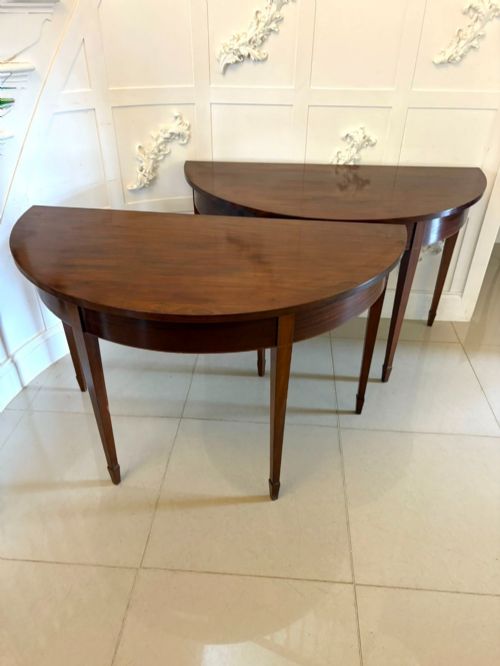
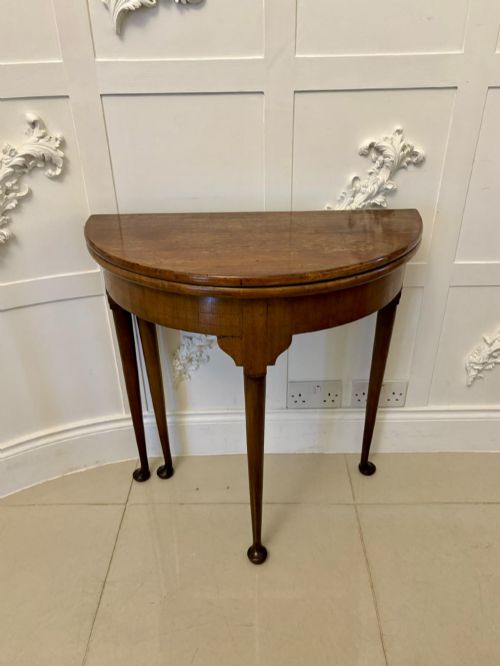

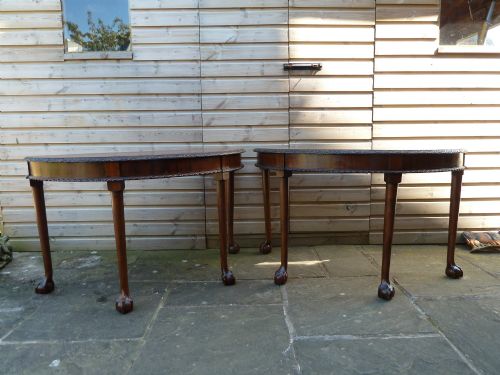


Half Round Hall Table
A half round hall table offers a neat footprint against narrow walls, providing a functional surface without blocking passageways.
Half Round Hall Table
A half round hall table is designed to stand flat against a wall, making it a practical choice for narrow corridors and entrance spaces. These pieces frequently appear as console tables, occasional tables, and side cabinets configured with a flat back edge and a curved front.
The materials and styles span centuries of cabinet making, with mahogany and pine appearing alongside walnut, elm, and fruitwood. Examples range from plain Scandinavian country pieces and Gustavian items to formal Georgian and Victorian designs.
Materials and construction
Construction relies heavily on timber framing, utilising solid woods such as mahogany, oak, pine, and walnut shaped into curved rails and tops. Cabinet makers employed traditional joinery to support the cantilevered or leg-supported semicircular surface.
Surfaces receive varied finishes depending on the origin and period, including polished mahogany, lime wash, and red lacquer. Brass fittings sometimes appear as structural or decorative elements on specific styles.
Half Round Hall Table Retail Price Guide 2026
Typical asking prices for half round hall table among the pieces listed under this phrase on Sellingantiques today, from the lower quarter to the upper quarter. They describe what is for sale here now, not the wider market.
Listings span periods from the 18th century through the Victorian era up to 1910, utilising woods including mahogany, pine, walnut, elm, fruitwood, and maple.
Judging quality in half round hall tables
Quality rests on the selection of timber and the precision of the curved joinery, particularly where the top meets the frieze and legs. Dense hardwoods like mahogany and walnut generally indicate more formal workshop production than utilitarian pine or softwood items.
Proportion and stylistic coherence dictate the standing of a piece, separating straightforward domestic furniture from elaborate revival or regional country work.
The Half Round Hall Table Glossary
- Demi-lune
- A French term meaning half-moon, commonly used to describe furniture with a semicircular shape. It is synonymous with half round construction.
- Console table
- A table designed to be fixed against a wall, traditionally supported by legs or brackets at the front. These tables often stand in hallways and reception rooms.
- D-end table
- A table with a semicircular end resembling the capital letter D. These frequently separate or combine with other sections to form larger dining arrangements or stand individually.
- Frieze
- The horizontal band running directly beneath the tabletop. This area often receives decorative carving, inlay, or simple moulding depending on the period style.
Half Round Hall Table: Frequently Asked Questions
Where should I place a half round hall table?
These tables suit narrow entrance halls and corridors because the flat back sits flush against the wall while the curved front softens the passage of movement.
They also function effectively in living rooms or landings where deep rectangular furniture would obstruct floor space.
How do I identify a Georgian hall table?
Georgian examples typically feature dense timbers like mahogany with restrained classical proportions and minimal ornamentation. Construction details often reflect 18th-century cabinet making techniques.
Later Victorian and revival pieces frequently incorporate heavier moulding or different secondary woods beneath the polished surface.
Can these tables stand unsupported?
A half round hall table relies on its legs for stability against the wall and generally requires no permanent wall fixture. Their design balances the weight distribution forward onto the front legs.
Some period console designs were historically anchored to walls with brackets, though most freestanding variants do not need this.
What is the difference between pine and mahogany versions?
Pine versions usually originate from regional or country traditions, such as Scandinavian country workshops, often featuring painted or lime-washed surfaces. They present a lighter, rustic aesthetic.
Mahogany variants tend to belong to formal Georgian or Victorian traditions, showcasing dark polished grain and finer joinery suited to polite reception rooms.