

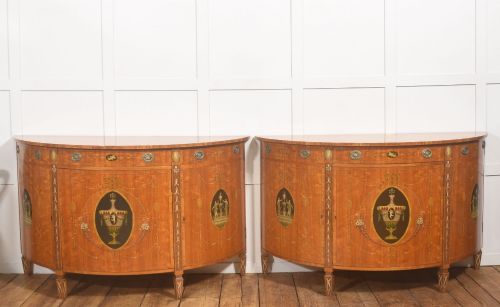
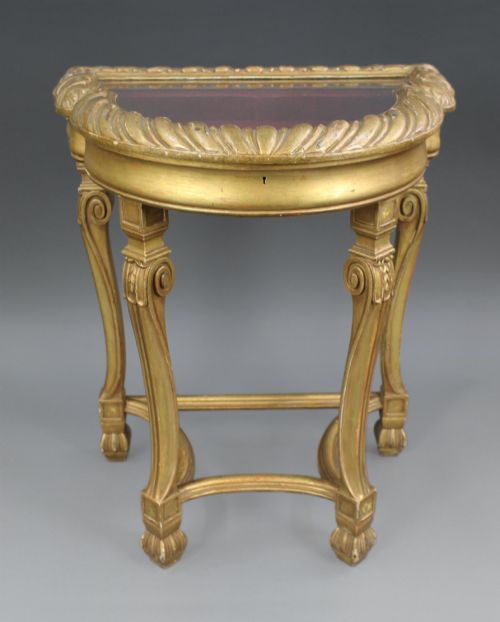
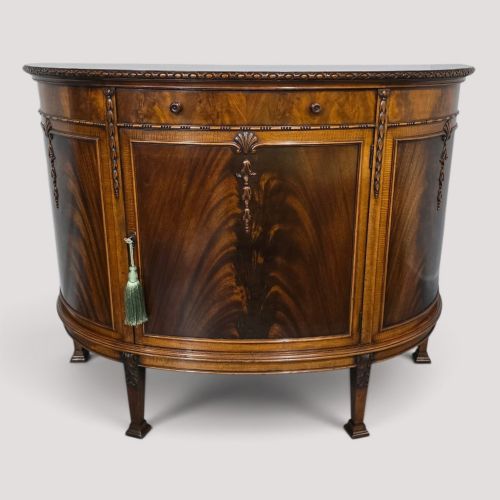
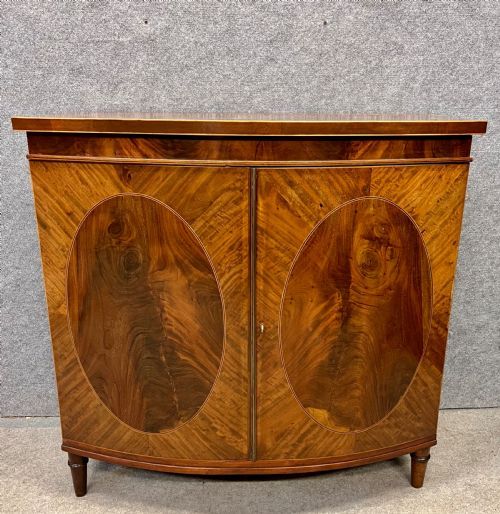


Half Moon Console Cabinet
These half moon console cabinet pieces combine curved fronts with compact wall-hugging profiles, offering elegant storage and display surface for narrow halls or living spaces.
Half Moon Console Cabinet
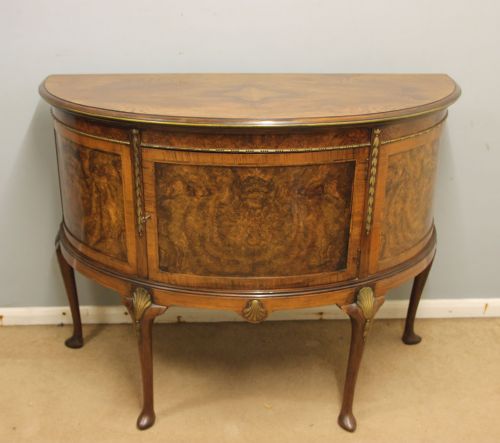
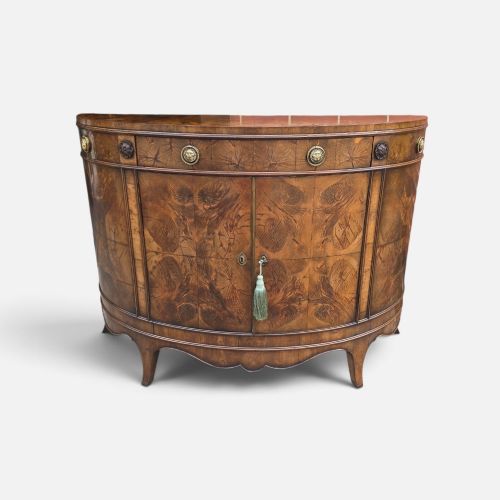
When buyers search for a half moon console cabinet, they encounter semicircular furniture designed to sit flat against a wall while saving floor space. The form includes side cabinets, commodes, and console tables with enclosed storage beneath flat tops.
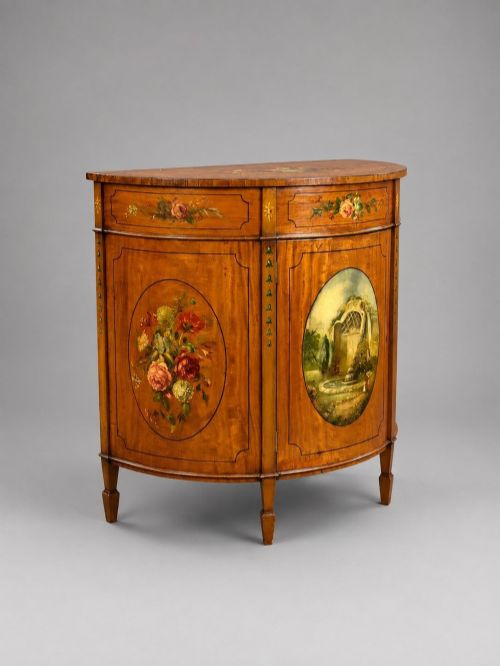
The versions most common on this page span from the late eighteenth century through the Edwardian period and the early twentieth century. Makers worked in mahogany, walnut, and satinwood, often applying painted panels or decorative inlay.
Stylistic influences range from Georgian and Sheraton Revival to Neoclassical and Louis XVI styles. Pieces vary from simple timber constructions to elaborate exhibition items featuring marble tops and brass details.
How they were made
Cabinetmakers constructed the curved carcase using timber frameworks, frequently applying veneers of mahogany, satinwood, or burr walnut across the semicircular front. Tambour shutters and hinged doors required precise joinery to follow the tight radius of the half moon shape.
Decoration relied on contrasting wood veneers, satinwood inlay, and hand-painted panels depicting floral or classical motifs. Marble tops were fitted to stone-topped console variants, whilst brass feet and mounts provided structural protection and accent.
Half Moon Console Cabinet Retail Price Guide 2026
Typical asking prices for half moon console cabinet among the pieces listed under this phrase on Sellingantiques today, from the lower quarter to the upper quarter. They describe what is for sale here now, not the wider market.
One Dutch cupboard utilises tambour doors that roll smoothly around a wooden track, proving that eighteenth-century joiners enjoyed mechanical puzzles just as much as we do.
What varies in quality
Quality separates through the choice of primary timbers and the precision of the veneer work on curved surfaces. Finer examples display meticulous matching of wood grain across doors and panels, alongside delicate, hand-painted detailing rather than printed substitutes.
The integration of materials dictates the standing of a piece, such as heavy marble slabs fitted accurately to mahogany or satinwood carcases. Superior hardware, including original brass feet and working locks, marks out the higher tier of these cabinets.
Pietro Ferrario
The Half Moon Console Cabinet Glossary
- Demi-lune
- A French term meaning half-moon, describing furniture with a semicircular flat back and a curved front. It appears frequently in descriptions of console tables and side cabinets.
- Satinwood
- A pale, lustrous hardwood native to Ceylon and India, prized for its golden sheen and smooth texture. Cabinetmakers used it extensively for veneers and decorative inlay during the eighteenth and nineteenth centuries.
- Marquetry
- The art of applying pieces of veneer to a structure to form decorative patterns and pictures. Craftsmen cut contrasting woods to create floral or geometric designs across cabinet doors.
- Tambour
- A flexible shutter made from narrow strips of wood glued to canvas, allowing doors to slide around curved tracks. This technique permits access to storage within enclosed semicircular frames.
- Commode
- A low chest of drawers or a cabinet with doors, originating in France. In English and continental furniture, the term often describes decorative freestanding storage pieces placed against walls.
Half Moon Console Cabinet: Frequently Asked Questions
Where should I place a half moon console cabinet?
These cabinets suit narrow hallways, entrance lobbies, and alcoves where rectangular furniture projects too far into the floor space. Their flat backs sit flush against the wall while the curved front softens room layouts.
They also function effectively in dining rooms or living areas as sideboards for serving or displaying objects without dominating the room's circulation.
How do I care for a satinwood cabinet?
Protect antique satinwood surfaces from direct sunlight to prevent the timber from darkening or losing its pale lustre. Dust regularly with a dry, soft cloth and avoid using silicone-based polishes.
Maintain stable indoor humidity levels to prevent timber shrinkage and veneer lifting along the curved edges of the cabinet carcase.
What is the difference between a console and a commode?
A console traditionally refers to a table designed to be fixed against a wall, sometimes supported by legs or brackets. Many nineteenth-century versions include integrated cabinets beneath the top surface.
A commode is a fully enclosed storage unit featuring doors or drawers, built as a freestanding piece of furniture rather than a wall-mounted support.
How can I identify a Sheraton Revival piece?
Sheraton Revival furniture dates primarily from the late Victorian and Edwardian eras, copying the lighter neoclassical styles of the eighteenth-century designer Thomas Sheraton. Look for satinwood veneers, painted floral swags, and tapered legs.
These pieces often display refined proportions and delicate inlay work that emulate earlier Georgian craftsmanship while utilising manufacturing methods of the early twentieth century.