

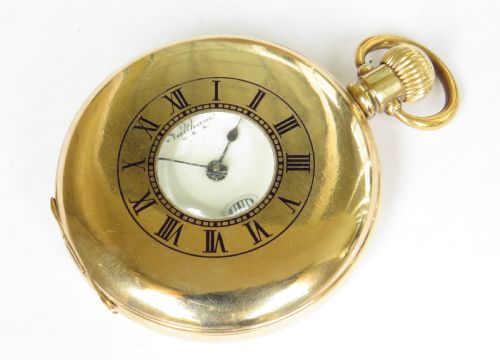


Half Hunter Watch
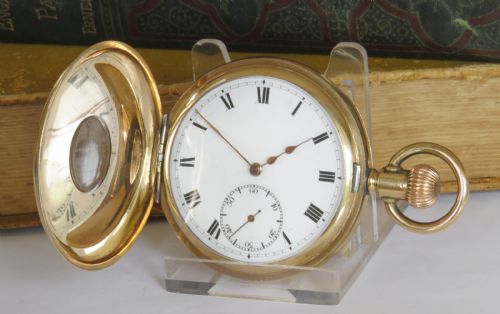
A half hunter watch offers the discretion of a protective outer case combined with a glass viewing port to check the time quickly.
Half Hunter Watch
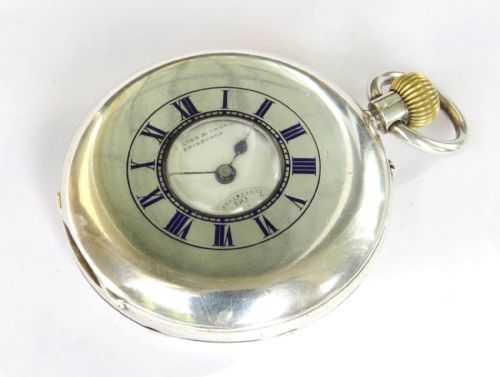
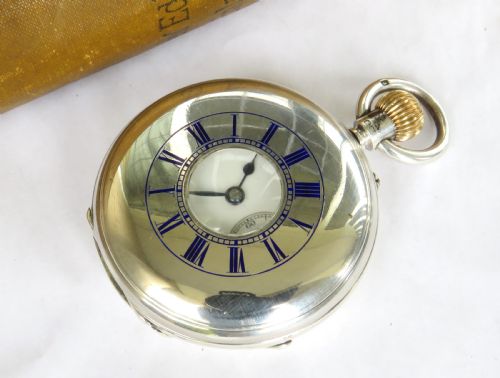
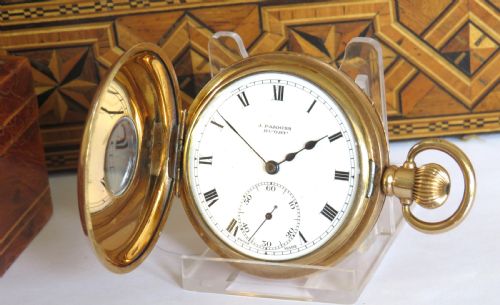
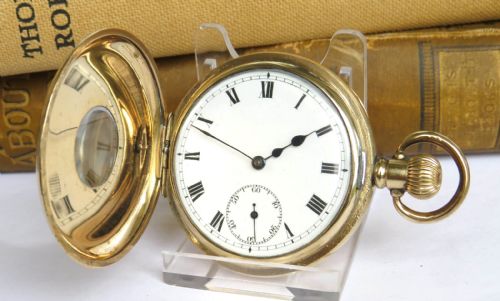
A half hunter watch is a pocket watch designed with a hinged metal cover over the dial, featuring a central glazed aperture that permits reading the hands without opening the case. When you search for this term, you encounter specimens spanning from the Victorian and Edwardian eras through to the interwar period of the 1930s.
The most common examples met on this page are silver and sterling silver pocket watches from the late nineteenth and early twentieth centuries. Gold and gold plate specimens, alongside smaller runs of brass and steel, also appear frequently across these decades.
Makers and retailers range from prominent London houses to Swiss workshops and regional British jewellers. These pieces take the form of standard pocket watches, fob watches, and occasionally early wrist watch adaptations from the period.
How they were made
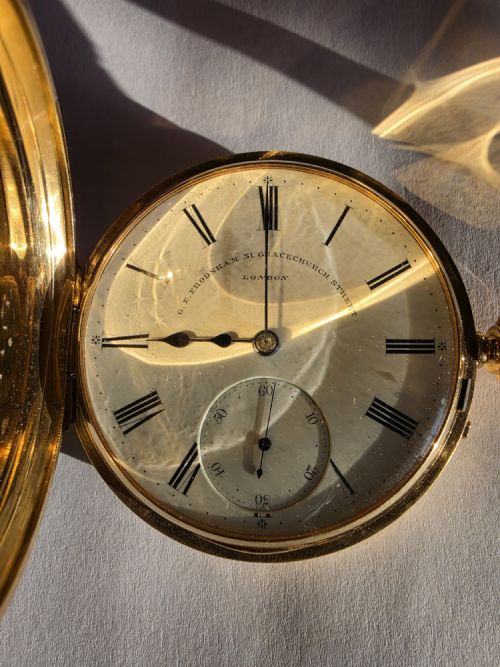
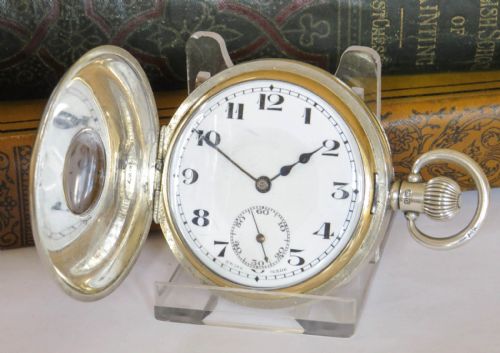
Cases are formed from sterling silver, gold, gold plate, brass or steel, enclosing mechanical movements driven by jewelled gear trains. Dial faces utilise white enamel marked with Roman or Arabic numerals, protected behind glass crystals.
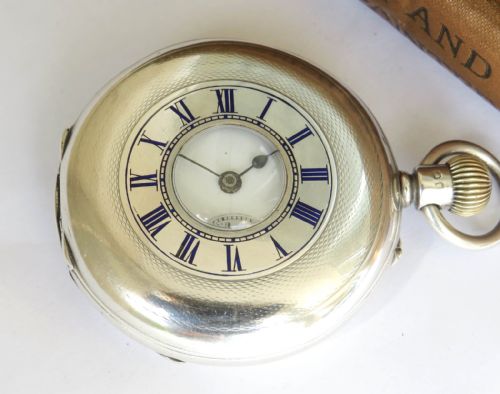
The outer spring-loaded covers incorporate enamel chapter rings surrounding the central aperture, allowing the wearer to view the hands against the dial markings while the case remains closed.
Certain watches record specific tales, such as bravery awards and presentations to local fishermen.
What varies in quality
The standard of a half hunter watch depends upon the precision of its internal movement, often measured by the number of jewels and the reputation of the maker or retailer. Workmanship seen in the gold or sterling silver casework, particularly the tightness of the spring hinge and the legibility of the enamel chapter ring, sets finer examples apart.
Provenance and original presentation cases add distinct character to certain pieces, while utilitarian models produced for specific societies or award recipients demonstrate simpler finish and robust utility.
Hamilton and Inches·George Edward Frodsham·Limit Revue·Waltham·JW Benson·A Golay Leresche Geneve·Eastern Watch Case Co·Baume and Co·Pimco·Bravingtons·Longines·Syren·Record·Stayte·Cyma·Helvetia·Moeris·Rotherhams·Uno·Mappin·Thos Russell and Son Liverpool
The Half Hunter Watch Glossary
- Half hunter
- A pocket watch with a closed metal outer lid that has a glazed central hole to show the hands. This design protects the delicate glass dial underneath from knocks.
- Enamel
- A smooth glossy substance fused to metal by firing, used to create the white dial face and the chapter ring on the outer case. It provides a durable surface for painted numerals.
- Chapter ring
- The numbered ring on the outer cover or the dial that indicates the hours. On a half hunter, the outer chapter ring is often filled with blue enamel numerals.
- Fob watch
- A small pocket watch designed to be worn attached to a short strap or chain called a fob. These pieces hang from a waistcoat pocket.
- Jewel
- A small synthetic bearing stone placed inside the movement to reduce friction on the rotating pivots. Higher jewelling counts indicate superior movement construction.
Half Hunter Watch: Frequently Asked Questions
How do I read the time?
You read the hours and minutes through the glazed central aperture on the outer metal cover. The painted numbers around this glass port align with the hidden hands beneath.
For a clearer view of the full dial, you press the crown button to pop open the spring-loaded outer case.
Can I wear a pocket watch daily?
These watches suit regular wear provided you wind them carefully at consistent intervals and protect them from moisture. Securing the piece to a waistcoat buttonhole with a sturdy chain prevents accidental drops.
Keeping the mechanical movement away from strong magnetic fields ensures reliable timekeeping during everyday use.
How do I date my watch?
British silver and gold cases feature hallmark stamps that indicate the assay office and the exact year of manufacture. Examining these small stamped letters inside the case back reveals the production period.
If the piece lacks British hallmarks, checking the serial numbers engraved on the internal movement helps identify the production decade and maker.
What is a jewelled movement?
A jewelled movement uses tiny polished bearing stones at high friction points within the gear train. These hard stones reduce wear on the metal pivots and improve the accuracy of the watch.
Movements range from basic configurations to higher grades containing fifteen or more functional jewels.