

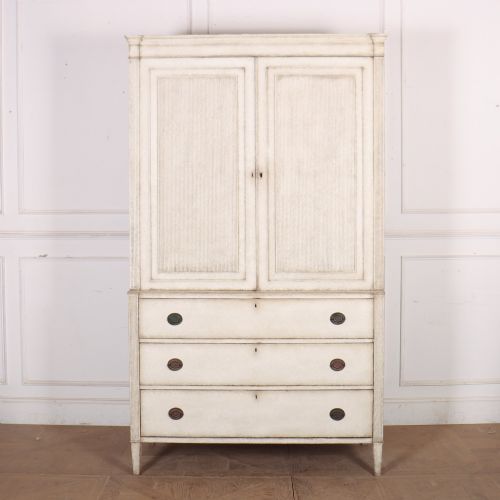
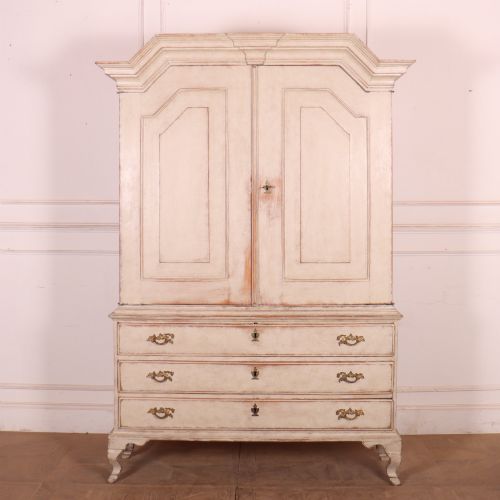


Gustavian Linen Press
A gustavian linen press is a substantial storage piece brought from Scandinavia, offering simple painted surfaces and deep interior shelving.
Gustavian Linen Press
When you search for a gustavian linen press, you encounter large storage furniture originating from Scandinavian countries. These pieces primarily date from the eighteenth and nineteenth centuries, spanning periods like the Victorian era and the year 1880.
The forms on this page include linen presses, linen cupboards, bonnet top cabinets, and cupboards on stands. Most examples reflect Scandinavian country and Swedish country styles, alongside occasional French country pieces.
Buyers are most likely to meet two-door cupboards and tall wardrobes designed to hold household textiles. These functional items combine architectural restraint with practical storage capacity.
How they were made
Carpenters constructed these cupboards using pine and painted softwood as the primary woods. Iron and brass fittings provide structural reinforcement and operational hardware for doors and drawers.
Surfaces received a painted finish or hand-painted layers, sometimes applied over older wood. Glass elements appear on specific cabinet doors, while bonnet tops and stands shape the silhouette of taller forms.
Gustavian Linen Press Retail Price Guide 2026
Typical asking prices for gustavian linen press among the pieces listed under this phrase on Sellingantiques today, from the lower quarter to the upper quarter. They describe what is for sale here now, not the wider market.
Several cupboards wear coats of old paint that have survived generations of domestic life in Swedish farmhouses.
What varies in quality
The distinction between ordinary and superior pieces rests upon the integrity of the painted surface and the retention of original finishes. Early eighteenth-century examples demonstrate different joinery standards compared to later nineteenth-century production.
Proportion and architectural detail separate simpler country cupboards from refined bonnet top cabinets and pieces built on stands. The handling of the painted woodwork and the preservation of original brass or iron hardware determine the overall character of each piece.
The Gustavian Linen Press Glossary
- Gustavian
- A Swedish neoclassical style spanning the late eighteenth and early nineteenth centuries. It adapts French court tastes into simpler geometric forms and pale painted finishes.
- Bonnet top
- A curved or arched upper section found on tall cabinets and cupboards. This architectural roofline softens the rectangular profile of storage furniture.
- Painted softwood
- Timber such as pine that has been coated with paint for protection and decoration. This material underpins the typical Scandinavian country aesthetic.
- Cupboard on stand
- A cabinet elevated on a separate frame or set of legs. This form lifts the main storage compartment away from damp floors.
Gustavian Linen Press: Frequently Asked Questions
What is a gustavian linen press used for?
These large cupboards were designed specifically to store household linens, sheets, and garments in domestic settings.
Today, they function as substantial wardrobes or general storage cabinets in bedrooms and living spaces.
How do I identify a nineteenth-century piece?
Nineteenth-century pieces often display pine construction and painted finishes typical of Scandinavian country workshops.
Comparing the joinery methods and hardware types helps distinguish these items from earlier eighteenth-century examples.
Where do these cupboards originate?
The listings consist largely of pieces originating from Sweden and wider Scandinavian regions.
They reflect rural and provincial design traditions rather than formal urban cabinetmaking.
How should I care for painted wood?
Painted softwood surfaces require stable indoor humidity to prevent the wood from shifting and the paint from cracking.
Dusting with a dry cloth is sufficient for routine maintenance without applying modern chemical polishes.