


Grey Watercolour Harbour Scene
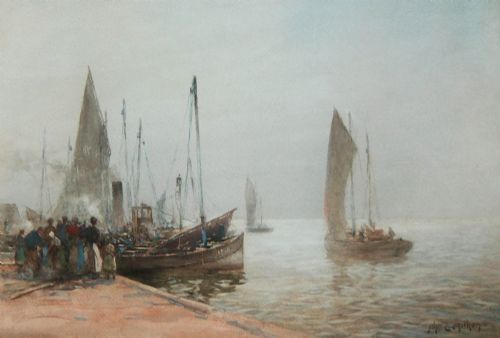
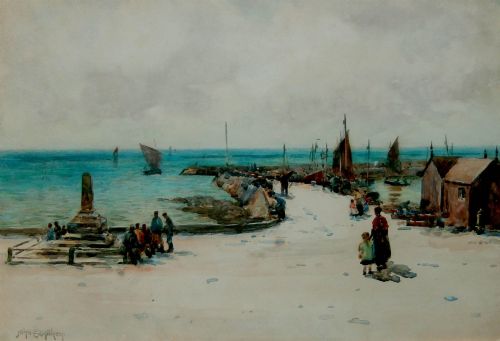
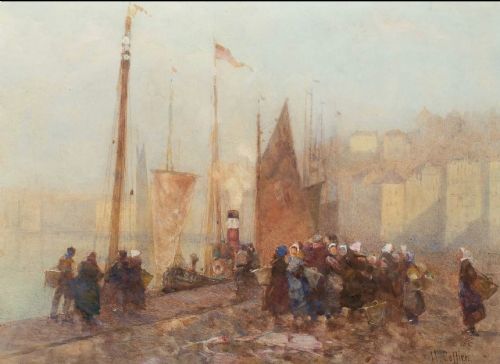
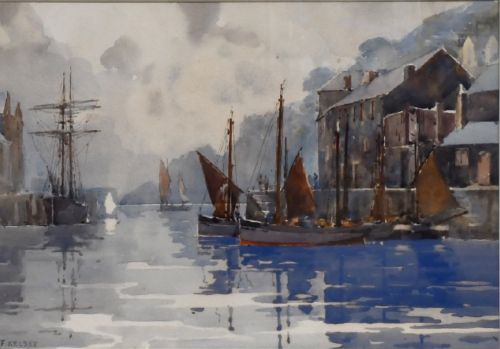
A grey watercolour harbour scene captures coastal grit and maritime industry in monochromatic washes, offering moody skies and bustling quaysides for the collector of maritime art.
Grey Watercolour Harbour Scene
A grey watercolour harbour scene depicts British fishing ports, tidal estuaries, and busy quaysides during the nineteenth and twentieth centuries. These works record coastal life from Staithes, Whitby, Looe, and Polperro through atmospheric washes.
The selections available span from Victorian academic studies to British Impressionist and Staithes School interpretations. Most examples date from the Edwardian era through the nineteen-fifties.
Artists focused on the daily labour of the fleet, depicting cobles, landing stages, and stone harbour walls under overcast skies. Paper serves as the primary support, carrying pigment applied with varied brushwork.
Judging quality in marine watercolours
Compositional strength separates standard topographical records from masterful works, particularly in how the eye moves across shipping masts and harbour architecture. Tonal control is crucial when working primarily in grey, as subtle graduation defines the distance between sea and sky.
Handling of the medium defines superior sheets, showing confidence in reserve whites and wash application without heavy reworking. The inclusion of figures engaged in harbour labour adds narrative depth and artistic execution.
Expect frequent depictions of sturdy northern fishing boats waiting for the tide.
James E. Aitken·John E. Aitken·Hector Caffieri·Frank Kelsey·Arthur Tucker·Ernest F. Hill·Frederick Stuart Richardson·Percy Brooke·Rowland Henry Hill·Frank W. Scarborough·Harry Wanless·William Lee Hankey·Frank Rousse·William Collins·Robert Leslie Howey
The Grey Watercolour Harbour Scene Glossary
- Coble
- An open traditional fishing boat with a flat floor, common along the north-east coast of England. These craft frequently appear pulled up on Yorkshire harbour shores.
- Staithes School
- A group of late nineteenth and early twentieth century artists working in the Yorkshire fishing village. They adoptedplein-air techniques to capture local maritime subjects.
- Wash
- A fluid application of diluted watercolour pigment across paper to create smooth areas of tone. In monochrome works, grey washes establish atmosphere and shadow.
- Reserve
- The practice of leaving areas of white paper untouched to represent highlights or foam. This technique maintains luminosity in watercolour painting.
Grey Watercolour Harbour Scene: Frequently Asked Questions
How should I frame these watercolours?
Mount the painting behind conservation-grade museum board to keep the paper surface from touching the glass. Choose simple wooden mouldings that complement the traditional period aesthetic.
Keep the framed work away from direct sunlight to prevent the watercolour pigments from fading over time.
What periods do these pieces date from?
The works span from the nineteenth century through the mid twentieth century, with a strong concentration around the Edwardian period. Artists of this era frequently recorded disappearing coastal traditions.
Victorian examples tend toward tighter detail, while nineteen-twenties and thirties pieces show looser impressionist tendencies.
Which regions appear most often in the scenes?
North Yorkshire fishing ports such as Whitby and Staithes feature prominently, alongside Cornish locations like Polperro and Looe. Scottish harbours and London tidal reaches also appear across the selection.
These sites were chosen by artists for their active fishing fleets and dramatic stone piers.