


Whitby Abbey Painting
A whitby abbey painting captures the iconic Yorkshire ruin above the harbour, offering a moody record of coastal light and maritime history.
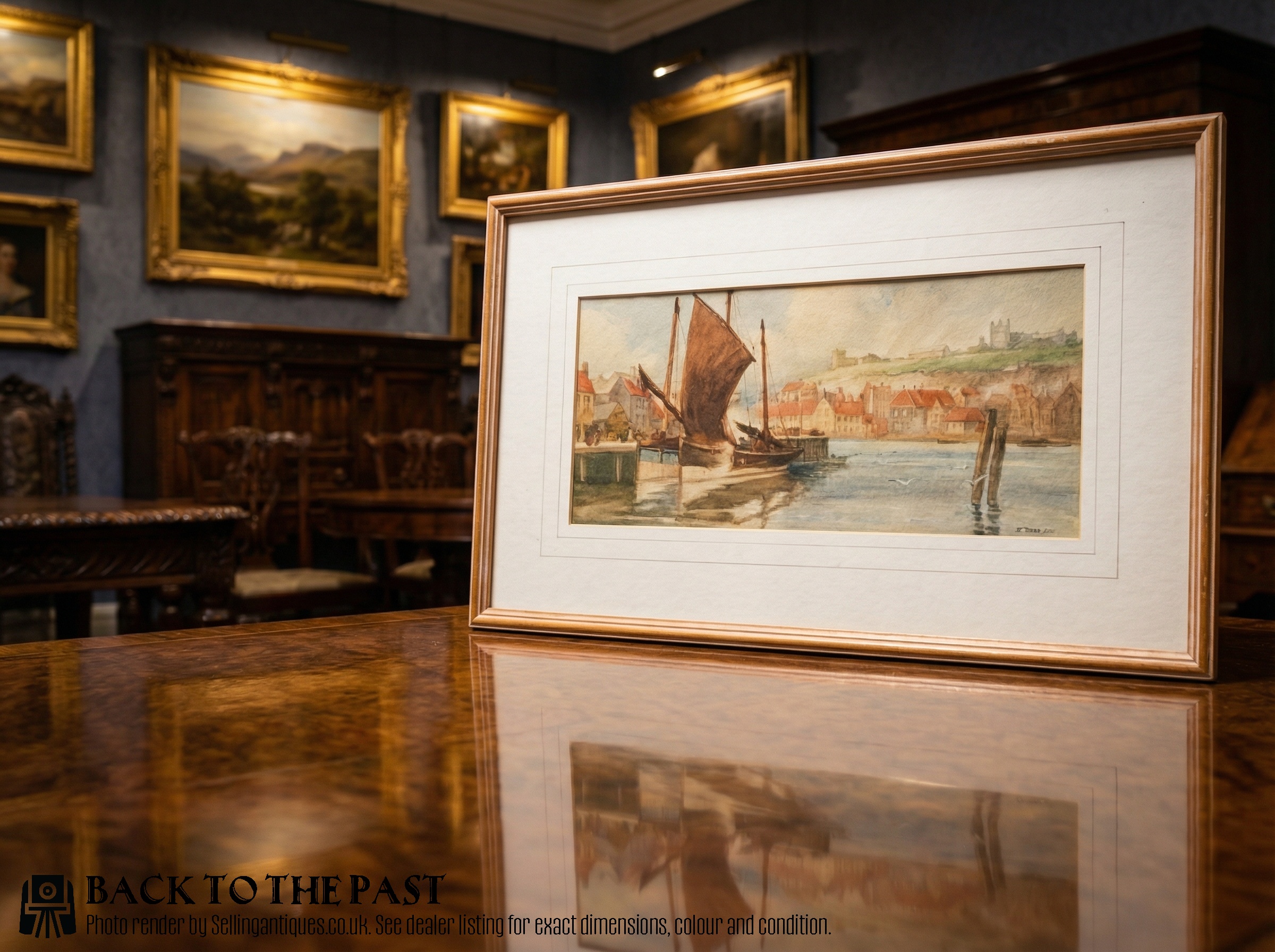
Whitby Abbey Painting
When you examine a whitby abbey painting, you encounter depictions of the famous North Yorkshire landmark, often framed by St Mary's Church and the surrounding harbour. These works range from late Victorian watercolours to early twentieth-century oils, recording the town's dramatic cliffs and tidal waters.
You are most likely to meet watercolour paintings on paper from the Victorian and Edwardian periods on this page. Artists frequently positioned themselves on the river Esk, the harbour, or Tate Hill Pier to capture the silhouette of the abbey against sunset, moonlight, or daytime coastal skies.
Materials and methods
Artists relied primarily on watercolour pigment applied to paper, alongside oil paint worked onto canvas or wood panels. Watercolour permitted rapid sketching of transient coastal weather and changing light over the North Sea, while oil allowed for heavier impasto and deeper tonal ranges.
Framing typically involved gilt wood and glass to protect delicate works on paper from moisture and atmospheric soot. The combination of traditional pigments, paper, and carved wooden frames reflects the standard workshop practices of British artists active around the turn of the century.
Several artists braved the Yorkshire wind with a box of watercolours just to catch the abbey mid-collapse.
Judging the work
Quality rests upon the artist's handling of atmospheric perspective and the specific topography of the Yorkshire coast. Stronger examples demonstrate a confident control of wash and pigment density, capturing the distinct luminosity of northern skies rather than relying on formulaic sketching.
The relationship between the architectural mass of the abbey and the bustling maritime activity below distinguishes accomplished compositions from simpler topographical records. Provenance, signature clarity, and the retention of period gilt frames further elevate individual pieces.
Alfred George Morgan·Tom Clough·Fred Waugh·George Weatherill·James Thomas Watts·Albert Robert Quinton·William Samuel Horton·Harry Wanless·Walter Emsley·Frank Rousse·Rowland Henry Hill·Donald Wood·R. J. S. Bertram·William Henry Williamson·John Wynne Williams·Edwin Cockburn·Walter Linsley Meegan·Edward William Cooke
The Whitby Abbey Painting Glossary
- Watercolour
- A paint consisting of colour suspended in a water-soluble binder, used extensively on paper for British landscapes.
- Diptych
- A painting divided into two distinct panels, hinged or presented as a matching pair.
- Gilt Wood
- Timber carved and coated with a thin layer of gold leaf or metallic gilt paint, typical of period picture frames.
- Impressionism
- A style characterised by relatively small, thin yet visible brush strokes and an accurate depiction of light.
- Provenance
- The chronological history of the ownership of a piece, establishing its authenticity and origin.
Whitby Abbey Painting: Frequently Asked Questions
What periods do these paintings span?
The available selection spans from the Victorian era through the Edwardian period and into the early twentieth century, including pieces dated from 1900 to 1930.
Earlier archive records demonstrate that depictions of the coastline extend back into the eighteenth and nineteenth centuries, reflecting enduring artistic interest in the Yorkshire landscape.
Are these works signed by the artists?
Many examples feature signatures or attributions to recognised British artists who painted along the Yorkshire coast. Signatures commonly appear in the lower corners of the paper or canvas.
Unsigned pieces frequently share stylistic traits and framing methods with documented works from the same regional schools.
How should I display watercolour paintings?
Watercolours require protection from direct sunlight to prevent the fading of delicate pigments on paper. Framing behind glass with conservation-grade mounts keeps the paper stable.
Placement away from damp walls and sudden temperature shifts ensures the longevity of both the painting and its period gilt frame.
What subjects accompany the abbey?
Compositions frequently incorporate St Mary's Churchyard, Whitby Harbour, and the River Esk flowing past the town. Fishing boats, shipping vessels off the coast, and piers also appear regularly.
These elements place the abbey within the broader context of a working Yorkshire port and maritime community.