


Grey Painted Rocking Horse
A grey painted rocking horse brings nineteenth-century craftsmanship into a modern interior.
Grey Painted Rocking Horse
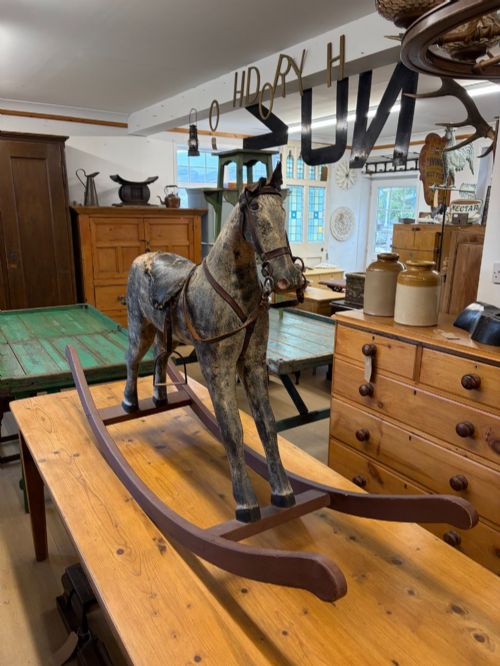
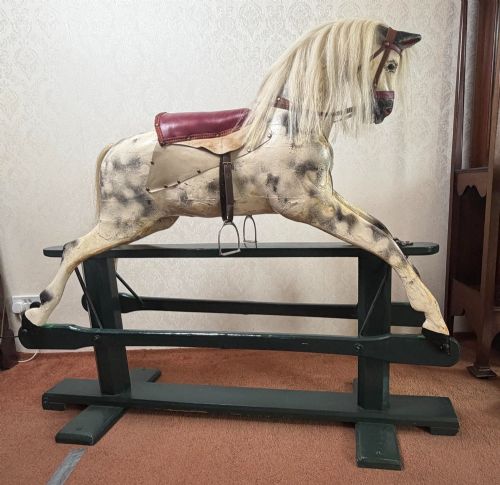
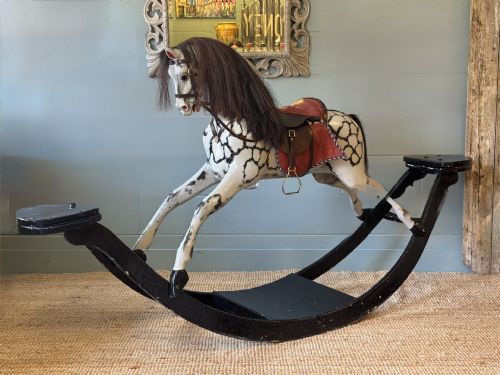
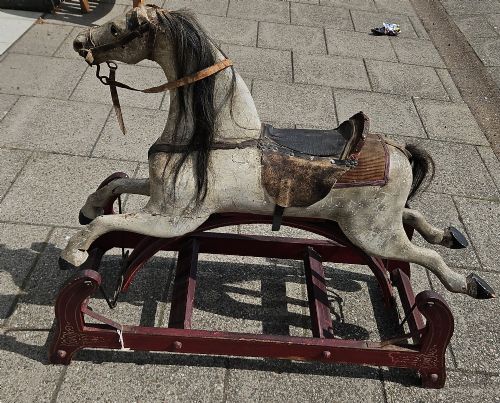
The versions most commonly met on this page feature carved wooden bodies coated in historic paint, sometimes styled with dapple grey finishes. Makers such as G & J Lines, F.H. Ayres, Lines Bros, and Collinson & Sons produced these enduring playroom pieces.
How they were made
Makers constructed these horses from carved wood and pine, shaping the bodies by hand or machine before applying layers of paint. Artisans fitted leather tack, horsehair manes and tails, and metal or iron brackets to complete the realistic forms.
Many examples retained their original painted surfaces, while others show later coats of dapple grey paint applied over the carved pine. Mounted on curved wooden rockers or pine trestle bases, the structures were built to withstand generations of heavy use.
Some horses survived decades of nursery gallops only to retire gracefully into the role of silent, painted sentinels.
What varies in quality
The standard of carving and the survival of original paint set individual examples apart. Pieces retaining their early surface decoration and maker stamps demonstrate superior workshop origin.
Proportion and stance distinguish fine nineteenth-century folk art interpretations from later mass-produced toys. The retention of original leather components and horsehair adds historical integrity to the piece.
G & J Lines of London·F.H. Ayres·Lines Bros Sportiboy·Collinson & Sons Liverpool
The Grey Painted Rocking Horse Glossary
- Rocking horse
- A carved wooden toy mounted on curved wooden rockers or a trestle base designed for children to ride.
- Folk art
- Utilitarian objects and decorative sculptures made by traditional craftsmen rather than academic artists.
- Dapple grey
- A spotted or mottled grey coat pattern traditionally painted onto the bodies of wooden rocking horses.
- Trestle base
- A rigid wooden frame supporting the rocking mechanism rather than traditional curved floor rockers.
Grey Painted Rocking Horse: Frequently Asked Questions
How old is my rocking horse?
Dating relies on construction methods, timber choice, and style markers. Nineteenth-century examples often feature primitive hand-carved pine bodies, while later twentieth-century pieces incorporate standardised metal hardware.
Maker stamps and original painted finishes help narrow down the period of manufacture. Comparing the rocker design and base construction provides further clues to its age.
Are these horses safe for children?
Most antique rocking horses serve primarily as decorative sculptures or folk art display pieces rather than modern toys. Their historic timber and iron components may not meet current safety standards.
Collectors generally preserve them in playworn or original condition. Careful placement in a room ensures they remain stable as ornamental objects.
What is a trestle base?
A trestle base is a rigid wooden stand that holds the rocking mechanism off the floor. This design replaced the traditional curved wooden rockers on many twentieth-century models.
It provided a steadier motion and kept the horse upright in the nursery. Surviving examples retain their pine trestles alongside the main body.
How do I care for original paint?
Preserving historic paint requires keeping the horse away from direct sunlight and damp conditions. Gentle dusting with a dry cloth protects the delicate pigment and dapple grey finish.
Avoid using modern cleaning chemicals or water on antique wooden surfaces. Maintaining a stable indoor temperature prevents the pine from cracking.