
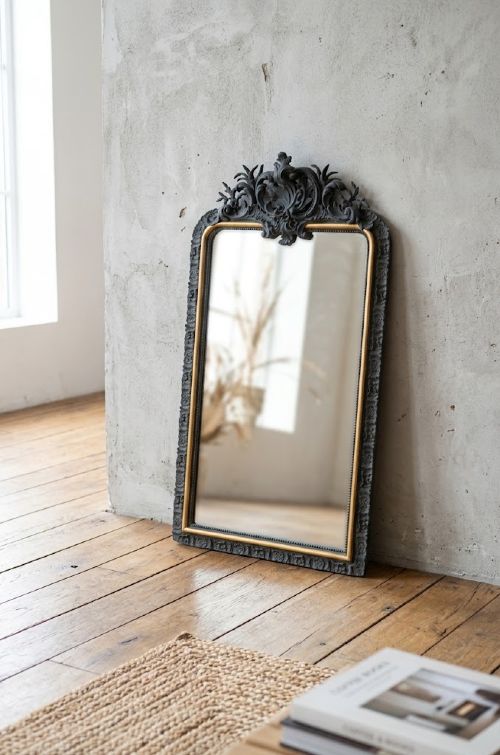

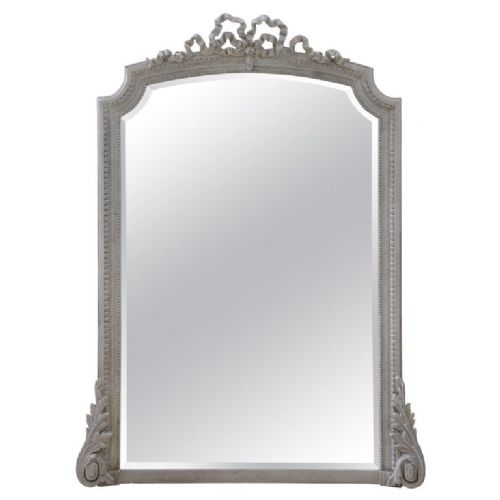


Grey Painted French Mirror
A grey painted french mirror brings light and proportion to a room, offering the subdued elegance of nineteenth-century continental design.
Grey Painted French Mirror
A grey painted french mirror encompasses wall-hanging designs, overmantels, and pier glasses originating from the nineteenth century. These items reflect stylistic revivals such as Rococo, Louis Philippe, and Empire, often incorporating arched tops or rectangular proportions suited to period interiors.
The version most commonly encountered on this page is the large nineteenth-century overmantel or wall mirror, formed from carved wood and gesso with a weathered painted finish. Surviving examples frequently show the softening of pigment over decades of domestic use.
Materials and Construction
Makers shaped timber frames from woods such as pine or hardwood, applying layers of gesso to build up decorative mouldings and relief details. Artisans then painted the surfaces, sometimes adding parcel gilt highlights or decorative panels.
Reflective surfaces relied on traditional mirror glass, occasionally retaining original mercury backing that displays characteristic foxing and spotting. Frames were assembled with pegged joints, and larger overmantels were engineered to bear the weight of heavy glass plates.
Listings feature pieces spanning the mid-nineteenth century to the early twentieth century, utilising glass, carved wood, gesso, and painted finishes.
Assessing Quality and Execution
The distinction between tiers rests upon the crispness of the carved wood and the depth of the gesso modelling beneath the paint layers. Finer specimens display deeply undercut foliage, scrolls, or architectural columns rather than shallow, moulded substitutes.
Proportion and the integrity of the original painted surface dictate desirability. Pieces retaining undisturbed historic paintwork without heavy modern intervention command greater interest among collectors of period decorative items.
The Grey Painted French Mirror Glossary
- Trumeau
- A decorative wall mirror featuring an upper panel containing painted scenes or carved reliefs, frequently integrated into neoclassical interior panelling.
- Gesso
- A plaster mixture applied to wooden frames to provide a smooth ground for gilding and painting.
- Pier mirror
- A tall, narrow glass designed to hang on the wall space between two windows.
- Overmantel mirror
- A large horizontal mirror specifically scaled to sit above a fireplace mantelpiece.
- Mercury glass
- An early form of silvering using a mercury and tin amalgam, noted for its mottled, atmospheric reflection.
Grey Painted French Mirror: Frequently Asked Questions
How do I hang a heavy overmantel mirror?
Large overmantels require professional installation into solid wall studs using heavy-duty brackets to support the substantial weight of the timber frame and glass.
Ensure the hanging wire or integrated fixing rings are securely fastened to the structural wood of the frame rather than decorative mouldings.
Are mercury glass mirrors safe?
The mercury is safely sealed between the glass and the backing layer during manufacture, presenting no hazard under normal domestic conditions.
Collectors prize the soft, uneven reflection produced by these historical plates as a mark of authenticity.
How should I clean a painted antique frame?
Dust the carved surfaces gently with a soft, dry brush to prevent accumulation in the recesses of the gesso work.
Avoid chemical cleaning agents and excessive moisture, which can soften fragile historic paint layers and lift the gesso ground.
What defines Louis Philippe style mirrors?
Louis Philippe mirrors are characterised by their simple, restrained rectangular or arched frames with gently rounded upper corners.
They offer a less ornate alternative to Rococo Revival pieces while maintaining classic nineteenth-century proportions.