
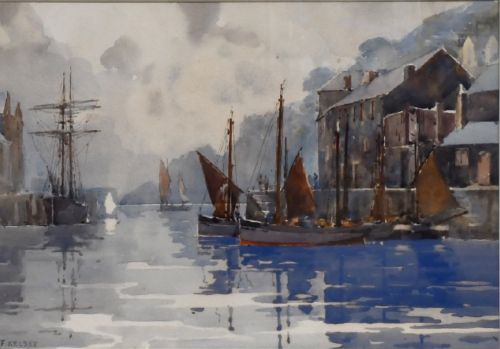


Grey Harbour Watercolour
These grey harbour watercolour paintings capture coastal life and maritime scenes across Britain through the nineteenth and twentieth centuries.
Grey Harbour Watercolour
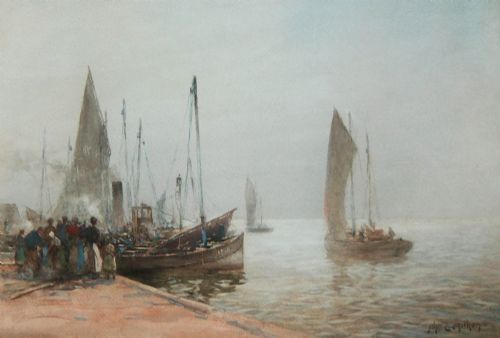
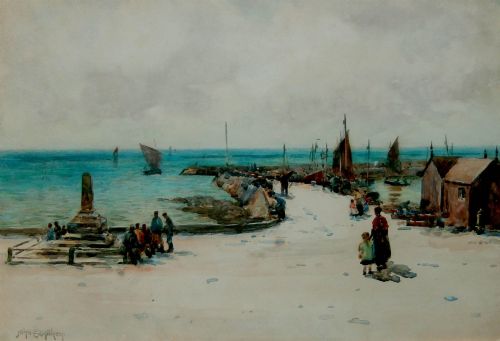
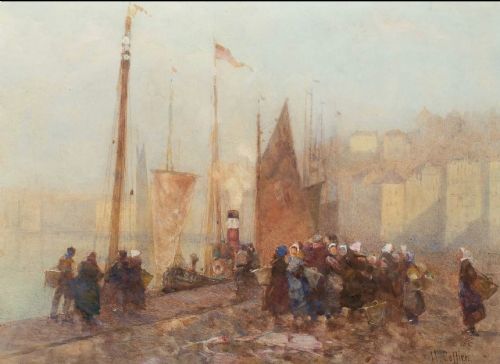
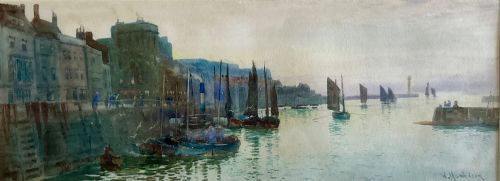
A grey harbour watercolour presents maritime and coastal subjects, often recording fishing fleets, piers, and tidal inlets under overcast skies. The selection here leans heavily towards British coastal scenes from the Victorian period through to the mid-twentieth century.
Works frequently depict specific locations along the Yorkshire and Cornish coasts, such as Whitby, Staithes, and Polperro. Painters observe local industry, recording sailing vessels, steamships, and harbour architecture with topographical precision.
These framed artworks span several stylistic movements, including British Impressionism, Victorian Marine Realism, and early twentieth-century marine painting. They function primarily as wall art that preserves historic maritime views.
Materials and Technique
Artists apply watercolour pigment and ink onto paper supports, often utilising the natural white or off-white tone of the paper to render light on water and sky. Washes of grey pigment build atmospheric depth, while finer ink lines define rigging and stonework.
Framed behind glass, these works rely on the transparent qualities of watercolour to create luminosity. Wood frames house the paper sheets, protecting the delicate pigments from atmospheric moisture and handling.
Subject matter concentrates heavily on British marine views, documenting regional harbours from Whitby to St Ives.
Assessing Quality and Execution
Quality rests upon the sureness of the brushwork and the artist's command of tone, particularly when managing monochromatic or muted grey palettes. Stronger compositions capture movement in water and weather conditions with economy and control.
The degree of detail in architectural and maritime elements distinguishes accomplished practitioners from lesser hands. Provenance and association with recognised regional painters or marine specialists also elevate individual works.
James E Aitken·John E Aitken·Hector Caffieri·William Matthison·Frank Kelsey·Eric Tufnell·Thomas Bush Hardy·Ernest Dade·Arthur Tucker·Tom Clough·Samuel Owen·Ernest F Hill·Frederick Stuart Richardson·Percy Brooke·William Kay Blacklock·Rowland Henry Hill·Fred Lawson·Frank W Scarborough·Frank Wasley·Harry Wanless·Fred Mayor·William Lee Hankey·Frank Rousse·William Collins·Frances E Nesbitt
The Grey Harbour Watercolour Glossary
- Watercolour pigment
- Finely ground colour suspended in a water-soluble binder, applied in washes to paper.
- Marine watercolour
- A painting on paper dedicated to maritime subjects, including ships, ports, and coastal views.
- British Impressionism
- A late nineteenth and early twentieth century painting style focusing on light, atmosphere, and loose brushwork.
- Wash
- A fluid application of diluted watercolour pigment across the paper to create broad areas of tone or sky.
Grey Harbour Watercolour: Frequently Asked Questions
What subjects appear in these watercolours?
Paintings show British coastal towns, fishing fleets, piers, and shipping traffic within tidal harbours. Scenes focus on specific ports in Yorkshire, Cornwall, and major river pools.
Compositions record everyday maritime activity, including vessels at moorings, steam and sail boats, and historic waterfront architecture under overcast skies.
How should I frame and display them?
Works on paper require framing behind glass with acid-free mounts to prevent direct contact with the glazing. This protects the watercolour pigment from humidity and physical damage.
Display watercolours away from direct sunlight to avoid fading the paper and muted grey tones over time.
Which periods are represented?
The selection spans the Victorian era through the early twentieth century, with examples dated from the 1890s into the 1950s. Most pieces originate from the early decades of the twentieth century.
Styles transition from Victorian marine realism towards British impressionist approaches to light and atmosphere.
Are these works signed by the artists?
Many examples retain the original artist signature or attribution on the face of the paper, often within the lower corners. Some carry descriptive titles inscribed by the hand of the painter.
Associated framing and gallery labels on the reverse frequently provide further context regarding the origin of the artwork.