



Grey Entryway Table
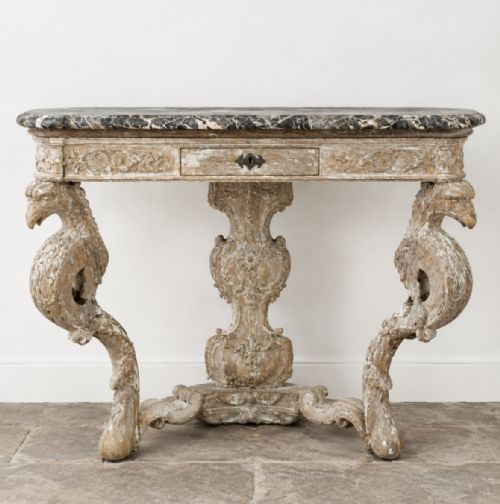
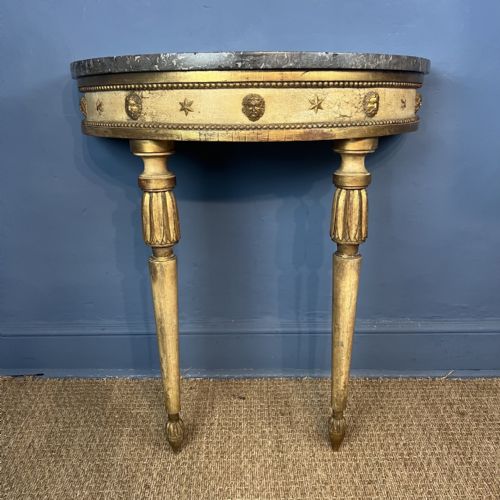
A grey entryway table offers a striking arrival point, bringing painted wood and marble surfaces together in narrow console and side formats.
Grey Entryway Table
A grey entryway table typically takes the form of a console or side table designed to stand flat against a hallway wall. The selection spans pieces from the 18th century, Regency period, and Edwardian era, through to the 1920s and 1930s.
Most examples found here adopt French styles such as Neoclassical, Rococo Revival, and French Empire, alongside Italian Neoclassical, Scandinavian Country, and English designs. These tables serve a functional purpose in a narrow corridor while anchoring the visual space of a hallway.
The primary formats are console tables and side tables, often built with slim proportions to suit entryways. Buyers frequently encounter painted wood finishes paired with marble tops in these narrow hallway configurations.
Materials and construction methods
Construction relies heavily on wood, including walnut and pine, shaped into carved woodwork or flat painted panels. Artisans applied paint finishes in shades of cream and grey, sometimes adding parcel gilt details to accentuate carved mouldings.
Heavy marble slabs form the top surface on many pieces, supported by sturdy wooden frames and occasional brass mounts. Carved wood details appear on French decorative items, utilising traditional joinery appropriate for console tables.
Period origins span the 18th century, Regency, Edwardian era, and the early decades of the 20th century.
Distinguishing quality across the range
Quality rests in the execution of the hand-carved wood elements and the integration of the marble top with the wooden base. Superior pieces display refined proportions and crisp carving, whereas simpler items rely on basic painted wooden surfaces.
The sophistication of the painted finish and the weight of the stone surface differentiate everyday side tables from grander country house console tables. Period authenticity in the hardware and the depth of the carved woodwork further divide the standard.
The Grey Entryway Table Glossary
- Console Table
- A table designed to be fixed against a wall, often supported by two front legs and secured to the wall at the back.
- Marble Top
- A heavy stone slab fitted to the upper surface of a table, providing a smooth and cool working or display area.
- Parcel Gilt
- A surface treatment where parts of an object, usually carved details, are highlighted with a thin layer of gold leaf.
- Serpentine Front
- A table front characterised by a gently curved line that undulates outward in the centre and inward at the sides.
Grey Entryway Table: Frequently Asked Questions
Where should a grey entryway table be placed?
These narrow tables suit hallways, corridors, and entrance spaces where floor area is restricted. Their shallow depth allows them to sit flat against a wall without obstructing movement.
They function well beneath a mirror or painting, creating an immediate focal point upon entering a home.
What materials are used in these tables?
The listings feature wood substrates such as walnut and pine, finished with paint or carved ornamentation. Many examples incorporate heavy marble tops resting on the wooden base.
Additional elements like brass fittings and parcel gilt highlights occasionally appear on continental pieces.
How do I identify the period of a console table?
Dating relies on stylistic markers such as Neoclassical symmetry, Rococo curves, or Edwardian painted finishes. Construction techniques and wood types also offer clues to the era of manufacture.
Reference points range from 18th-century forms to 1930s interpretations of earlier French and English styles.
Are side tables and console tables the same thing?
While both serve similar placement needs, console tables are traditionally designed to stand against a wall, sometimes requiring wall attachment for stability. Side tables are generally freestanding four-legged furniture items.
In narrow entryways, both terms often describe furniture built with slim proportions.