


Grey Country Landscape
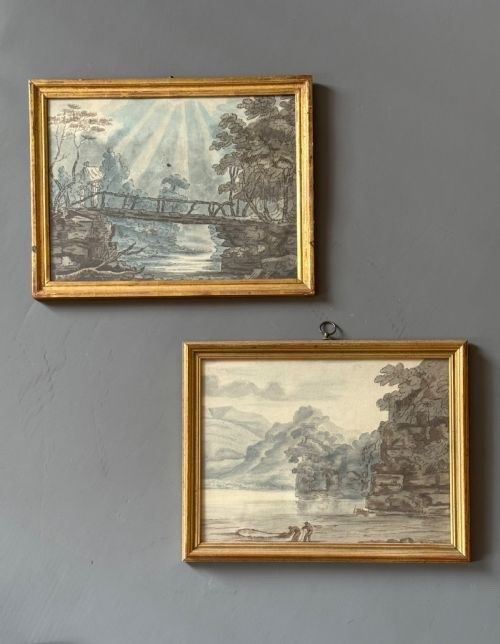
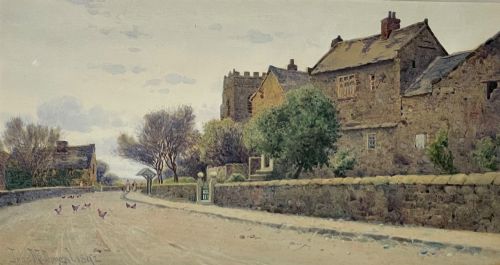
These grey country landscape works capture pastoral views and rural scenes in muted tones through oil paint and watercolour.
Grey Country Landscape
A grey country landscape presents rural vistas, farms, moorlands, and river valleys rendered in subtle neutral palettes. These pieces range from Victorian watercolours to twentieth-century oil paintings on canvas and board.
You will encounter depictions of agricultural life, country lanes, and pastoral settings created during the nineteenth and early twentieth centuries. The selection spans British Impressionism, realism, and regional schools.
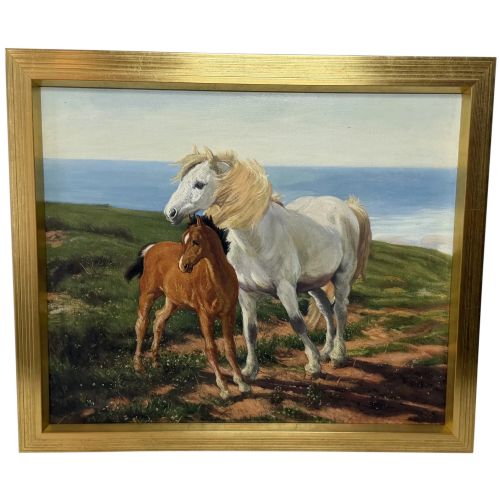
Moorland watercolours and rural oil paintings dominate the selection, often portraying horses, farm workers, or quiet villages under overcast skies. The forms vary from intimate works on paper to framed canvas landscapes.
How they were made
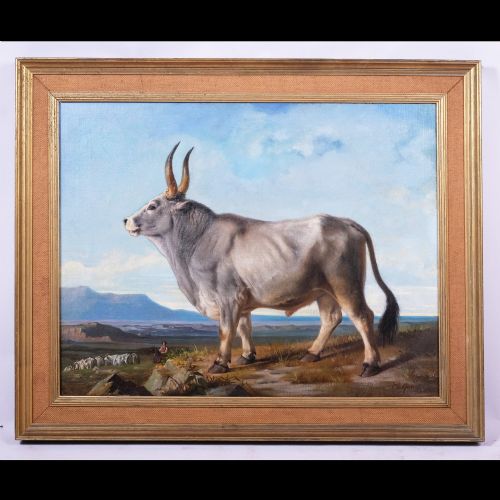
Painters applied oil paint to stretched canvas or wooden boards, building up rich textures and deep tones for rural scenes. Watercolours utilised pigment on paper, relying on washes to capture atmospheric effects and damp countryside light.
Artists worked in studios or outdoors directly from nature, employing ink and pencil underdrawings to structure composition before adding colour. Canvases were mounted in traditional wood frames, while watercolours received protective glass and card mounts.
Listings feature works executed on paper, canvas, and board using oil paint, watercolour pigment, and ink.
What varies in quality
Quality rests upon the artist's handling of light, atmosphere, and composition within the rural scene. Superior works display confident brushwork and a precise sense of place, whereas weaker examples lack depth in tonal variation.
The preservation of the paper or canvas dictates the longevity and visual impact of the piece. Strong works retain their original pigments without excessive fading or discolouration in the painted surface.
John McDougal·F.J. Snell·Robert Little·Arthur Reginald Smith·William Grant Murray·Ernest Higgins Rigg·Henri Joseph Harpinies·John Smith Atherton·Clifton Tomson·Herbert Royle·Edmund Morris Wimperis·Thomas James Lloyd·Charles Jones·John Frederic Greenwood·Vernon Stokes·Amos Green·John Abernethy Lynas-Gray·William J Hodgson·Robert Winchester Fraser·Henry Charles Fox·Nora Munro Summers
The Grey Country Landscape Glossary
- Watercolour pigment
- Finely ground colour suspended in a water-soluble binder, applied to paper to create translucent washes.
- Oil paint
- Pigment mixed with a drying oil such as linseed, allowing for thick impasto application or smooth glazing on canvas.
- Canvas
- A heavy woven fabric stretched across a wooden frame to serve as a sturdy support for oil paintings.
- Pastoral style
- Art depicting the rustic life of shepherds, farmers, and country landscapes in an idealized or realistic manner.
Grey Country Landscape: Frequently Asked Questions
What periods do these paintings come from?
The works span from the nineteenth century through the Edwardian era up to the mid-twentieth century. Most examples date from the Victorian period and the early decades of the nineteen hundreds.
Creators utilised traditional painting techniques established during these periods, reflecting the shifting styles of British landscape art over time.
How should I care for a watercolour?
Watercolours require placement away from direct sunlight to prevent the pigments and paper from fading. Framing behind protective glass with conservation mount board shields the delicate surface from moisture and atmospheric dust.
Keep these works in rooms with stable humidity levels to protect both the paper support and the historic frame.
What subjects appear in these scenes?
Common subjects include Yorkshire dales, Welsh country lanes, moorlands, farmyards, and coastal villages. Animals frequently feature, ranging from heavy cart horses and shire horses to grazing sheep and working dogs.
Human figures occasionally appear as farmers, riders, or figures outside cottages, adding narrative scale to the wide rural vistas.
How do I distinguish canvas from board?
Canvas consists of woven fabric stretched over a wooden frame, offering slight give when pressed gently. Board provides a rigid, inflexible support made from wood or thick compressed material.
Canvas works often show the texture of the weave through the paint layer, whereas board presents a completely flat backing.