
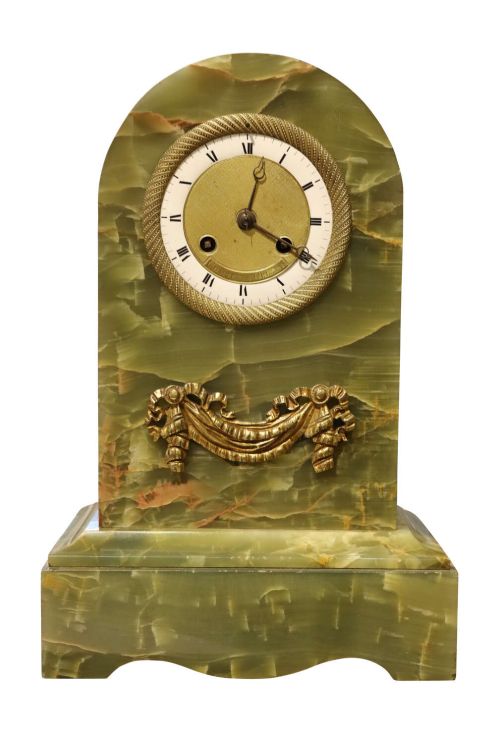




Green Marble Desk Clock
A green marble desk clock anchors a workspace with weight and presence, bringing together carved stone and precision movement.

Green Marble Desk Clock
A green marble desk clock combines the geological weight of stone with functional timekeeping, appearing across nineteenth-century and Art Deco periods. These pieces range from substantial architectural mantel clocks to smaller desk timepieces housed in green marble or green onyx.
The materials span French Empire, Louis XVI Revival, and Art Deco styles, often accompanied by brass, gilt bronze, or ormolu mounts. Buyers encounter French timepieces alongside British and continental examples.
Forms include single timepieces, clock sets with garnitures, and pieces incorporating sculptural figures in bronze or chrome. Each object reflects the interior design priorities of its decade, from classical revival to modernist geometry.
Materials and construction
Lapidaries cut and polished green marble and onyx to form the heavy cases that house mechanical movements. Craftsmen combined these stone bodies with cast metals such as brass, bronze, and ormolu for dials, bezels, and decorative mounts.
Dials frequently featured enamel cartouches or glass covers, protecting painted numerals and delicate hands. Movements relied on mechanical escapements, including silk suspension systems and fusee mechanisms, driven by springs or weights.
Some desk clocks double as calendars or equations of time, proving that past owners took their astronomical calculations very seriously.
Assessing quality and execution
The refinement of the stone carving and the crispness of the gilt bronze or ormolu mounts separate standard production from superior work. Heavier, deeply saturated green marble and intricately chased metal fittings indicate higher craftsmanship.
Movement complexity also determines standard, ranging from simple timepieces to perpetual calendars and equation of time complications. The integration of signed movements by known makers elevates the integrity of the piece.
Charles à Orléans·Garrards·Pinchon Fils Paris·Brocot·Ferdinand Priess·Michel Decoux·Reiche
The Green Marble Desk Clock Glossary
- Ormolu
- Gilded bronze achieved through a mercury-gilding process common in French decorative arts. This technique produces a durable, rich golden surface that contrasts with green stone.
- Fusee
- A conical pulley used in clock movements to maintain even power as the mainspring unwinds. It ensures consistent timekeeping across the duration of the wind.
- Garniture
- A set of matching ornamental objects, typically a central clock flanked by vases or candelabra. These decorative ensembles were designed to sit on mantelpieces or desks.
- Silk suspension
- A method of hanging the pendulum by a short thread of silk within older French clock movements. This delicate arrangement allows for fine regulation.
- Enamel cartouche
- Individual white enamel plaques bearing numerals, pinned to the clock face. They provide high contrast against darker stone dials.
Green Marble Desk Clock: Frequently Asked Questions
How do I wind a mechanical desk clock?
Insert the key into the winding arbor on the dial and turn it gently until you feel resistance. Do not overwind, as this can damage the mainspring.
Most mechanical movements require winding once a week or every eight days, depending on the train configuration.
Are these clocks suitable for daily desk use?
These clocks were built for domestic and office use, housing robust mechanical movements designed for continuous operation. Regular placement on a stable, level surface ensures accurate timekeeping.
Care should be taken when adjusting the hands and setting the time to protect vintage escapements.
How do I tell an Art Deco clock from a Victorian one?
Victorian examples lean toward architectural symmetry, classical revival motifs, and ornate ormolu mounts. They often feature prominent columns, heavy pediments, and detailed bronze figures.
Art Deco pieces favour geometric lines, streamlined forms, and minimalist dials, frequently pairing green onyx with chrome or sculptural elements.
What maintenance does green marble require?
Dust the stone regularly with a soft, dry cloth to prevent accumulation in carved crevices. Avoid using commercial chemical cleaners, which can dull the polished surface of the marble or onyx.
If the stone requires cleaning, a damp cloth with mild soap followed by immediate drying is sufficient.