


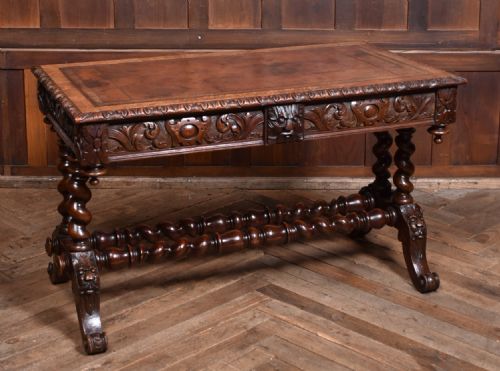


Green Man Carved Table
A green man carved table brings the intense foliage-masked visage of ancient folklore directly into nineteenth-century domestic interior architecture.
Understanding the green man carved table
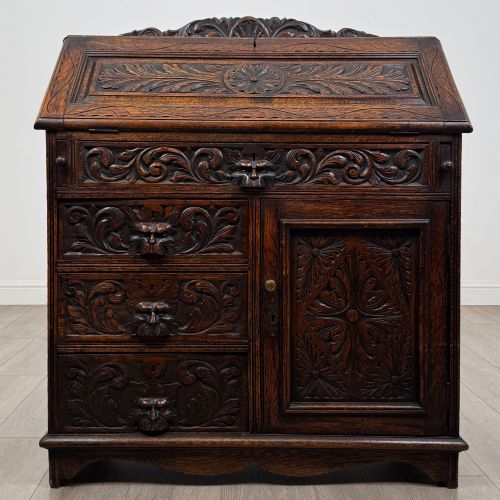
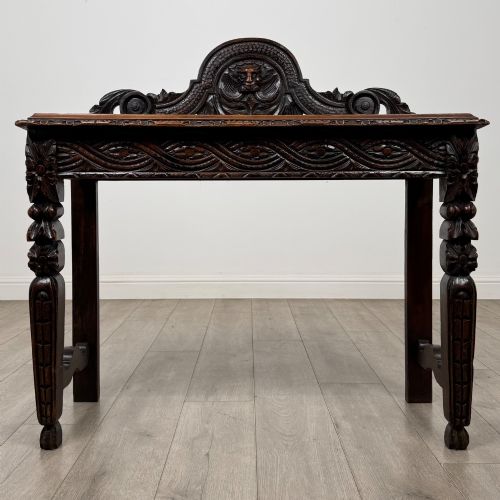
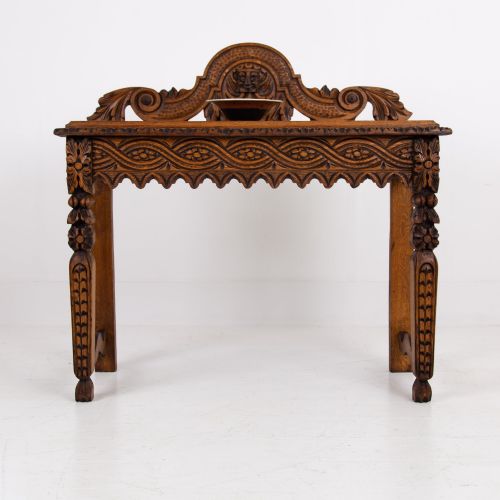
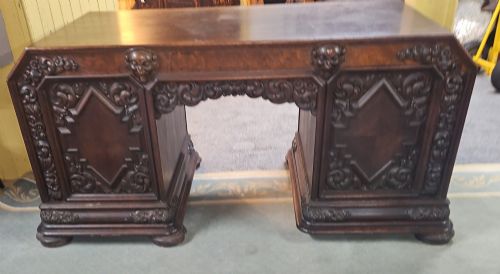
The green man carved table stands as a striking embodiment of nineteenth-century revivalist tastes, appearing most frequently on this page as hall tables, side tables, and writing desks. These pieces merge functional surface utility with dense mythological woodcarving, dominated by the foliated human mask known as the green man.
The pieces recorded here belong primarily to the Victorian era, spanning specific decades from eighteen-sixty to nineteen-hundred. Stylistically, they draw heavily upon Victorian Gothic Revival, Jacobean Revival, and Renaissance Revival vocabularies, often featuring structural forms like console tables, drum tables, and library desks.
Originating predominantly within British and sometimes French provincial workshops, these tables served grand entrance halls and reception rooms. Their presence reflects a Victorian fascination with medievalism, folklore, and heavy dark woods that conveyed both lineage and antiquarian taste.
Construction and material execution
Every piece listed in the archive and current inventory relies upon solid oak as its foundational material, occasionally paired with leather inserts for writing surfaces. Oak provided the structural strength and dense grain required to support deep, highly articulated sculptural relief work without splintering.
Retail Price Guide 2026
Typical UK retail prices for green man carved table, calculated from the Sellingantiques database of over a million retail prices indexed since 2003. This retail price guide relies exclusively on Sellingantiques data; no external sources or auction records are used, so the figures do not describe the wider market.
The archive shows that oak is the exclusive wood used across every recorded green man table.
Distinctions in craftsmanship and design
The distinction between ordinary and exceptional examples rests upon the depth, animation, and proportion of the carving. Superior tables display crisp, undercut foliage where leaves and vines appear to emerge naturally from the wood rather than sitting as shallow surface decoration.
Proportion and secondary ornamentation also dictate the hierarchy of these tables. The finest pieces integrate the green man mask seamlessly with structural supports like carved dolphin feet or mythical beasts, maintaining architectural harmony across the entire frame.
The Green Man Carved Table Glossary
- Green man
- A sculptural mask of a human face surrounded by or sprouting from foliage, vines, and leaves. This ancient motif symbolises rebirth and the cycle of nature.
- Console table
- A table designed to be fixed against a wall, frequently supported by decorative brackets or legs at the front only. These pieces served grand entrance halls.
- Gothic Revival
- An architectural and decorative style drawing inspiration from medieval design principles. It employs pointed arches, heavy tracery, and dark woods.
- Drum table
- A circular library or centre table featuring a deep frieze fitted with drawers, resembling the shape of a drum. It rests on a central column or substantial pedestal base.
- Renaissance Revival
- A nineteenth-century movement reviving sixteenth-century European architectural and furniture forms. It emphasises symmetry, heavy classical moulding, and bold sculptural reliefs.
Frequently Asked Questions
Where should I place a green man carved table?
These tables find their natural home in spacious hallways, entrance foyers, or principal reception rooms where their heavy timber presence grounds the interior. Their substantial proportions require adequate floor space to allow the carved details to be appreciated.
Because many examples function as side or console tables, placing them against a wall prevents blocking walkways while highlighting the sculptural frieze. Pairing them with complementary Victorian furniture enhances their architectural context.
How do I date a green man carved table?
Dating relies heavily on identifying stylistic markers associated with Victorian revivalism, such as Gothic or Renaissance Revival motifs combined with nineteenth-century joinery techniques. The vast majority of these tables date from the mid to late Victorian period, specifically between eighteen-sixty and eighteen-ninety.
Examining the underside, drawer construction, and type of oak helps confirm the period. Hand-cut dovetails and uniform timber ageing align with nineteenth-century workshop practices.
What is the difference between a hall table and a centre table?
Hall tables typically feature a flat back designed to sit flush against a wall in an entryway or corridor. They often prioritise surface depth over all-around decoration.
Centre tables are finished on all four sides, intended to stand freely in the middle of a library or large room. They frequently incorporate sculptural elements like dolphin feet or central pedestals visible from any angle.
How do I care for solid oak furniture?
Solid oak requires stable environmental conditions away from direct heat sources and strong sunlight to prevent the timber from drying out or splitting. Regular dusting with a dry, soft cloth maintains the finish without stripping natural oils.
Occasional application of appropriate wax polish preserves the sheen of the dark oak grain. Leather inserts on writing desks benefit from gentle cleaning and leather-specific conditioners.