
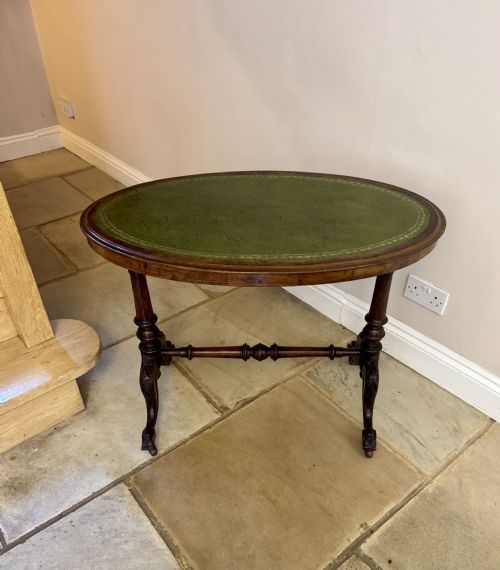
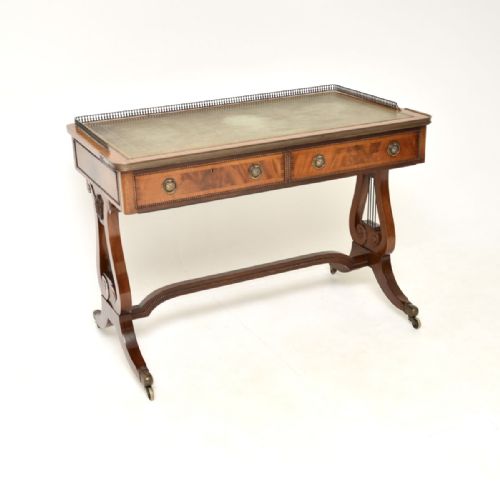
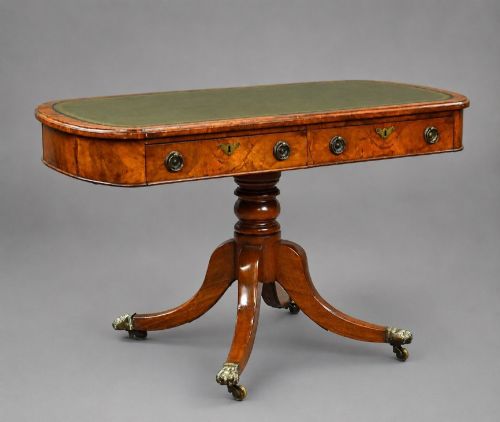
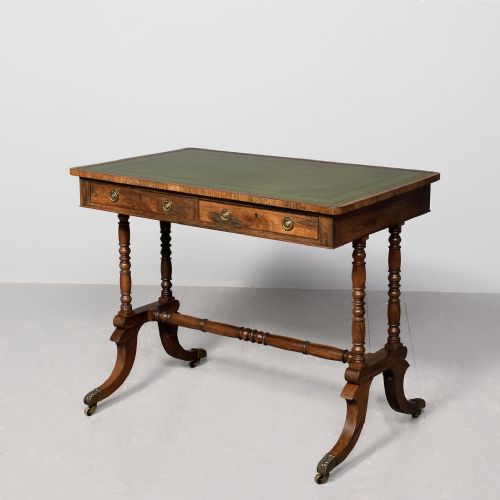


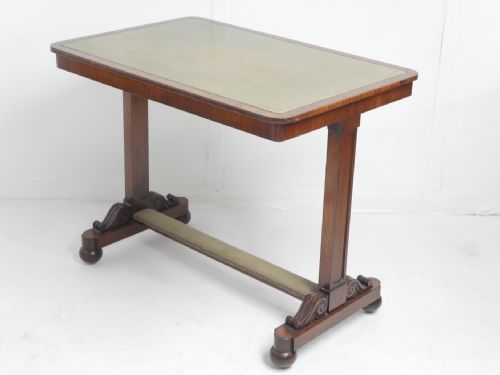


Green Leather Sofa Table
A green leather sofa table brings useful surface space and rich timber grain to a room, offering both character and function.
Green Leather Sofa Table
A green leather sofa table provides a practical writing and display surface, often taking the form of a writing table, library table, or console table. These pieces emerge from periods spanning the Regency era through the Victorian epoch and into the Edwardian years.
The versions most frequently met here combine rich timber structures with leather writing surfaces, reflecting forms designed for drawing rooms, libraries, and studies. Makers and workshops of the nineteenth and early twentieth centuries produced these tables in various timbers to suit formal and domestic interiors.
How they were made
Craftsmen shaped these tables using dense hardwoods such as mahogany, rosewood, walnut, burr walnut, and goncalo alves, often selecting figured veneers for visual depth. Brass fittings and gold leaf tooling frequently complement the timber frames and leather inserts.
The construction relies on traditional joinery methods suited to freestanding library and writing furniture, incorporating turned supports, carved details, and inset leather panels designed for daily use.
Listings feature items from the Regency, Victorian, William IV, and Edwardian periods, constructed in mahogany, rosewood, walnut, and goncalo alves.
What varies in quality
The calibre of a piece rests on the selection of timber, the crispness of any carved or turned ornament, and the integrity of the structural joinery. Tables displaying finely figured burr walnut or rich rosewood demonstrate a higher grade of material selection by the maker.
Attention to detail in the secondary woods, the execution of brass mounts, and the neatness of gold leaf tooling distinguish finer examples from simpler commercial production of the period.
Willmington and Cope
The Green Leather Sofa Table Glossary
- Library table
- A large freestanding table designed to sit in the centre of a room rather than against a wall. These pieces typically feature finished backs and drawers accessible from the front.
- Goncalo alves
- A dense exotic hardwood known for its striking contrasting grain patterns. Makers utilised this timber in the nineteenth century for distinctive occasional and writing furniture.
- Burr walnut
- Timber taken from the growth excrescences of a walnut tree, yielding highly decorative swirling patterns. Cabinet makers prized this material for veneering prominent surfaces.
- Gold leaf
- Extremely fine gold beaten into sheets and applied to surfaces for ornamentation. Tooling on leather writing surfaces often incorporates this material.
Green Leather Sofa Table: Frequently Asked Questions
Where should a sofa table go?
These pieces traditionally sit behind a sofa or stand freely in the middle of a library or sitting room. Their finished appearance on all sides allows them to occupy central floor space.
They also function effectively against a wall as a side table or writing desk, providing a convenient surface for lamps and correspondence.
How do I identify a Regency table?
Regency pieces often display classical architectural influences, including reeded legs, brass inlay, and dark mahogany or rosewood timbers. The proportions tend to be clean and restrained.
Later Victorian interpretations frequently introduce heavier carving, burr walnut veneers, and more elaborate supports while retaining similar functional forms.
What timber was used most?
Mahogany forms the basis for many nineteenth-century examples, valued for its stability and deep reddish-brown colour. Rosewood and walnut also appear frequently in high-status pieces.
More exotic woods like goncalo alves and burr walnut surface in specific decorative contexts, adding variety to the surviving examples.
Are these tables suitable for daily use?
The sturdy construction of nineteenth and early twentieth-century tables makes them well-suited for regular placement in modern rooms. Their original purpose as writing and library furniture ensures practical utility.
Careful placement away from direct heat sources helps preserve the timber and the leather writing surfaces over time.