


Chippendale Style Console Table
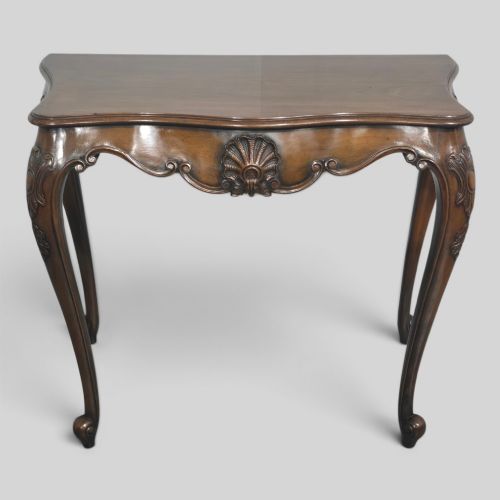
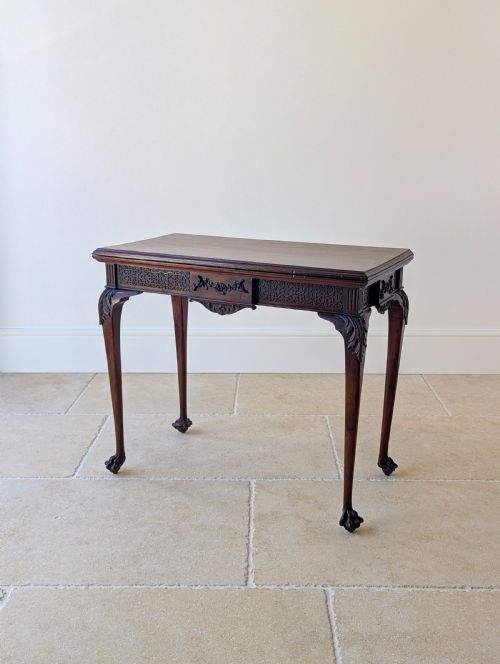
A chippendale style console table brings unmistakable architectural presence and carved mahogany elegance to a hall or drawing room.
Chippendale Style Console Table
When searching for a chippendale style console table, you encounter pieces spanning the eighteenth century through to later revival periods in nineteen hundred, nineteen twenty, and the Victorian era. These tables function primarily as console, serving, or side pieces designed to stand against a wall in a hallway or principal reception room.
The selection ranges from genuine eighteenth century George III and George II originals to nineteenth and twentieth century revival pieces executed in the Chippendale manner. Many examples incorporate fold over tops for card and games use, or take serpentine and demi lune shapes.
You will frequently meet revival interpretations from the Edwardian period alongside earlier English and Irish cabinet work. These forms reflect the enduring appeal of elaborate carving, ball and claw feet, and rich timber surfaces.
Materials and construction methods
Cabinet makers relied principally upon solid mahogany and flame mahogany veneer, often supported by secondary timbers such as oak. Selected pieces feature burr walnut or gold leaf highlights applied to elaborate hand carved frames.
Construction relies upon traditional joinery techniques combined with deep relief carving on knees, aprons, and legs. Brass hardware, such as swing handles and locks, completes the execution of functional fold over card and games tables.
Several games tables still retain hidden compartments once used for concealing secret wagers.
Judging the depth of execution
Quality rests entirely in the sharpness and depth of the hand carving, where crisp acanthus leaves and well defined claw and ball feet separate superior cabinet work from mechanical reproduction. The choice of timber also dictates standing, with rich flame mahogany veneers and dense solid mahogany showing greater depth than plain secondary woods.
Proportion and structural integrity distinguish finer examples, as does the integration of secondary elements like polished brass fittings and original folding mechanisms. Pieces attributed to notable makers or specific regional workshops carry distinct structural refinements that elevate their status.
Hicks of Dublin·Edwards and Roberts·Elkington and Co
The Chippendale Style Console Table Glossary
- Console table
- A table designed to stand against a wall, frequently secured to it or balanced on shaped legs. These pieces serve decorative and serving functions in formal spaces.
- Card table
- A folding table with a hinged top that opens to reveal a baize lined playing surface for games. They date extensively from the Georgian period onward.
- Lowboy
- A small occasional or dressing table with one or more rows of drawers beneath the working surface. They typically feature cabriole legs ending in pad or claw feet.
- Serpentine
- A curved line of furniture fronting that bends outward in the centre and inward at the sides. This contour requires advanced woodworking skill to execute properly.
- Demi lune
- A half moon shape utilised for console tables and side cabinets designed to sit flush against a wall. This format became popular during the eighteenth century and subsequent revivals.
Chippendale Style Console Table: Frequently Asked Questions
Where should I place a console table?
These tables suit hallways, entrance foyers, and living rooms where they sit flat against a wall beneath a mirror or painting.
Their narrow profile ensures they occupy minimal floor space while providing a useful surface for lamps or decorative objects.
How do I identify a revival piece?
Revival pieces from the Victorian and Edwardian eras often display machine precision in their carvings and standardised internal fixings.
Examining the timber grain, secondary woods, and tool marks helps separate nineteenth century interpretations from eighteenth century originals.
What is a fold over top?
A fold over top consists of a hinged double surface that opens outward to double the table area for gaming or dining.
When closed, the table functions as a compact side or console piece against the wall.
Are these tables suitable for daily use?
Solid mahogany and sturdy frame construction make these tables robust enough for everyday placement in modern homes.
Care should be taken with polished surfaces to avoid moisture and direct heat damage.