
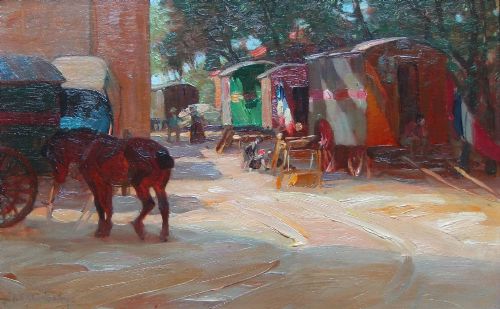


Green Landscape Horse Art
Green landscape horse art captures the enduring bond between working animals and rural scenery across canvases and watercolours spanning several centuries.
Green Landscape Horse Art
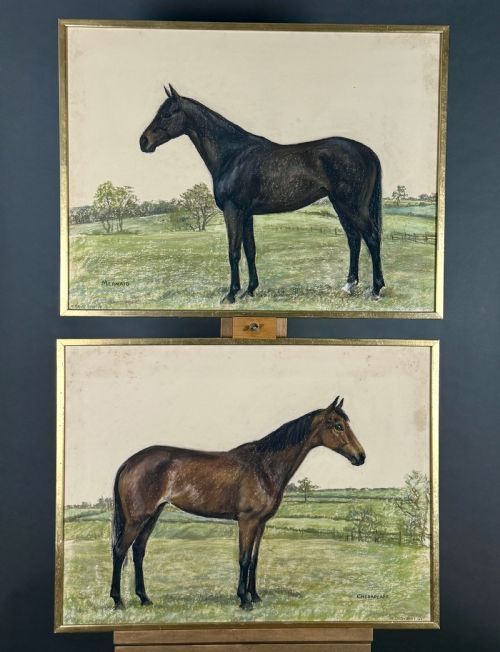
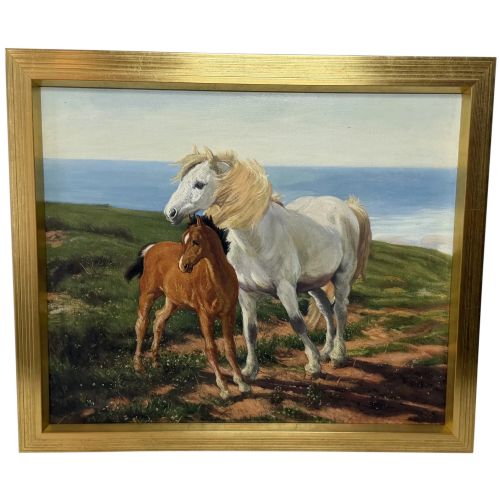
When searching for green landscape horse art, buyers encounter traditional oil paintings, delicate watercolours, and pastel studies depicting equines within pastoral and sporting settings. The selection ranges from Victorian coaching scenes and fox hunting portrayals to early twentieth-century harvest views and mid-century modern depictions of ponies in Welsh fields.
The most common pieces on this page are oil paintings on canvas and wood panels, alongside watercolours on paper, reflecting both 19th-century British School traditions and later 20th-century interpretations. These works frequently integrate horses with everyday rural labour, such as ploughing, cart transport, and market scenes, or capture spirited moments at the races.
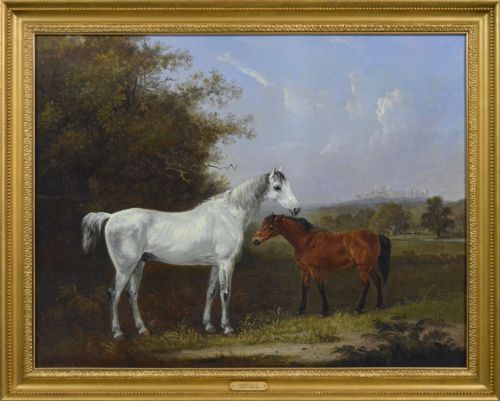
Originating predominantly from British and occasionally French workshops, these artworks span multiple periods including Georgian, Victorian, Edwardian, and mid-century decades. Such variety ensures buyers find everything from precise equestrian portraits set near Windsor Castle to impressionistic rural watercolours.
How they were made
Artists utilised traditional oil paint on stretched canvas, wood panels, or oil boards, building rich textures and deep pigment layers to capture the tones of pastures and coats. Watercolours on paper offered a lighter, more fluid medium favoured for atmospheric rural views and quick studies.
Frames historically utilised carved giltwood or simple wood mouldings to complement the painted scenes, often preserving the original presentation of the period. Pigments applied with confident brushwork define the characteristic styles seen in British Impressionism and Victorian fine art.
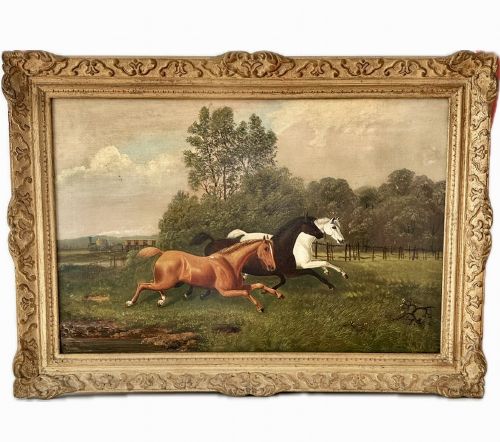
Several horses share their green landscapes with steam locomotives and stagecoaches, recording the exact moment old transport met the new.
What varies in quality
The distinction between standard works and exceptional pieces rests upon the anatomical accuracy of the horses and the atmospheric depth of the surrounding landscape. Master artists render muscle structure, movement, and light with precision, whereas lesser works rely on formulaic compositions and rigid figures.
Condition and originality play a significant role, with intact canvases retaining their original stretcher bars and period frames commanding greater appreciation. The handling of the medium, from the luminosity of oil glazes to the deft control of watercolour washes, ultimately defines the upper tier of the range.
Edmund Bristow·Edward Priestley·Harry Freckleton·Hazel M Barnett·George Wright·Gabriel Dauchot·John Sanderson Wells·Philip Henry Rideout·John Atkinson·John Linnell·John Alfred Wheeler·Clifton Tomson·Will Anderson·Robert Hollands Walker·Frederick J Knowles·Ernest Higgins Rigg·Walter Duncan·George Turner·Gudrun Sibbons·H Alken·Donald Wood·Alfred George Stevens·Frederick J Haycock·John Parker Davis·John Baragwanath King
The Green Landscape Horse Art Glossary
- Canvas
- A heavy woven fabric stretched across a wooden frame to serve as a durable support for oil paintings. It provides a textured surface that holds thick pigment layers securely.
- Giltwood
- Wood that has been coated with a thin layer of gold leaf or gilt powder for decorative framing. This finish was widely applied to frame Victorian and Edwardian fine art.
- Watercolour
- A paint consisting of pigment suspended in a water-based solution, typically applied to paper. It allows for translucent washes and delicate atmospheric effects.
- Equestrian
- Pertaining to horses, horse riding, or horse art. In antique paintings, this genre encompasses racing, hunting, and working farm animals in pastoral settings.
- Pastel
- A dry medium composed of powdered pigment and a binder, pressed into stick form for drawing on paper. Pastel studies offer soft tonal gradations and immediate expressive marks.
Green Landscape Horse Art: Frequently Asked Questions
What periods do these paintings come from?
The available pieces originate from various historical eras, stretching from the Georgian and Victorian periods through Edwardian times and into the mid-twentieth century. Each era brings distinct stylistic approaches to rural subjects and equestrian portraiture.
Buyers can identify these eras through characteristic brushwork, framing styles, and the specific attire of figures depicted alongside the horses in the landscape.
How were these artworks originally displayed?
Most of these oil paintings and watercolours were housed in domestic interiors, country houses, and parlours, often framed in period giltwood to complement traditional home decor.
Many retain their original or period-appropriate frames, which provide helpful clues regarding their age and historical context.
Are these pieces painted on canvas or paper?
The collection includes works executed on multiple supports, predominantly oil on canvas, wood panels, and oil boards, alongside watercolours and pastels on paper.
Canvas and panels were generally preferred for durable oil compositions, while paper was utilised for fluid watercolours and detailed studies.
How do I care for antique horse art?
Preserving these pieces involves hanging them away from direct sunlight and maintaining stable indoor humidity to protect both the canvas and the original wooden frames.
Dusting should be done gently with a soft, dry cloth, avoiding any liquid cleaners on the painted surface or giltwood.