


Green Earthenware Spill Vase
These green earthenware spill vase examples are tactile vessels designed to hold taper matches, bringing domestic utility and figure modelling together on the mantelpiece.
Green Earthenware Spill Vase
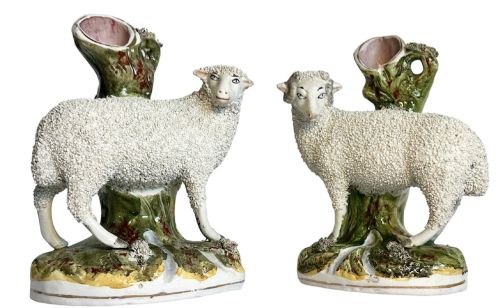
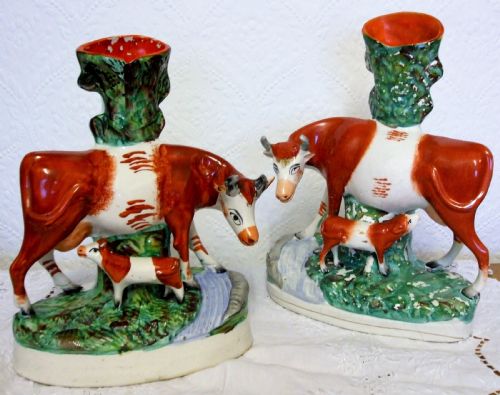
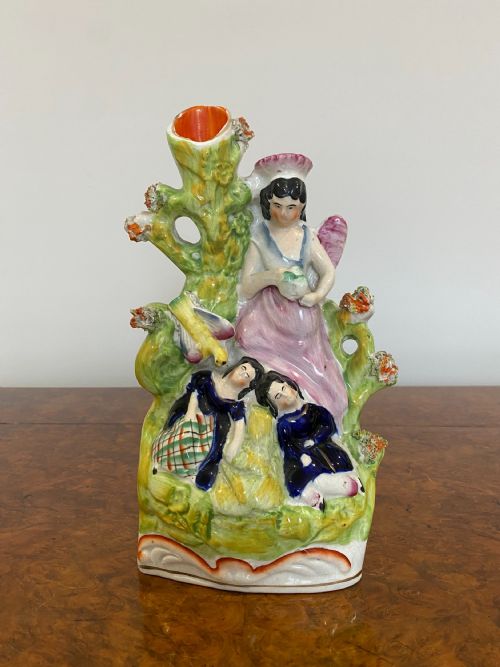
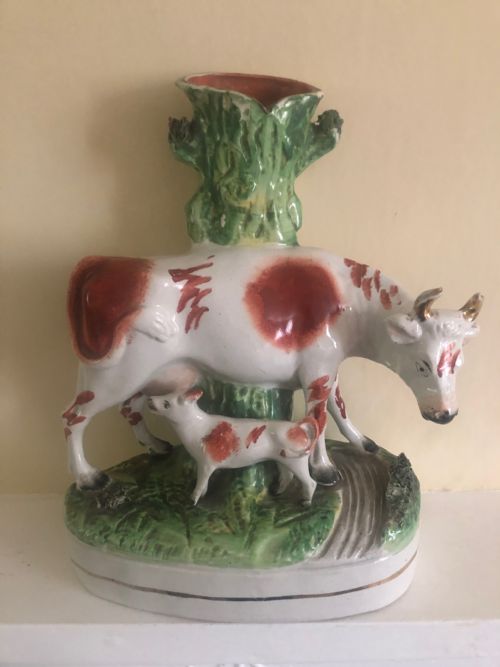
A green earthenware spill vase combines a functional tubular holder for wooden tapers with figurative earthenware pottery, predominantly taking the form of Staffordshire animal groups, figures, and architectural follies. These pieces emerge across the Regency, Victorian, and early twentieth century periods, reflecting changing tastes in domestic mantelpiece ornaments.
The buyer meets pairs of sheep, cow and calf groups, and turret bridges alongside individual figures and an Art Nouveau ceramic piece by Ernst Wahliss. These objects stem from English potteries, capturing rural subjects and structural fancies executed in moulded clay.
Materials and construction
Makers shaped these earthenwares through pressing or slip casting in moulds, building up hollow figures and attached cylindrical receptacles for spills. The resulting bodies were then bisque fired before receiving manual applications of enamel pigment and fluid glaze.
Surfaces display distinct glaze variations, ranging from early pearlware glazes with characteristic blue pooling to rich lead glazes and vibrant enamels. These traditional ceramic finishes define the tactile quality of the earthenware surface.
Listings span the Regency, Victorian, and early twentieth century, utilising earthenware, lead glazes, and pearlware glazes.
Assessing quality
The handling of the glaze and the integration of the spill cylinder into the figural composition also dictate merit. Finer examples balance sculptural presence with clean potting, whereas lesser pieces display heavy-handed construction.
Walton·Ernst Wahliss
The Green Earthenware Spill Vase Glossary
- Spill vase
- A hollow vertical vessel designed to hold taper matches used for lighting candles and fires. These cylindrical additions are integrated directly into pottery figures.
- Pearlware
- A refined earthenware developed in the late eighteenth century featuring a subtle bluish glaze that pooled in recesses. It creates a pale, bright surface beneath enamels.
- Earthenware
- A porous pottery body fired at lower temperatures than stoneware or porcelain. It requires a vitreous glaze to render it impermeable to liquids.
- Flat back
- A Staffordshire figure construction method where the reverse side is left unglazed and flat. This allowed pieces to sit flush against mantelpiece walls.
Green Earthenware Spill Vase: Frequently Asked Questions
What are green earthenware spill vases?
These objects are hollow ceramic containers moulded into figures or architectural forms with an attached tube for holding taper matches. They served a practical function in nineteenth-century homes while doubling as decorative mantelpiece ornaments.
Most surviving examples depict animals, pastoral scenes, or rustic structures decorated with coloured glazes and hand-painted enamel details.
How were these vases used?
Households placed them on mantelpieces to keep wooden taper spills close at hand for lighting oil lamps, candles, and coal fires. Users would pull a slim spill from the tube and touch it to the hearth to transfer a flame.
They bridged utility and ornament, keeping combustible spills tidy and dry in domestic living spaces.
How do I date a spill vase?
Dating relies on identifying stylistic markers, ceramic bodies, and manufacturing techniques associated with specific periods such as the Regency or Victorian eras. Pearlware glazes and specific maker marks like Walton point toward earlier nineteenth-century production.
Later pieces often show shifts toward Art Nouveau styling or smoother earthenware bodies characteristic of twentieth-century factories like Ernst Wahliss.
Are these figures typically found as pairs?
Many Staffordshire animal groups and spill holders were manufactured as matching pairs to flank a clock or ornament on a mantelpiece. Sheep and cow groups frequently appear in symmetrical pairs.
Single figures and architectural spill vases also exist independently as standalone decorative items.