
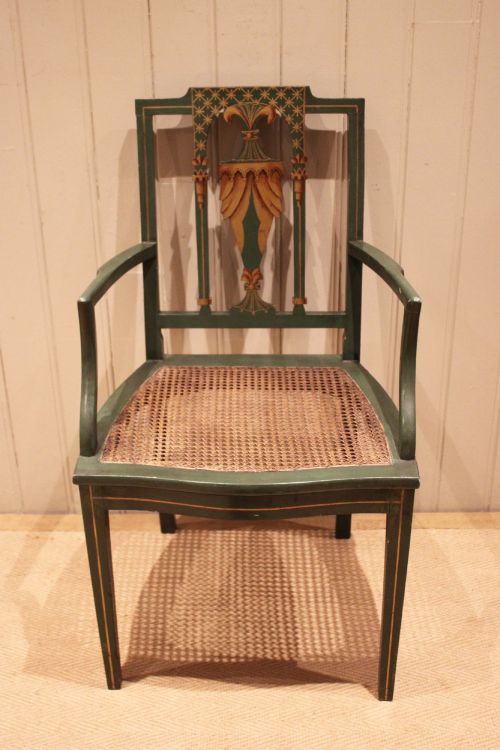
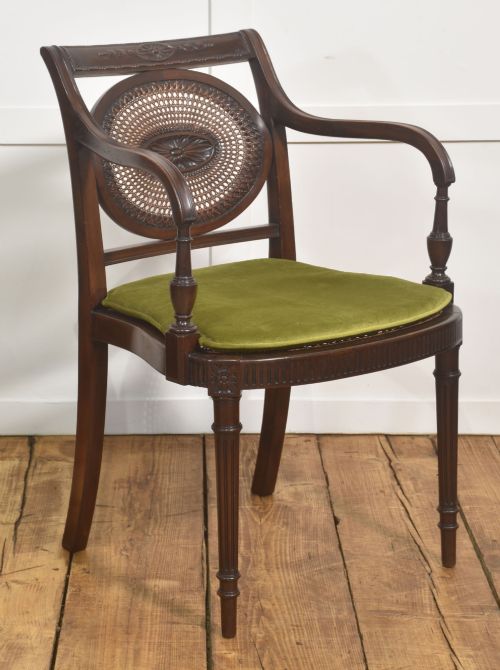


Green Cane Seat Chair
These green cane seat chair options bring together Regency, Victorian, and revival designs built from mahogany, oak, and painted wood.
Green Cane Seat Chair
A green cane seat chair encompasses seating forms ranging from nineteenth-century dining chairs to library armchairs and bergères. Buyers searching this phrase encounter dining chairs and heavier armchairs spanning the Regency period, eighteen fifty, the nineteenth century, and nineteen ten.
The selection on this page relies heavily on mahogany and painted wood frames paired with woven cane seats. Pieces arrive in styles including Hepplewhite, Sheraton Revival, Regency Revival, and William IV, reflecting both original nineteenth-century manufacture and later revivals.
How they were made
Makers constructed these frames predominantly from solid mahogany, oak, and rosewood, often applying paint or faux rosewood finishes to mimic exotic timbers. Hand-woven rattan cane forms the characteristic seats and back panels, supported by sturdy wooden joinery.
Detailing includes painted decoration, such as hand-painted motifs on dining sets, alongside brass accents and upholstered elements in leather and velvet. Construction techniques follow traditional cabinet-making methods appropriate to the Regency and revival periods.
Listings span four distinct periods: Regency, eighteen fifty, the nineteenth century, and nineteen ten.
What varies in quality
Quality differentiates by the precision of the timber framing and the execution of hand-painted decoration or faux finishes. Superior examples display refined proportions and crisp carving associated with Regency taste and Sheraton Revival workshops.
The tightness and regularity of the woven cane panels dictate the standard of the seating surface. Finer chairs combine robust mahogany or rosewood structures with intact, evenly tensioned rattan cane.
The Green Cane Seat Chair Glossary
- Cane
- Woven material made from the outer skin of rattan palms. It provides a lightweight and flexible surface for chair seats and backs.
- Regency
- A British design period spanning the early nineteenth century. It draws inspiration from neoclassical motifs and ancient Greek and Roman forms.
- Sheraton Revival
- A late nineteenth and early twentieth century style reviving the lighter, elegant furniture designs of Thomas Sheraton. Pieces often incorporate mahogany and painted details.
- Hepplewhite Style
- A classic eighteenth-century design vocabulary characterised by shield-back chairs and delicate tapered legs. Revival versions repeat these slender proportions.
Green Cane Seat Chair: Frequently Asked Questions
What is a green cane seat chair?
A green cane seat chair is a seating item featuring a woven rattan seat and a frame finished in green paint, spanning styles from Regency to Sheraton Revival.
These pieces include dining chairs and library armchairs constructed from woods such as mahogany, oak, and rosewood.
How do I identify a Regency chair?
Regency chairs date from the early nineteenth century and exhibit classical neoclassical proportions, saber legs, and dark timbers like mahogany and rosewood.
Revival pieces from later decades imitate these specific Regency and William IV characteristics.
Were these chairs used for dining?
Yes, specific listings include sets of hand-painted dining chairs designed for formal dining rooms during the nineteenth and early twentieth centuries.
Heavier armchair variants, such as bergères, served primarily as library or reading chairs.
What materials make up these frames?
Makers utilised solid woods including mahogany, oak, and rosewood alongside painted surfaces and faux rosewood finishes.
Secondary materials incorporate brass fittings, velvet, leather, and natural rattan cane.